High Ticket Digital Marketing: Is it Worth it or Not?

Are you wondering whether investing in high-ticket digital marketing is worth it?

High-ticket digital marketing refers to the promotion of high-value products and services that require significant investment.

In this blog, we will explore what high-ticket digital marketing is, how it can benefit your business, and the channels you can utilize to market these products.

We will also dive into the essentials of high-ticket digital marketing, including email marketing, paid search, retargeting, personalized marketing, and more.

Additionally, we will discuss the future of high-ticket digital marketing with a focus on personalization, artificial intelligence, automation, customer experience, and augmented and virtual reality.

Lastly, we will answer a question that’s on everyone’s mind – what is the salary of high-ticket digital marketers?

Read on to find out if investing in high-ticket digital marketing is worth it for your business.

What is High Ticket Digital Marketing?

What is High Ticket Digital Marketing

High-ticket digital marketing refers to online marketing strategies focused on promoting high-priced products or services, typically over $1,000. The goal is to generate leads and sales through digital channels like social media ads, influencer collaborations, webinars, and email marketing. Since the products are more expensive, the focus is on providing a lot of value upfront and building trust to encourage potential customers to make a large purchase. High-ticket digital marketers create funnels that educate prospects on solving complex problems or improving their lives with personalized attention and offers. The backend sales and customer service teams closely guide qualified leads to finalize large transactions. These high-priced products can include luxury items, enterprise software, specialized services, marketing campaigns, and more.

What are High-Ticket Digital Marketing Products?

High-ticket digital products typically refer to online courses, coaching programs, software, or other digital information products that are priced at over $1,000.

Some common examples of high ticket items in the digital marketing industry include luxury cars, yachts, high-end jewelry, real estate, enterprise software, consulting services, and more. These high-ticket items are known for their relatively high price point compared to similar items in the market. They provide a lot of value and highly personalized service to justify the $1,000+ price tags.

High-Ticket Digital Marketing Examples

A high-ticket item is something that costs a lot more money compared to similar things you might find for sale.

These items usually have a higher price tag than most other things you can buy, and they need a big investment, meaning you have to spend a lot of money on them.

The exact price that makes something a high-ticket item changes depending on what it is and the place where you’re buying it.

For example, if most things in a store cost about $100, something that costs $500 would be seen as a high-ticket item. But in a fancy shop where expensive things are normal, $500 might not seem that expensive.

Some examples of high-ticket items are:

  • Fancy cars, yachts, and private jets
  • Expensive jewelry or watches
  • Big machines or equipment
  • Houses or property
  • Fancy clothes made by famous designers
  • Expensive electronics like top-notch cameras or audio gear
  • Services like professional advice, coaching, or therapy
  • Complex computer programs used by big companies

High-ticket items aren’t always things you can touch; they can also be online stuff like courses, coaching sessions, or software that you buy and use on the internet. For making coaching sessions successful, you can leverage coaching software and ensure seamless scheduling, progress tracking, and client communication.

High Ticket Digital Marketing Channels

When you’re trying to sell expensive things, it’s really helpful to use all the different ways you have available to you.

Here are some of the best methods that lots of companies have used before to make more money from their sales.

The Essentials

Selling expensive things really well means using lots of different ways to do it.

Here are some important methods and ideas to help you do that:

  1. Email Marketing: When you make really good emails about your expensive stuff, it helps you talk to people more directly. This makes it more likely that someone who’s interested will actually buy something from you.
  2. Paid Search: Putting money into ads that show up when people search online can bring the right folks to your website. These ads help attract the kind of people who might be interested in buying expensive things. Websites like Google Ads let you make ads with words or pictures that show up at the top when someone looks for stuff online.
  3. Retargeting: Retargeting is a clever way to remind people about your stuff. It uses special tools to find people who visited your website before but didn’t buy anything. Then, it shows them ads about your products when they visit other websites. This helps bring them back to your website and makes it more likely they might buy something this time. Utilizing a website builder can enhance the effectiveness of retargeting strategies.
  4. Paid Advertising: Putting money into ads on websites like Google, Facebook, or LinkedIn is a good way to get more people to visit your site and be interested in buying expensive things. These websites have tools that help you show your ads to certain groups of people based on things like their age, interests, or what they like.
  5. Personalized Marketing: Making things personal is really important when you’re trying to sell expensive stuff. If you use information about the people you’re trying to sell to, you can make ads or messages that really speak to them. This helps create a special bond and makes it more likely they might buy something from you.
  6. Virtual & In-person Events: Events where you meet people face-to-face or online are great chances to show off your expensive things and talk to people who might want to buy them. It could be hosting a real event like a trade show or setting up a webinar online. These events let you share lots of details, answer questions, and make friends with the people who come To capture these moments professionally, consider hiring an event photographer to document the experience and create lasting memories.
  7. Account-Based Marketing: Account-based marketing (ABM) means concentrating on certain important customers or people who really want to buy. By making ads or messages that are just right for these individuals, you can make it more likely they’ll buy something. This also helps you make better connections with the important people who decide to buy things.

Optimizing Your Website

To make your online marketing for expensive items work better, it’s important to make your website really good for getting people to buy things and to make sure it’s easy for them to use.

Here are some important things to think about:

  1. Chatbot Marketing: Adding chatbots to your website helps you talk to people right away and suggest things they might like to buy. Chatbots can answer common questions, help visitors buy stuff, and give them help if they need it. A LangChain chatbot example shows how AI-powered chatbots can deliver more natural and context-aware interactions, improving customer engagement and overall experience.
  2. Conversion Rate Optimization: Making your website work better so more people buy things is really important. You can do this by trying different things like testing different versions of your site, seeing where people click the most, asking people what they think, and adding things that make visitors want to buy more.
  3. Social Proof & Case Studies: Telling stories about how your expensive items have helped other businesses or people can be a really strong way to show how good they are and make people trust you more. When you put comments from customers, stories about how your stuff was useful, and proof from social media on your website or in your ads, it makes people believe more in what you’re selling.

Focus on Engaging Content

Making interesting and helpful stuff is really important when you’re trying to sell expensive things.

Here are some ideas for making that kind of content:

  1. Interactive Product Demos: Making cool ways for people to see and try out products online, like showing products in 360 degrees, letting people try things on virtually, or giving virtual tours, helps them imagine and experience the product before buying it. These fun experiences make people more excited about the product and feel more sure about buying it.
  2. Live Streaming: Going live on video is a strong way to tell people about your expensive items and make more sales. When you show live videos like answering questions, demonstrating products, or showing behind-the-scenes stuff, it helps you talk to your audience right then and there. It also makes them feel like they’re part of something special and urgent.
  3. Webinars: When you run live online sessions called webinars, you can show your expensive items in detail and answer any questions people have. By giving helpful info and showing how good your stuff is, you can make people trust you more and make it more likely they’ll buy something.

Content Marketing with Sales in Mind

Making stuff that matches how you sell expensive things is really important.

Here are some ideas for making that kind of content:

  1. SEO-Focused Content: Making helpful content that teaches people about why your expensive items are great can bring the right people to your site and make them trust you more. By using tricks to make sure your content shows up well when people search online, you can get more people to visit your website without paying for ads.
  2. Harnessing the Power of Community: Making a group of people who are interested in your brand online can be a really good way to talk about and sell your expensive things. You can do this on social media like Facebook or Instagram, in forums, or in special online groups just for your customers. It’s a place where people can chat, share their experiences, and suggest things to others.
  3. Partner Marketing: Teaming up with other businesses that go well with yours can help you talk to new people and sell your expensive stuff together. When you work with brands that have the same kinds of customers, you can use their popularity and trust to sell more of your things.
  4. Referral Marketing: Asking your current customers to tell others about your business can help you get more sales and find new customers. When you give rewards or bonuses to customers who bring in new people, you’re using the good things they say about your business to get more customers.

The Future of High Ticket Digital Marketing

The Future of High Ticket Digital Marketing

As new technology keeps growing, the way we sell expensive things online keeps changing too.

Here are some things that might change how we do it in the future:

Personalization

Making things personal will be even more crucial in selling expensive stuff online. Companies will use information and tech to create special experiences just for each person. This will make people more interested and more likely to buy things.

Artificial Intelligence and Automation

Smart computers and automatic systems will be really important in selling expensive things online. These computer tools will quickly understand how customers act and what they like, making it easier to give them what they want. This will make customers happier and more likely to buy things. Whitelabel agentic ai can coordinate these personalization layers across channels without rebuilding core systems.

Customer Experience

Making customers feel really happy with their shopping experience will become even more important. Companies will spend more time and money making sure everything goes smoothly, feels personal, and is easy for customers. This will help customers trust the business more, come back again, and tell others about it. Also, companies invest in cloud contact center to enhance customer support, ensuring seamless interactions, personalized assistance.

Augmented and Virtual Reality

We’ll see more of those cool virtual reality and augmented reality things in selling expensive stuff online. These technologies will let customers see and feel the expensive items almost like they’re real, helping them decide if they want to buy before actually buying.

What is the Salary of a High Ticket Digital Marketer?

Professionals in high ticket digital marketing can earn a significant amount of money as commission rates tend to be large.

A talented digital marketer who sells high-priced products with large payouts can expect to earn an average commission of at least $500 per sale and potentially reach five figures.

For example, if they were to sell a $2,000 online course, they could make a commission of $1,000 per sale. Closing just 10 sales per month would therefore bring in $120,000 annually. Top performers at leading high ticket firms often exceed $300,000 in annual income from both commissions and salary.

However, results take time to build at first. Overall incomes are uncapped so six figure earnings are common with consistent high ticket sales.

FAQ’s:

Is High Ticket Digital Marketing Legit?

Is High Ticket Digital Marketing Legit?

Yes, high ticket digital marketing is a legitimate business model. It involves selling premium-priced digital products like online courses, software, and coaching programs that provide high value.

The $1000+ products cater to business owners, executives, and entrepreneurs rather than the mass market. Providers can deliver personalized services, attention, and results at these price points.

One key reason why people start selling high-ticket items in the first place is because they know they need fewer sales in order to meet their financial goals.

One effective strategy for selling high ticket digital products is through the use of sales funnels. Sales funnels are a proven method for guiding potential customers through a series of steps that ultimately lead to a purchase.

By implementing a well-designed sales funnel, businesses can effectively showcase the value of their high ticket digital products and convert leads into paying customers.

As with any industry, some products and sellers are better than others. But overall high ticket digital marketing is a valid approach for experts to monetize their knowledge at premium rates. The key is ensuring transparency and delivering on the promised quality and outcomes to buyers.

Can you make money from high ticket affiliate marketing?

Yes, there is certainly good money to be made with high ticket affiliate marketing. You promote high priced digital products like courses, software, or coaching programs and earn handsome commissions. Commissions for products priced at over $1000 can exceed $200-1000 per sale.

The key to creating a passive income through high ticket affiliate marketing is finding reputable high ticket offers with good conversion rates and recruiting an engaged audience of business owners or entrepreneurs. Delivering value first before promoting is crucial in this process. Though sales volumes may be lower, the high dollar commissions per client can become a lucrative income stream in high ticket affiliate marketing.

Overall, high ticket affiliate marketing is a viable business model that requires some upfront effort to earn higher commissions and make money online. Lastly, leveraging affiliate tracking software Trackdesk can help monitor and optimize performance, ensuring effective management of high ticket affiliate marketing efforts.

Can high ticket digital marketing be used for all types of businesses?

No, high ticket digital marketing works best for businesses that provide high value services or products to other businesses or wealthy clients. For example, IT software, executive coaching software, and business consulting firms can utilize high ticket strategies well.

But regular consumer goods companies or low-cost service providers are probably not a good fit for high ticket digital marketing as average customers won’t pay over $1,000 for this type of product. The best match is having an expensive offering that brings transformational results to a niche business or elite clientele.

So high ticket should be selectively used based on one’s business and target audience rather than universally applied.

What qualifies as a high ticket item?

High-ticket items are usually things that cost a lot more compared to what most other things in the market cost. They might be different depending on what they are, but they usually need you to spend a lot of money on them.

Why is high ticket digital marketing essential?

Selling expensive stuff online needs a special way because it’s a big deal for people to spend a lot of money. To do it right, you need to make people trust you, believe in what you’re selling, and give them lots of info about it.

How can businesses effectively market high-ticket items online?

Good ways to sell expensive things involve using different ways like sending emails, paying for ads that show up in searches, reminding people who visited your site before, showing ads on different websites, making ads just for certain people, doing events online or in person, and concentrating on important customers.

Also, making your website work better for getting people to buy things, making interesting stuff, and making customers happy is an effective way to ensure success in marketing high-ticket items online.

Investing in paid advertising platforms like Google Ads, Facebook Ads, or LinkedIn Ads can be another effective strategy to drive traffic and generate leads for high-ticket items. These platforms offer sophisticated targeting options, allowing you to reach specific demographics or individuals with relevant interests.

What role does content play in high ticket digital marketing?

Good content is really important when you’re trying to sell expensive things online because it helps get people interested. Some great content ideas are showing how products work with cool demos, doing live videos, holding online classes, making sure your content shows up in online searches, and making a group of people interested in your stuff online.

These things help show why expensive items are worth it and can attract the right target audience and create a sense of trust and credibility.

By utilizing search engine optimization techniques, you can ensure your content ranks well in search engine results and drives organic traffic to your website.

How can businesses stay ahead in high ticket digital marketing?

To stay ahead, it’s important to keep up with new things and changes. In the future, selling expensive stuff online will include making things personal, using smart computers, making customers even happier, and using cool virtual and augmented reality stuff.

What are the foundational elements for successfully marketing high-ticket items?

Doing well in selling expensive things starts with some important basics. You need to believe in your product, really know why it’s important, and be sure it’s valuable. Also, having a good plan for selling online that focuses on who you’re selling to, getting people’s attention, learning about them, and making good connections is really important.

Why is audience targeting crucial in high ticket digital marketing?

Finding the right people to sell to is really important. When businesses know who might buy their stuff and make special ads just for them, it makes it more likely those people will actually buy something.

How does research and relationships contribute to successful high ticket digital marketing?

Putting effort into learning about what problems customers have and showing how your product can solve those problems is important. Doing this helps connect your product with customers and makes a relationship that lasts even after they buy it.

Conclusion

In conclusion, high ticket digital marketing can be a worthwhile investment for businesses looking to target a specific audience and generate higher revenue.

By implementing effective strategies such as email marketing, paid search, retargeting, and personalized marketing, businesses can reach their target customers and drive conversions.

Additionally, staying ahead of the curve by embracing new technologies like artificial intelligence, automation, augmented reality, and virtual reality can provide a competitive edge in the digital marketing landscape.

The future of high ticket digital marketing lies in personalization, enhancing customer experience, and utilizing innovative technologies.

So, if you’re ready to take your marketing efforts to the next level and maximize your ROI, investing in high ticket digital marketing may be the right choice for your business.
Drop Servicing Business: Step-by-Step Guide

Hey there! Ready to explore a cool way to make money outside the usual 9-5 routine?

Let’s talk about drop servicing. Imagine being the link between folks needing services and those skilled at providing them.

You offer services to clients but hire experts to do the job at great rates. This means you can give top-notch services without doing the work yourself.

In our blog, we’ll dive into drop servicing: how it works, its perks, how to kickstart your own, success stories, costs, services you can offer, and more! Whether you’re keen on starting a business or just curious, keep reading!

By the way, have you checked out vh-info? They’re a savvy link-building agency for SaaS companies, and they can help you kickstart your drop-servicing journey too!

What is Drop Servicing?

What is Drop Servicing?

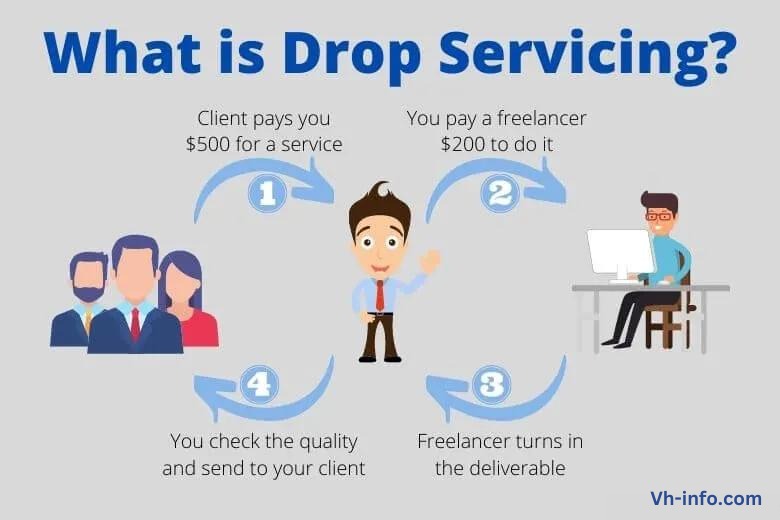
Drop servicing is a business model where you offer services to clients without actually providing the services yourself. Instead, you outsource the services to freelancers and take a percentage of what the clients pay.

So essentially you find clients who need a service, connect them to freelancers who can provide it, handle payments and communication, but don’t do the work. It allows you to sell services you can’t do yourself by leveraging freelancers. It’s a way to make money with minimal work through outsourcing.

How does Drop Servicing Work?

How does Drop Servicing Work?

Drop servicing is a business model that allows entrepreneurs to provide services to clients without actually owning a service-based business themselves.

Here are the key aspects of how drop servicing works:

  • The drop servicer acts as a middleman between clients who need a particular service, and freelancers or companies who can provide that service. For example, a client may need web development services.
  • The drop servicer does not actually provide the services themselves. Instead, they find and vet freelancers or agencies that can provide the specific services the client requests. The freelancers or agencies provide the actual services.
  • The client pays the drop servicer for arranging and coordinating the services. The drop servicer then pays the freelancer or agency for actually doing the work, typically keeping some percentage as profit.
  • Common services offered through drop servicing include graphic design, web development, digital marketing, SEO, writing, business consulting and more. However, almost any service business can potentially work with this model.
  • The value that drop servicers provide is by finding and vetting quality freelancers, managing the process and communication between clients and freelancers, and handling client acquisition – allowing clients to get services and freelancers to get work more easily.

So, drop servicing allows entrepreneurs to run a service business without actually providing the services themselves – they play a coordinating role between client needs and external service providers. It provides more flexibility than owning a full agency.

Benefits Of Drop Servicing

Here are 5 key benefits of drop servicing:

  1. Low Startup Costs – You don’t need much investment, just a laptop and internet to get started. Leverage freelancers for minimal upfront costs.
  2. Easy to Scale – You can take on more clients without hiring more staff by leveraging more freelancers. Grow your business faster.
  3. No Expertise Needed – You don’t need to be an expert in the services yourself. Freelancers handle delivering the actual services.
  4. Flexible – You can work when you want from anywhere with an internet connection. It’s a location-independent business.
  5. Higher Profit Margins – You keep the difference between what clients pay and the lower rates paid to freelancers. This model allows healthy margins.

Challenges And Limitations Of Drop Servicing

Here are 5 main challenges and limitations of drop servicing:

  1. Finding Good Freelancers – It can be difficult to find skilled and reliable freelancers who provide consistent quality work. Extensive vetting is required.
  2. Managing Communication – As the middleman between clients and freelancers, managing communication and expectations on both sides can be tricky.
  3. Tight Profit Margins – After paying freelancers, profit margins can sometimes become too tight to justify the effort. Pricing has to be set appropriately.
  4. Lack of Control – You have little control over the actual delivery of the services compared to other business models. Quality control is imperative.
  5. Building Trust and Reputation – As a new business, establishing a professional reputation, reliability and trust with both clients and freelancers poses challenges initially.
  6. To reduce risks around quality, scope creep, and IP ownership, build a solid contract stack—client service agreements, MSAs with SOWs, NDAs, and subcontractor agreements. If you’re not sure how to tailor these for a reselling/outsourcing model, consider getting contract support for service businesses from experienced commercial contracts lawyers who can draft and review terms like payment milestones, liability caps, indemnities, and confidentiality to protect both client and provider.

How to Start a Drop Servicing Business?

How to Start a Drop Servicing Business?

Starting a drop-servicing business isn’t super complicated. It doesn’t need a lot of money or a big investment. You can begin your own drop servicing business by getting freelancers or virtual helpers to manage the work while you concentrate on advertising and making sales.

But before anything else, you have to pick what area you want to focus on.

Choose your Niche

Picking what you specialize in is a big deal when you start a drop servicing business.

It’s tricky because you have to find out who might want to buy what you offer. To do this, you can use tools like Google Trends and Google Keyword Planner for market research. These tools help you see what services potential customers look for the most. After making a list, you can check places like Reddit and Quora to see if people are interested in those specific areas.

Let’s start with the service your business will offer. Remember, there are many options available. Your imagination is key here!

If you’re not sure which drop servicing area to pick, think about these things:

  1. Do I know a lot about any particular idea already?
  2. If not, which idea looks doable or interesting to learn about?
  3. Which ideas seem easy to start and do?
  4. Which ideas do people really need or want?
  5. Which ideas could make the most money for my business?

Choosing a niche can be tricky. Think about what matters most to you and build your business based on that.

Find and Train your Team of Service Providers

Picking your team is a crucial step in your drop servicing business. They’re the heart of your business, so choose wisely.

Here’s a checklist for when you’re picking people for your team:

  1. Do they know a lot about the service you want? Ask for examples.
  2. How much training will they need to meet your standards?
  3. Will they finish their work on time and be dependable?
  4. Are they good at communicating and working together?
  5. Do they live in a different time zone? Will that cause problems?

You can find team members on sites like Fiverr, Upwork, and others. Once you find some good options, give them a small test project to see how well they do.

Build your Brand and Bring it to Life

Once you’ve got your plan and a great team, it’s time to set up your company! If you’re looking to find clients online, having a good online presence is super important.

Your website is the most crucial part. Also, think about making social media profiles.

There are lots of tools to build websites like Shopify, Wix, WordPress, and Squarespace. Many let you try for free before you decide.

Make sure your website and other things related to your brand have:

  1. A unique logo that shows what your brand is about
  2. Info about your brand, why you do what you do, and what makes you special
  3. Details about your services and what clients can expect (you can share prices or talk about them during sales)
  4. If you’re selling stuff online, put your prices and choose a website tool that lets you take payments online
  5. If you’re aiming to build a website for your no-code app on all platforms without diving into complex coding, consider seeking assistance from Squarespace experts to optimize your online presence for maximum visibility and engagement.

Attract Customers with Marketing

Marketing is super important for any business. It’s no good having a great brand and website if no one sees it, right?

There are many ways to make your business known, get new clients, and keep the ones you have.

Here are a few:

  1. Referral marketing. It’s a way to get more customers without spending a lot. You can start a program that rewards current customers for bringing in new ones.
  2. Content marketing. This means using different kinds of content like blogs, videos, emails, pictures, books, and even podcasts. It helps teach, entertain, and make more people aware of your brand.
  3. Social media marketing. If your customers are on social media, you can make special plans to talk to them there. Just find out where they are and make content for those places.

Make your First Sale … and keep going!

They say your first sale is a special moment. Sometimes it happens quickly, other times it’s tough. But the important thing is to keep going and not give up.

When you talk to more potential clients, you’ll learn what works and what doesn’t.

Listen carefully to what these potential clients are saying. Is your price too high? Are you forgetting something important? Maybe your competition is doing something that you should also think about doing.

Drop Servicing Business Examples

  1. Website Building – Find clients who need a website. Outsource their website building projects to freelance web developers at a lower price. Handle client relations yourself.
  2. Graphic Design – Get clients who need graphics work like logos, brochures etc. Pass on the work to graphic designers at cheaper rates. Manage project deliverables. Or you can create by yourself by using a logo maker, or brochure maker app.
  3. Digital Marketing – Offer search engine optimization, social media marketing, email marketing to local businesses. Hire online marketing freelancers to actually execute campaigns at affordable costs.
  4. Business Consulting – Provide consulting to startups or small businesses on their operations, processes etc. Leverage freelance business consultants to advise them over calls/emails.
  5. Transcription Services – Provide transcription services for videos, podcasts, interviews etc. Hire freelancers to transcribe the audio/video content.
  6. Animation Video Creation – Offer animated explainer video services for businesses. Outsource video creation to animation specialists and designers.
  7. Bookkeeping – Offer bookkeeping and accounting services to small businesses. Leverage bookkeepers to handle tasks like reconciliations, financial reporting.
  8. Tech Support – Provide ongoing tech/IT support for consumers and small businesses. Use freelance computer technicians to troubleshoot.
  9. Logo Animation – Sell animated logo reveal services for brands. Pass these video projects to animation studios.
  10. Product Listing – Offer product listing optimization for eCommerce stores. Hire freelancers to create SEO-optimized listings.

How much does it cost to start a drop servicing business?

The great thing about drop servicing is that you can start with minimal capital and a low budget.

Here is a quick breakdown of the approximate costs to get a basic drop servicing business up and running:

  1. Website & Domain – $100-300 depending on options This would cover building a simple informational website to promote your services and allow prospects to contact you.
  2. Branding – $50-200 for a logo and branding Even a basic logo design and color palette helps lend legitimacy early on.
  3. Admin Tools – $50-100/month Includes email service, productivity software, CRM, project management tools etc. Automation helps.
  4. Marketing – $100-300 initially Could include things like business cards, listings, online directories submission to get the word out.

Total: Approximately $500-1200 to cover the basics

The largest recurring costs then become any paid ads for client acquisition. But otherwise, it’s possible to start a basic drop servicing operation for under $1500 if you manage costs diligently. Let the profits help fuel further growth.

So, extremely lean compared to other small business models that require office space, inventory, equipment etc. The outsourced nature of drop servicing keeps overheads very low in these early stages.

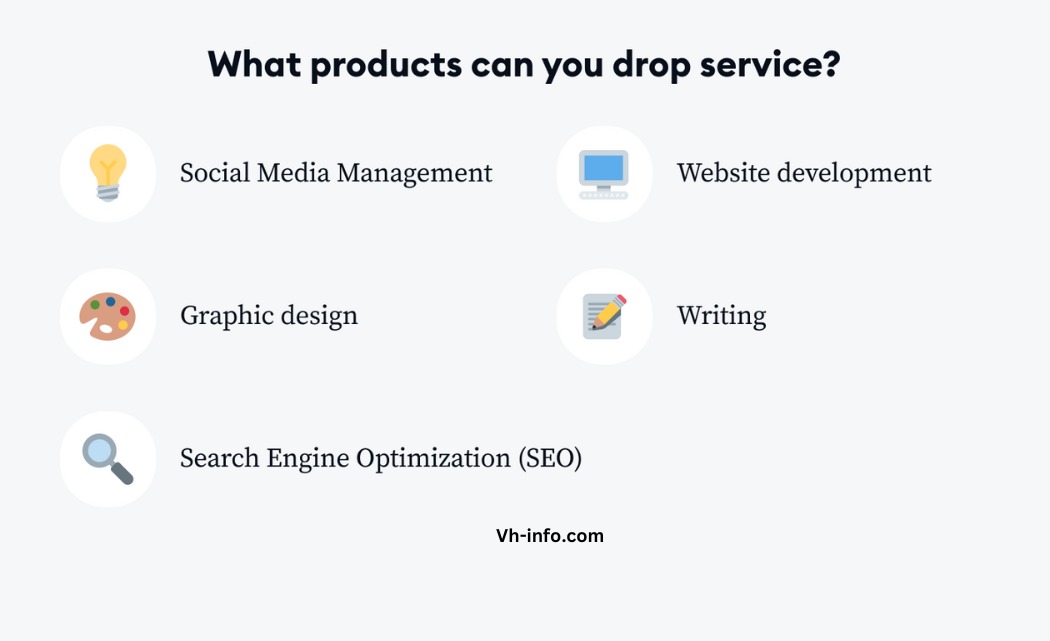
What Products or Services Can You Drop Service?

What Products or Services Can You Drop Service?

The various products or services you can offer in a drop servicing business are as follows:

  1. Design: Every business needs designs. This could be for things like making their brand look good, packaging products, or advertising. Lots of businesses know that hiring freelancers or agencies for designs can cost a lot of money. But with drop servicing, businesses might save more money by asking other companies to do their graphic design work for them.
  2. Writing: In the online world, people believe that content is really important. This is still true today. Every business that wants to be noticed online needs people who write well, like copywriters and content writers. It’s something to think about in drop servicing. You can hire different freelance writers to do the writing work for you. Also, there are services specifically for writing content that you can try. These services can help with different types of writing, like blogs, and writing for websites, ads, and emails. A paraphrase tool can also assist in rephrasing sentences and paragraphs.
  3. Video Creation and Production: This has three parts. First, if a YouTuber asks you for help with making or editing videos, they’ll need someone like an editor or producer. Second, some businesses might need videos for their brand or products. Lastly, businesses might want videos for marketing their products or services.
  4. Data Entry and Analytics: Some businesses like real estate, shipping, and banking need assistance with entering data. If your clients work in industries that rely a lot on entering data, your drop servicing business can make good money. The people who are best at this job are either beginners or those who work part-time entering data. Besides data entry, your clients might also want data analysis. For this, they’ll need an experienced freelancer in that field. Moreover, banks and other financial institutions should adopt IDP in fintech in fintech to streamline operations and manage documents efficiently.
  5. Marketing: Another area you can think about in drop servicing is marketing. Some businesses think that hiring marketing agencies costs a lot. Businesses won’t search for marketers directly on freelance platforms if they choose drop servicing. You might need to find freelancers who are experts in different types of marketing, like social media, inbound, email, and content.
  6. SEO: Lots of businesses want to be at the top of search engines, so SEO (search engine optimization) is really important. Many freelancers know a lot about SEO and can help different clients. By adding SEO experts to your drop servicing business, you can make your online presence stronger and make more people know about your brand.
  7. Advertising: Another service you can offer is advertising. There are many parts to it like making ads, videos, social media ads, and ads for publications. Doing this needs special skills because they might work on writing, design, and making videos all together.
  8. Web Development: If a business wants to be seen online, it needs a drop servicing website. Site builders can make it quickly, but web developers help keep the website working well. You can find skilled web developers like front-end, back-end, and full-stack developers on freelance websites for your drop servicing business.
  9. Programming: Another thing you might think about for your drop servicing business is programming. Lots of brands want special apps for their stuff, like online stores or shipping services. Programmers are the ones who can make these apps, so you might want to have them on your team too.
  10. Social Media: Businesses often hire a drop servicing reseller for social media help. Some businesses need someone to manage their social media accounts. They might want freelancers who are good at managing communities and designing posts, especially if they prefer just one person to handle their social media.
  11. Translation: Big companies that operate worldwide might need help translating things they use internally or for their brand. Sometimes a business wants to start selling in other countries. If you have a drop servicing business, you can easily find freelancers who specialize in translation. They can help these businesses with their needs.
  12. Audio and Music: This area might seem not so popular, but people making podcasts and videos need help with sounds and music. For instance, a business might want someone to speak over their videos for marketing. Or they might need special music or tracks for their brand.
  13. Transcription: People who make podcasts or videos might need help writing down everything that’s said in them. This is called transcription. Sometimes they’re too busy to listen to their episodes or videos and write it all down themselves. If you offer this service, lots of people might want to hire you for it.
  14. Accounting: Small businesses sometimes need help managing their money and keeping track of their sales and expenses. They can ask a drop servicing reseller for help with accounting. This is important for them because it gives them time to focus on growing their business. Offering accounting services could be a good idea for your drop servicing business.
  15. Interior Design: Shops that want to open more stores in different places might need an interior designer’s help. But if they don’t have enough money to hire an experienced interior designer, they might ask your drop service business for help. Even though they can’t be there in person to design the store, they can share ideas for the design and give pictures and plans to start the work.
  16. Animation: Making animations is a part of creating videos. But it’s not just for videos – animations can also be used in making pictures and designing characters. Also, businesses making gaming apps and online games will need people who can create animations. If you’re working with different clients who have these needs, you might need different animators to help you out.

How to get Clients for Drop Servicing?

How to get Clients for Drop Servicing?

Here’s on how to get clients for your drop servicing business:

  1. Research Market Demand: Look into what services people want the most and are willing to pay for. Websites like freelance job boards and tools like Google Trends can help you identify trending services.
  2. Promote Your Business: Spread the word about your drop servicing business. Use social media, create a website, or advertise on platforms where potential clients hang out. The goal is to make them aware of your services.
  3. Send Proposals: Reach out to suppliers and let clients know upfront about cost-saving options like supplier location. Being transparent can help attract more customers.
  4. Utilize LinkedIn: Connect with potential partners and leverage word-of-mouth marketing through referrals. Networking on LinkedIn can help you find clients and build partnerships.
  5. Try Facebook Ads: Facebook advertising can be a potent tool for attracting clients to your drop servicing business. Create targeted ads to reach your desired audience.

Other strategies that can help you get clients for drop servicing include:

  1. Undercutting Competitors: Offering competitive pricing or additional value can make your services more appealing.
  2. Using GetResponse: Utilize email marketing tools like GetResponse to reach out to potential clients and maintain communication.
  3. SEO Strategies: Optimize your website and content for search engines to improve visibility and attract organic traffic.
  4. Focus on Evergreen Services: Offer services that are always in demand, like website development, ensuring a consistent flow of potential clients.

By combining these strategies and adapting them to your business, you can effectively attract clients for your drop servicing venture. Remember, building a strong reputation and delivering quality service are key to retaining clients and growing your business in the long run.

Where can you promote Drop Servicing?

Where can you promote Drop Servicing?

You can tell people about your business on different places online, like:

  1. Social media sites (like Facebook, Instagram, Twitter, LinkedIn)
  2. Freelance websites (like Upwork, Fiverr, Freelancer)
  3. Online stores (like Amazon, Etsy, eBay)
  4. Business listings (like Yelp, Google My Business)
  5. Your own website or blog

Drop Servicing Blueprint

Here are simple steps to start this business:

  1. Pick what you’ll specialize in.
  2. Find people who can do the work.
  3. Make a website or page to get clients.
  4. Decide how much you’ll charge.
  5. Tell people about your services.
  6. Get orders and talk to the people doing the work.
  7. Give the finished work to your clients.

The Difference Between Drop Servicing and Dropshipping

The Difference Between Drop Servicing and Dropshipping

Here is the key differences between dropshipping and drop servicing:

Basis for Comparison Dropshipping Drop Servicing
What is sold Physical products Services
Role of middleman Sells products, handles marketing/sales Sells and delivers services, handles marketing/sales
Inventory Supplier holds inventory No inventory involved
Logistics Handled by supplier Handled by service provider
Effort required Lower, focus on sales/marketing Higher, consult with service providers
Profit margin Retail price – wholesale price Retail price – wholesale service rate
Risks Inventory issues, shipping delays Quality control, dependability of providers
Examples Selling supplements, apparel, electronics Web design, writing services, marketing services

FAQ’s:

Is Drop Servicing Legal?

Is Drop Servicing Legal?

Yes, drop servicing is completely legal.

As long as you run your business honestly and transparently, there are no legal issues with this model. You provide real services to clients by outsourcing the work to freelancers that you pay fairly for their work. There is no fraud or deception involved when done right.

You do still need to follow all standard business compliance rules and tax laws like any other company. But the core concept of acting as a middleman, finding clients, managing the services, without actually doing the work yourself is not illegal at all.

As long as both your customers and freelancers clearly understand your value proposition and terms, are willing participants, and services are delivered satisfactorily, drop servicing operates well within legal bounds. You provide legitimate value to both sides.

Is Drop Servicing Profitable?

Yes, drop servicing can certainly be a very profitable business model.

By acting as the middleman between clients and freelance talent, you get to charge a rate to customers that covers both the cost of freelancer fees plus your own profit margin. So after paying out freelancers at lower price points, you pocket the difference.

Margins in drop servicing are often healthy since freelance services come at affordable costs compared to final prices charged to customers.

And because you can scale drop servicing through technology without too many overheads, higher volumes bring the ability to compound profits.

However, just like any business, appropriate pricing strategy, cost control and customer service is key to long term returns. Offshore customer service can play a crucial role in maintaining cost control while delivering excellent customer support. By outsourcing customer service operations to offshore teams, businesses can benefit from lower operational costs without compromising on service quality. This strategic approach allows companies to allocate resources efficiently, ensuring sustainable profitability and long-term success.

But executed well with some persistence, drop servicing provides the foundation and leverage needed for substantial profit generation over time through well-managed client projects. The outsourced nature of delivery keeps risk low too.

Is Drop Servicing The Same As Reselling?

No, drop servicing isn’t reselling. It’s more like a kind of trade where you buy something at a lower price and then sell it for a higher price. In this case, the price is decided by the partner who provides the service.

Can you start Drop Servicing with no Budget?

Yes, it is possible to launch a drop servicing business without any substantial startup capital through sweat equity and strict cost control initially.

By minimizing expenses, ensuring at least 50% client payment upfront, establishing clear written expectations, and leveraging free tools and unpaid reach opportunities in the beginning, you can start with essentially zero budget.

It will take hustle and financial discipline but the flexible outsourced structure of drop servicing enables ultra lean bootstrap starts.

What Skills do you need for Drop Servicing?

The most important skills for drop servicing are sales and client acquisition abilities, project and freelancer management competencies, and basic admin, finance and accounting knowledge.

As the middleman between customers and service fulfillment, you need marketing aptitude to locate clients, operational skills to oversee freelancers, and organizational skills to manage the business.

Technical expertise in the actual services isn’t as necessary since freelancers handle delivery. The core skills involve generating demand, managing outsourced capacity, and running the back-end logistics of the operation.

Can I make Good Money with a Drop Servicing Business?

Some folks may ask how much money you can make with drop servicing. It’s important to understand that while some drop servicing businesses can be profitable, you need to put in effort and work hard.

The service business isn’t a way to get rich quickly. But if you look online, you’ll see that drop shipping has been making good money for some time. It might be a good idea to start with a dropshipping business first to see how it goes.

Is Dropservicing easy?

Yes, drop servicing is easy and anyone with a computer and internet can do it. But before starting, you need to understand the market and how it all works.

Remember, it won’t happen quickly. Building a successful drop servicing business takes time. It won’t make big profits right away.

Conclusion

In conclusion, drop servicing is a lucrative business model that allows you to leverage the skills and expertise of others to provide valuable services to clients.

By following the step-by-step guide outlined in this blog, you can start your own drop servicing business and achieve success.

Remember to choose a niche, find and train your team of service providers, build your brand, attract customers through marketing, and make your first sale.

Keep in mind that drop servicing comes with its own set of challenges and limitations, but with determination and strategic planning, you can overcome them.

At VH Info, we specialize in helping SaaS companies navigate the complex world of SaaS link building Services, SEO for Startups and white label Link building service.

Whether you’re interested in design, writing, video production, or any other service, there are endless opportunities to offer and promote your drop servicing business.

So, take action and embark on your entrepreneurial journey today!

Search Content Marketing: A Complete Guide

Search Content Marketing is like creating valuable information online to attract people interested in what you offer. This helps get more visitors to your website.

In our guide, we’ll explore this method deeply and why it’s essential today.

We’ll talk about different types of content like blogs, videos, podcasts, and more. These can help you reach people at different stages when they’re figuring out what to buy. Plus, we’ll show real campaigns that worked well to give you ideas.

If you’re looking to boost your SaaS company’s online presence through effective link-building strategies, VH-Info, a specialized agency in this field, can assist you. They understand how to utilize content marketing to enhance your website’s visibility and attract your target audience effectively.

What Is Search Content Marketing?

What Is Search Content Marketing?

Search content marketing refers to creating and optimizing online content specifically to appear in search engine results pages. The goal is to produce content that answers common customer questions so that it ranks highly in search engines when people look for information about a topic. By showing up prominently in searches and providing valuable information to searchers, brands build trust and credibility. This in turn leads site visitors to become loyal customers over time as they come to view the brand as an authority they can rely on to get in front of the right people at the right time and fulfill search intent. This includes optimizing all web pages and landing pages for search, containing clear messaging, and including all primary keywords.

Why is Search content marketing important?

Here are the key reasons why search content marketing is important:

  1. It helps brands get discovered by people already actively searching for related information, products, or services – this means capturing an audience at the precise moment they are looking to engage.
  2. Optimized, useful content that answers search queries can drive qualified organic website traffic, reducing the need for expensive outbound marketing. Partnering with an affiliate recruitment agency can further amplify this effect by leveraging their networks to enhance visibility and reach.
  3. Ranking well in searches builds credibility and trust, positioning the brand as a reliable industry resource.
  4. Informative content answers questions and solves problems for searchers at no cost to them, fostering goodwill towards the brand.
  5. Strong search presence indicates relevancy and authority around keywords and topics, influencing searchers’ perceptions positively.
  6. Allows brands to reach customers during critical decision-making and research moments where they are more receptive to messaging.
  7. More cost effective than traditional interruptive advertising for gaining an interested audience.

Types of Search content marketing

Here are the main types of search content marketing:

  • Blog articles – In-depth, long-form articles and blog posts designed to appear for informational search queries. They educate readers on topics and answer common questions.
  • FAQ pages – Comprehensive lists of frequently asked questions and detailed answers on a topic. Helpful for customer research questions.
  • How-to guides – Step-by-step tutorials for users looking for help completing tasks or learning processes.
  • List posts/Roundups – Listicle-style posts that aggregate and compare products or tips around a topic. Useful for comparison shoppers.
  • Video content – From snappy 60-second video FAQs to YouTube tutorials, video content can rank highly and inform searchers.
  • Podcasts – Podcast episodes focused on searcher questions or industry topics can rank for terms prospects use.
  • Case studies – Demonstrate expertise by showing how your product or service solved problems for real-life uses cases.

How does search content marketing works?

How does search content marketing works

Once you know what kind of content your business will make, it’s time to plan how you’ll do it. Content marketing is about making connections and solving problems.

So, every strategy for content marketing should think about how to handle the three stages of content marketing.

1. Awareness

The awareness stage is the start of the customer journey. This is when people realize they have a problem. During this stage, content should talk about what customers need and what’s hard for them, without pushing too much about your solutions or products. The best types of content for this stage are blogs that answer common questions, helpful how-to videos, or detailed eBooks that give an overview.

2. Consideration

During the consideration stage, your audience is aware of their issue and starts searching for ways to fix it. At this point, businesses should keep providing useful information through content, but they can also include some promotions within the content. Good types of content for this stage are helpful infographics and how-to blogs.

3. Decision

In the decision stage, your audience makes up their mind about picking your solution or not. This is when your content should focus more on selling. Things like comparison lists, stories from happy customers, videos showing how the product works, and guides for buyers work best now. Businesses can also use paid ads that target people who showed interest before but didn’t continue, allowing you to choose a tone of voice that aligns with your brand and guide them through the buyer’s journey.

Search Content Marketing Examples

Here are some excellent content marketing examples from various companies:

  1. Netflix’s Blog: Netflix publishes an extremely popular blog sharing insights into user behavior, new releases, company culture, and more. It builds brand awareness and trust.
  2. Dollar Shave Club’s Video Content: Dollar Shave Club went viral with its funny video campaigns, driving massive growth. The videos entertained while educating people about its razors.
  3. REI’s #OptOutside Campaign: On Black Friday, REI closes its stores and pays employees to enjoy nature. This campaign aligns with REI’s brand and values on sustainability and the outdoors.
  4. Sedona Resort’s E-Book: Sedona Resort created an e-book positioning its resort as a luxury wedding destination. The informative e-book establishes Sedona’s expertise.
  5. Home Depot’s DIY Workshop Videos: Home Depot creates useful, engaging DIY video tutorials related to home improvement projects, attracting diy-ers to its brand and product offerings.
  6. Starbucks’ Blog and Social Content: From its “Idea in Action” blog to fun social content on seasonal drink flavors, Starbucks creates branded lifestyle content customers love sharing.

These are just a few stellar examples of how leading brands leverage the power of content to connect with customers in a genuine and strategic way. The content provides value while building affinity for brands.

What Is Content Marketing?

What Is Content Marketing?

Content marketing is about sharing helpful and interesting stuff with your audience, like articles, videos, or social media posts. It’s not just about advertising your products; it’s about giving your audience information they find valuable. This content could be anything that solves their problems or gives them more knowledge about things they care about. By doing this, you become an expert in their eyes, and when they need something you offer, they’re more likely to choose you. It’s all about building trust and relationships by providing useful and effective content marketing campaigns that people actually want.

Content Marketing Examples

Content Marketing Examples

Here are some great content marketing examples from various companies and industries:

  1. Shopify: Shopify creates tons of valuable content focused on ecommerce, entrepreneurship, and running an online business. From blog posts and guides to webinars and podcasts, they consistently publish useful content that establishes them as thought leaders.
  2. HubSpot: Known for inbound marketing, HubSpot offers a wealth of blog posts, ebooks, courses, and more on topics like marketing, sales, customer service, and business growth. Their content is very educational and helpful for their target audience.
  3. Neil Patel: As an influential online marketer, Neil Patel frequently publishes in-depth, data-backed articles and guides on his blog. His content showcases his expertise and has helped him become a sought-after industry voice.
  4. Slack: With their brand focused on business collaboration, Slack publishes helpful blog posts and videos all about improving workflow, communication, and productivity in the remote work era. Their content fills a key need for their audience.
  5. Mailchimp: From guides to webinars and podcasts, Mailchimp creates useful content centered on email marketing, small business growth, and e-commerce. This positions them as a go-to resource for their customers.
  6. REI: With their outdoor enthusiast customer base, REI creates robust blogs and videos providing tips on outdoor sports, camping, hiking, biking, and more. This drives brand loyalty and sales.

The key is to consistently publish relevant, valuable content tailored to your audience like these leading brands do. Educational, inspiring, or entertaining content that fills a specific need or interest for your target customers.

Types of Content Marketing

Lots of people who sell things use different ways to share information with others on different websites or apps. The kind of information they share depends on how they want to do business and who they want to talk to. It’s a good idea to include these types of sharing information in your plans for how you’ll sell things in 2024.

Blogs

Blogs are like stories that businesses write to talk about their products or share their knowledge. They use words, pictures, and sometimes videos. Blogs are really popular because they help businesses get noticed by people and search engines. They’re great for marketing because they’re affordable and easier to make than videos. To write a good blog, focus on one topic per article and use different lengths—short, medium, and long. But remember, longer doesn’t always mean better. Keep it interesting and helpful to keep people reading and provide a next step to move the visitor through the buyer journey and eventually convert them into a customer. Original research can also be a valuable addition to blog content, providing thought leadership and unique insights.

Video

Videos are super important for businesses to share things online, whether on their website or platforms like TikTok and YouTube. They help companies explain stuff quickly using pictures, music, and talking. Making videos has become easier and cheaper because of phones. Businesses use videos to show how things work, share thoughts from customers, talk about their team, or show new stuff they’re doing. Even though some might feel unsure about making videos, it’s a good idea for every company in 2023 because people really like watching them and want to see more from their favorite brands. Videos can also be changed into other things like blogs or social media posts, which helps companies make different content faster. Fortunately, AI video editors like Vidscale Pro simplify the video creation and editing process, making it easier for businesses to harness the power of video.

Podcasts

Podcast content marketing helps businesses talk to specific groups using audio content. They can make their own podcast collaborate with podcast promotion companies or be guests on others’ podcasts related to their business. In podcasts, businesses talk about solving problems for their audience, share customer stories, industry updates, and examples that connect with listeners’ feelings, and they can use free podcast transcription to make their content more accessible and engaging. Some businesses don’t realize the power of podcasts, but they’re becoming popular for connecting with customers, as more people are listening to podcasts nowadays.

Social Media

Social media marketing is when businesses share content like words, pictures, and videos on platforms like Instagram, Facebook, TikTok, and others. It’s a way for businesses to chat with customers in a more relaxed way than emails or websites. When people like the content, they might share it with others, helping the business reach more people. Plus, it brings more visitors to a business’s website regularly.

Infographics

Infographics are cool pictures showing interesting facts and numbers in a fun way, mainly used for business purposes. They simplify big ideas into easy-to-read visuals, often created from existing content like blogs. These pictures are great because they’re easy to understand quickly, and businesses can share them in smaller parts on social media. Tools like Adobe Express make creating these visuals quicker and simpler.

Ebooks

Ebooks are special books that businesses use to teach other businesses or shoppers about important things. They’re popular mostly for B2B businesses but sometimes used by B2C brands too. Companies make these books to get people’s emails and stay connected. To be effective, ebooks should offer valuable and unique information, like research or industry insights. Done well, they help businesses get more interest and look knowledgeable.

Paid Advertising

Paid advertising is when businesses use money to show their ads on search engines, social media, and other websites. These ads use words, pictures, or videos to catch people’s interest and make them want to learn more. It costs money each time someone sees or clicks on the ad. Even though it’s more expensive than other ways of marketing, it can bring quicker results and helps reach more people who might not have known about the business otherwise.

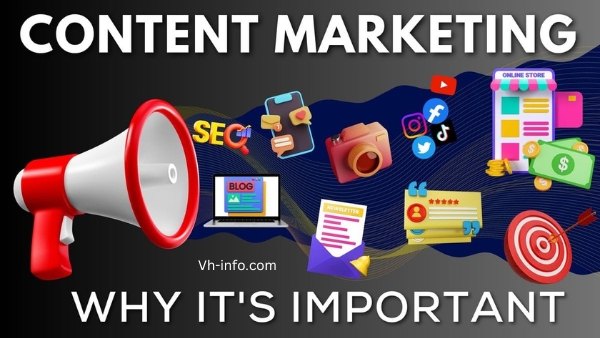
Why is Content Marketing Important?

Why is Content Marketing Important?

Imagine when you see lots of advertisements everywhere, like on TV or the internet. Sometimes there are so many ads that it’s hard to pay attention to all of them. Content marketing is like a different way for companies to talk about what they offer without just showing ads.

Here’s why it’s important:

  1. Helps people learn: Content marketing tells people about a company’s products or services in a helpful way. It’s like teaching them something interesting while also talking about what the company does.
  2. Makes more people interested: When a company shares useful information, more people notice and become interested in what they offer. This can help the company become more popular.
  3. Encourages people to buy: When a company shows it understands what people need, it makes them more likely to buy something from that company.
  4. Shows how it solves problems: Content marketing explains how a product or service can help solve a problem someone might have. This helps people understand how useful it can be.
  5. Helps a company become more known: By sharing good content regularly, more people get to know about the company. This makes the company more popular and easier to find online.
  6. Builds trust: When a company shares helpful and good-quality content, people start to trust it more. This makes them more likely to stay loyal to that brand.
  7. Content marketing is becoming more popular: Especially after the pandemic, more and more people are using content online. Companies are planning to create even better and more useful content to catch people’s attention.

So, content marketing is about making people interested in a company by sharing helpful and interesting information without just showing lots of ads. It helps companies to become popular, build trust, and show how their products or services can help people in different ways.

FAQ’s:

How Often Should I Update My Content For SEO Purposes?

Keeping your website content up-to-date is super important for how well it shows up on search engines like Google.

When you regularly update your site with new stuff that people are searching for, it helps your site appear higher in search results. This is because search engines really like to show the most recent and helpful content to people looking for information.

So, by adding new blog posts or making changes to your website, using words that people search for (keywords), you can improve where your site shows up in search results.

It’s not a strict rule, but updating every few weeks or months can make a big difference in how well your site does on search engines.

What Types Of Content Have The Most Success With SEO?

In the world of making your website stand out on the internet, using search engine optimization (SEO) is super important. It’s all about understanding what people search for and making your website’s content match that.

To do well, your content needs to have lots of keywords related to what people are looking for. Things like blog posts, videos, cool images, informative articles, and other helpful stuff can make your website more popular if you do them right.

Making sure your content is interesting to people and also looks good to search engines is key. That means having good titles, clear descriptions, and links inside your website that all help your website show up higher when people search for things.

So, the types of content that work best for SEO are the ones that people find helpful and that include the right words to match what they’re searching for.

What Is The Best Way To Track The Performance Of My SEO and Content Marketing Efforts?

Keeping an eye on how well your SEO and content marketing are doing takes some work, but it’s really important to know if your plans are working.

To do this, you can use special tools called analytics tools.

These tools help you see lots of details about how people are using your website, like how many visit your pages, how long they stay, and if they do what you want them to do, like buying something or signing up. This info helps you figure out what’s going well and what needs fixing.

Also, checking how each page is doing separately is a good idea. It helps you understand which pages are popular and which ones need a little help. This way, you can change things up to make them better or create new stuff that people will like more.

By using these tools and keeping an eye on your pages, you can make sure your hard work gets the best results possible.

How Can I Increase My Website Visibility With SEO and Content Marketing?

Want more people to notice your website? SEO and content marketing work together to make your site more visible. But how do they actually help your website get seen?

SEO, short for search engine optimization, is about making your web pages show up higher in search engines like Google. This involves using specific words (keywords), getting other websites to link to yours, and making sure your site loads fast.

On the other hand, content marketing focuses on making content that interests people and brings them to your website. This content can be articles, videos, cool pictures, or anything that’s helpful for readers.

When you use both SEO and content marketing, they’re like a super team for boosting your website’s visibility. By creating awesome content that’s also great for search engines, you make sure your website gets noticed by more people.

This means more folks finding your website through search engines or links from other sites. And when you improve your current content, it can climb higher in search results and bring in more potential customers for your business.

Mixing SEO with content marketing brings more visitors to your website and makes it easier for people to find what they need. So, with this cool strategy, you’ll reach more folks and give them the useful info they’re searching for!

Is There a Way To Automate SEO and Content Marketing Tasks?

there are ways to make SEO and content marketing tasks automatic. It’s totally possible! Using automation can make things easier by doing some of the repetitive work, so businesses can concentrate on more important stuff.

Loads of tools are out there that help automate SEO and content marketing jobs.

For instance, there are tools for finding new keywords without you having to search manually. Others can check your website for any technical issues that might stop people from finding it. Some tools even help share your content on social media automatically, bringing more visitors to your site.

These tools are awesome because they let businesses handle their SEO and content marketing tasks without spending heaps of time on them. With a smart plan, companies can save time and cash while still getting the results they want.

Conclusion

In conclusion, search content marketing plays a crucial role in reaching and engaging your target audience.

It allows you to create valuable and relevant content that aligns with their needs and interests, ultimately driving traffic, leads, and conversions.

By utilizing various forms of content such as blogs, videos, podcasts, social media posts, infographics, ebooks, and more, you can cater to different preferences and consumption habits.

Additionally, optimizing your content for local, voice, and visual search ensures that your brand is discoverable across different platforms and devices.

Incorporating search content marketing into your overall marketing strategy can help you establish your brand as an authoritative source and build strong relationships with your audience.

Digital Marketing Process: A Step-by-Step Guide

In today’s digital world, having a strong digital marketing process is crucial for businesses to thrive.

If you’re wondering where to begin, look no further!

In this blog, we’ll guide you through every step of the digital marketing process, from initial research to optimization.

We’ll delve into various types of digital marketing like SEO, PPC, and social media marketing, explaining why a solid digital strategy matters for your business’s success.

We’ll explore whether this approach fits all businesses or not and share real-life success stories of impactful digital marketing campaigns.

As a link-building agency, VH-Info understands the significance of effective digital strategies. We’ll even provide insights into FAQs about digital marketing strategies.

So, let’s start this journey together!

What is the Digital Marketing Process?

What is the Digital Marketing Process?

Digital marketing, also known as online marketing, is like showcasing things online, such as products, services, or brands, to get attention, make sales, or spread the word. It involves using the internet and digital platforms to reach people in today’s digital landscape. The digital marketing process includes various strategies and techniques, including marketing techniques, used by digital marketers to meet business goals, like boosting sales or increasing brand awareness. It’s basically how businesses use online tools to connect with customers and achieve their marketing aims.

Digital Marketing Process Steps

Step 1: Research

The first thing in digital marketing is doing research, including keyword research. This means gathering info about the product, the people who might want it, and the market it’s in. We also look at other similar stuff out there.

This helps make a smart plan for advertising and standing out from others. The info we collect includes things like details about the business, who might be interested, what’s being sold, and what the competition is up to.

Identifying the target audience and understanding their pain points, including crafting detailed buyer personas, is imperative for every content strategy if you want users to find you on search engines.

Additionally, it is important to consider different options for marketing communications in the online marketplace, including video ads. For businesses looking to make a significant impact, utilizing creative video solutions in Australia can offer customized approaches that enhance visibility and audience engagement.

Step 2: Create

The next step in digital marketing is being creative. We take all the info we gathered earlier and use it to make a cool plan for advertising, including a ppc campaign. This plan focuses on goals we want to reach and things we want to achieve, including marketing goals.

We come up with ways to show off the brand and decide what kind of content strategy to use, including reaching new audiences. The main goal is to achieve your business objectives, whether it’s making more money or getting the attention of lots of customers, or maybe both!

Step 3: Promote

This is when the digital marketing teams begin showing off the products or services. They do this on lots of online places like search engines, social media, emails, and other websites where people buy things or see ads.

Step 4: Analyze

The last part of digital marketing is checking how everything went. They gather all the results from the campaigns and look at them closely to see if they made good money or not. This helps figure out what worked well and what didn’t, so they can make even better campaigns later. They use tools like Google Analytics, which is from Google, to analyze the performance of their landing page and other assets and channels using key performance indicators (KPIs).

Different Types of Digital Marketing Processes

Different Types of Digital Marketing Processes

Now that we know what digital marketing is, let’s check out the different ways marketers use to show off, advertise, and sell their stuff.

E-Mail Marketing

E-Mail Marketing

Email marketing is when you send emails to people who might be interested in your stuff to tell them about your products or services.

But it’s not as simple as it sounds.

To start, you need to make sure your emails don’t end up in the spam folder. You do this by making a list of people who want to get your emails.

Here’s what you need to do to create an effective email marketing campaign:

  • Personalize the content for each person in both the email body and the subject line.
  • Clearly explain what kind of emails the person will get.
  • Don’t add fluff, and try to be brief – a Editpad summarizer can be a quick solution to achieve email brevity.
  • Send different types of emails – some for promotions, some for transactions.
  • Make it easy for people to unsubscribe if they want to stop getting your emails.

The goal is to make sure your customers see your emails as helpful, not just ads.

Email marketing is a great way to get leads. If you use marketing tools that automate tasks, it becomes even better. These tools help you organize and schedule your emails based on what your customers want, making things easier for you.

Marketing Automation

Marketing Automation

Marketing automation is a way of doing digital marketing smarter.

It uses special software to help with campaigns, making things work better and faster. This software gathers info about customers and uses it to plan specific campaigns. It uses special software for digital marketing to help with campaigns, making things work better and faster.

By studying this info, it sorts out and plans when to send marketing messages to the right people at the right time.

Search Engine Optimization (SEO)

Search Engine Optimization (SEO)

Search Engine Optimization (SEO) is a digital way to make sure your website shows up higher when people search for things on search engines like Google, Bing, or others. It’s a big deal in digital marketing and can lead to good job opportunities.

To make your web pages rank better in search results, you need to focus on a few important things: have really good content, keep people interested in your site, make sure it works well on mobiles, and get good quality websites to link to yours. To make your web pages rank better in search results, you need to focus on a few important things: have really good content, keep people interested in your site, make sure it works well on mobiles, or, even better, create an app, and get good quality websites to link to yours.

Since Google changes how it ranks pages often, it’s important to keep up with these changes when planning your SEO strategy to increase the amount of organic search traffic to your site. Also, keep an eye on your web pages regularly and make changes if needed.

Content Marketing

Content Marketing

Content marketing is a way to get people interested in things by sharing really good content. This content can be in different forms like written stuff such as blogs or articles, audio things like podcasts, or video content like vlogs shown on websites or online channels. Some even use YouTube video production services to create high-quality content that will captivate their audience.

The key is to make content that’s original, fun, and interesting for the people who see it, so they like it and maybe tell others about it too. Implementing a content marketing strategy, including content creation, is crucial for businesses to effectively reach their target audience and engage them with valuable content, including social media posts that drive website traffic.

Search Engine Marketing (SEM)

Search Engine Marketing (SEM)

Search engine marketing is a way to get noticed more on search engines by paying for ads. People who want their stuff to show up when others search for specific words pay search engines to boost their visibility.

To make this work well, it’s important to have good ads, pick the right words related to what you’re selling, make sure the page people land on is good, and decide how much to pay for the words and ads you use.

Pay Per Click (PPC)

Pay Per Click (PPC)

PPC marketing is a type of online advertising where companies pay whenever someone clicks on their ad and goes to their website. Usually, these ads are on Google and Microsoft Ads.

There are different kinds of campaigns within these platforms, depending on what the advertiser wants to achieve.

These can be:

  1. Ads that show up in searches.
  2. Ads that appear on websites.
  3. Ads specifically for shopping.
  4. Ads on YouTube.
  5. Ads for apps.
  6. Ads on Discover.
  7. Performance Max ads.

These ads can be aimed at specific groups of people or for everyone, based on what the company wants. If you’re running a PPC campaign for a SaaS business, consider reading about PPC for SaaS to optimize your approach. Whatever ad you are running it’s important to monitor it, so if you’re running Google ads, consider using a Google ads reporting tool to understand what meets your wants and what doesn’t. Overall, PPC helps companies get more traffic, make more sales, and get more people to take action on their website.

Affiliate Marketing

Affiliate Marketing

Affiliate marketing( is when you team up with a company, like an online store, to send people to their website or buy their stuff.

When people you send over make a purchase or just visit, you get a commission. You can do this by writing about their products on your site or by running ads that lead people to their product pages on search engines.

Influencer marketing, like affiliate marketing, relies on working with an influencer–an individual with a large following, such as a celebrity, industry expert, or content creator–in exchange for exposure.

In many cases, these influencers will endorse your products or services to their followers on several social media channels.

Instant Message Marketing

Instant Message Marketing

Instant message marketing is when companies use messaging apps to either advertise their products or give customers a good experience. Lots of businesses do this by using their official chat accounts and using automated tools or chatbots to talk with people.

Social Media Marketing (SMM)

Social Media Marketing (SMM)

Social media marketing means using social media sites, such as Facebook, YouTube, Twitter, Instagram, and other social platforms, to advertise and sell things.

It’s all about getting people interested in products and services by talking about them on these platforms. Social media presence also uses famous people on these sites to promote things to specific groups of people who follow them.

For example, an older celebrity might promote anti-aging products, while a younger influencer might show off trendy clothes.

Native Advertising

Native Advertising

Native advertising is when ads blend in with entertaining content. The idea is to make the ad look interesting, so people don’t ignore it and actually watch or read it. But it’s important not to trick or annoy people.

The ad should say things like “sponsored” or “promoted” to show it’s an ad. It needs to be clear it’s an ad but also fun and interesting so people like it and feel good about the product without feeling like they’re just being sold something.

Mobile Marketing

Mobile Marketing

Mobile marketing refers to advertising and marketing efforts that target users on their smartphones and tablets. It involves customized messaging and content designed for the small screen, delivered through SMS mass texting using a text length counter to ensure concise and effective campaigns, mobile apps, mobile sites, and mobile ads. The goal is to effectively promote brands, engage customers, and drive conversions on mobile devices.

Why having a Digital Marketing Process is important?

Why having a Digital Marketing Process is important?

Here are a few key reasons why having a defined digital marketing process is important:

  1. It provides strategic direction – A documented process acts as a roadmap and guides your digital marketing efforts. It ensures you have clear goals and a plan to work towards them in a methodical way.
  2. Improves efficiency – A defined workflow means your team knows exactly what needs to be done, by whom, and when. This eliminates guesswork, confusion about responsibilities, and duplications of effort.
  3. Aids collaboration – Different digital marketing activities often involve multiple teams and stakeholders. A set process facilitates better communication and collaboration between them.
  4. Measures progress – Milestones and metrics built into the process help you track progress. You can monitor what stage a campaign is at and if goals are being achieved at each step.
  5. Identifies optimization areas – Analytics insights gained at each process stage can reveal issues and opportunities for optimization to improve future campaign performance.
  6. Institutionalizes expertise – Documenting the process captures the knowledge and expertise of top performers. This can help develop a mentorship program to train new hires and build organizational capability over time.

Does having a proper digital marketing process work for all businesses?

Digital marketing can help any kind of business, no matter what they sell. It’s about understanding who your customers are and making useful stuff online for them.

But it doesn’t mean every business should use digital marketing tactics, like social media, content marketing, and email marketing, in the exact same way.

Different businesses might need specific goals and strategies for a proper digital marketing plan and digital media marketing tactics to work best.

B2B Digital Marketing

B2B Digital Marketing

If your business sells to other businesses (B2B), your digital marketing probably aims to get new leads online, leading to a chat with a salesperson. Your strategy might focus on bringing in the best possible leads for your sales team through your website and other online ways.

Apart from your website, you might spend more time on places like LinkedIn, where other businesses hang out online. That’s where you’re likely to find the people interested in what you offer.

B2C Digital Marketing

B2C Digital Marketing

If your business sells directly to people (B2C), your digital marketing is probably about getting folks to visit your website and buy things without needing to talk to a salesperson.

You might not focus as much on traditional ‘leads‘ and instead aim to speed up how quickly someone goes from visiting your site to making a purchase. This might mean highlighting your product features early on and using more powerful messages to get people to buy.

B2C companies often find Instagram and Pinterest more helpful than LinkedIn because these platforms are where regular people spend more time online. To make the most of Pinterest, many businesses opt to schedule Pinterest posts, ensuring a steady flow of content without constant manual updates.

Digital Marketing Examples

Digital Marketing Examples

Lego’s Rebuild the World Campaign

This digital marketing campaign by Lego is awesome because it shows what the brand stands for. Lego talks about important world problems in this campaign to connect with its audience.

These days, it’s more and more important for companies to talk about big world problems and show they care about the same things as their customers. This campaign is a big way for Lego to tell its story and message.

Because 82% of customers like buying from brands that care about the same things they do, this was a smart move for the toy company.

Dove’s Reverse Selfie Campaign

Dove wanted to talk about how social media affects young girls, so they did something cool.

Their Reverse Selfie campaign shows what a teenage girl does before taking a selfie and then how she changes the picture with editing. They did this to show how social media can make people feel bad about themselves.

This is a great example of marketing that really connects with its audience. Dove knows their audience well – they’re mostly real women, some of them parents. That’s why Dove could talk about something important that many people might not think about when using social media.

Jennifer Lopez’s #InTheMorningChallenge

In this social media thing, Jennifer Lopez made a dance challenge to tell people about her new song. Fans could do the dance in their pajamas or dressed up.

It worked really well! Lots of people watched the video more than 16 million times, and over 5,000 folks posted about it.

Using social media is a cool way to get people involved with your brand and make them a part of what you’re doing.

Always’ #DayoftheGirl Campaign

Here’s another digital campaign that focuses on feelings. Always, a brand, asked their own workers for advice they’d give to girls. These women shared their thoughts to inspire everyone for International Day of the Girl, which happens every October.

They didn’t talk a lot about their product in this campaign. Instead, the goal was to inspire people. By doing that, they reached more folks, made more people know about their brand, and showed that they care about the same things as their audience.

Now let’s check out different ways digital marketing works!

Topicals – Email Marketing

Topicals, a company that sells skincare stuff, uses email marketing in its digital plan. They sent an email (shown below) promoting a deal: if you subscribe, you get 20% off when you buy refills.

Ashley White – Affiliate Marketing

Ashley White is an esthetician who does affiliate marketing. On her Twitter profile, she has a Linktree page with links and codes for discounts. When people shop using her links, she gets credit or perks.

She presents herself as a supporter of these companies, which helps these brands get noticed. When someone checks out her Linktree, they might want to try a new brand. And if an influencer like Ashley recommends it, that suggestion can be even more convincing.

Samsonite – Search Engine Marketing

Search engine marketing is a cool part of digital marketing. Brands bid on words and show ads when someone looks up those words online.

The picture below shows an example from Samsonite. When someone searches for “luggage,” ads for different luggage options pop up from well-known brands. These brands made ads to show their products first when people search for luggage.

Yes Williamsburg – Sponsored Ad

Yes Williamsburg uses native advertising on its Instagram. They share a paid partnership with a local Brooklyn business. Even though it’s labeled as a paid partnership, it looks like a regular post in a user’s feed. This ad fits in well with Yes Williamsburg’s usual content, where they talk about cool local businesses for people to explore.

FAQ’s:

What is a Digital Marketing Strategy?

What is a Digital Marketing Strategy?

A digital marketing strategy is a planned, integrated approach to reaching a company’s target audience through digital channels like search, social media, email, and websites.

It leverages data and marketing automation to understand customers and personalize engagement across platforms. This data-driven approach forms the foundation of any effective marketing project, enabling businesses to tailor their messaging and offerings to specific audience segments. An effective strategy sets goals and tactics for digital activities to attract customers, drive sales, and deliver ROI.

Essentially, a digital strategy brings a business’ messages and offerings to relevant online spaces to achieve marketing and business growth objectives. It requires understanding your audience, marketplace, competitive landscape and how to break through the digital noise.

How does Digital Marketing help Businesses reach their target audience?

Digital marketing allows businesses to use online platforms and tools to connect with their ideal customers.

By analyzing data, they can tailor content and ads to specific groups based on interests and browsing habits. This level of personalization helps grab the attention of potential customers.

Overall, digital marketing gives companies a more focused, measurable way to promote products and services to relevant audiences online.

Why is Digital Marketing more Cost-Effective than Traditional Marketing?

Digital marketing platforms like social media and search engines allow businesses to reach large audiences with very little spend. Tools are available to target specific groups based on data like interests and demographics.

Companies only pay when users actively engage with the content, like clicking on an ad. With print or TV ads, you pay upfront without guarantee anyone sees or acts on it.

Overall, digital marketing provides more accountable, optimized, and affordable options to connect with potential customers.

What Type of Business need Digital Marketing?

Digital marketing is crucial for any business that wants to reach modern audiences online.

This includes companies that sell products or services to consumers via ecommerce sites or apps. It’s also important for B2B companies that want to connect with other businesses through content marketing and social media.

Essentially any organization that wants to find new customers, connect with stakeholders, promote their brand, and grow revenue would benefit from some form of digital marketing strategy. This allows key messages and value propositions to be distributed on critical digital channels.

Is Digital Marketing Better for the Future?

Yes, digital marketing is essential for the future as more consumers shift their time and attention to online platforms and mobile devices.

Companies must have an online presence and strategy to connect with target audiences. Digital channels also allow for better tracking of engagement and sales data in order to optimize spending and results.

While traditional formats like TV, print and radio still have value, digital tactics continue to see rapid innovation and rising importance. Businesses that fail to keep up digitally will get left behind competitors who leverage these smarter tools and insights.

Overall, emerging digital marketing approaches are critical for brands to remain visible and successful.

Conclusion

To sum up, a well-defined and structured digital marketing process is crucial for businesses to achieve their goals and maximize their online presence.

By conducting thorough research, creating compelling content, promoting effectively, analyzing data, and optimizing strategies, businesses can drive targeted traffic, engage customers, and achieve higher conversions.

While having a digital marketing process is essential for all businesses, it is important to tailor the approach based on the specific needs of B2B and B2C markets.

Each market requires unique strategies to effectively reach and engage their target audience.

Furthermore, several successful digital marketing examples, such as Lego’s Rebuild the World campaign, Dove’s Reverse Selfie campaign, and Jennifer Lopez’s #InTheMorningChallenge, highlight the effectiveness of well-executed digital marketing strategies.

If you have any more questions about digital marketing or want to explore how it can benefit your business, feel free to check out our FAQ section or contact our team for personalized guidance.

Overcoming Digital Marketing Challenges: Expert Tips + Guide

In the ever-growing world of digital marketing, challenges often come along.

At VH-Info, a link-building agency specializing in SaaS companies, we understand these hurdles well.

In our blog post, we’ll dive into the top challenges faced by businesses today in digital marketing and strategies to conquer them.

Moreover, we’ve gathered insights from industry experts, providing valuable solutions.

Stay tuned as we not only cover the obstacles but also unveil forthcoming opportunities in digital marketing by 2024 and how your business can seize them.

Whether you’re an entrepreneur or a marketer at a major brand, our post has all you need to stay updated and succeed in the fast-paced realm of digital marketing.

Digital Marketing Challenges: Three Key Areas

People who work in marketing are looking at three main things: engagement, budget optimization, and artificial intelligence.

In this article, we’ll talk about the biggest problems that digital marketers have and share some ideas about the tools and methods they can use to solve these problems.

1) Engagement: the importance of data analysis

Engagement is a big deal for marketers, no matter what kind of business they’re in. It’s tough because people’s interests and habits change a lot.

There’s a ton of stuff out there—lots of ads and information. This makes it hard to grab people’s attention because they switch between different websites and apps a lot, looking for quick and helpful answers.

To tackle these marketing challenges, marketers need to use lots of different platforms and share a consistent message about their brand. This means being everywhere the customers are.

Even though it’s getting trickier to reach people, there are new ways to connect with them. Working with influencers can help reach diverse audiences and build genuine relationships. Also, interactive tools like apps and videos give people more control and make interactions more engaging than before.

2) Budget optimization: investing in digital marketing is always a good idea

Managing budgets while meeting goals is a big problem in digital marketing that companies will keep dealing with. Economic changes might make businesses think about cutting their spending on marketing, especially when people focus on buying essential things like food and utilities.

But cutting marketing costs might not help in the long term. Some studies suggest that companies doing well in the long run are the ones still investing in marketing during uncertain times. This is because marketing helps understand what customers care about and how they decide what to buy. For example, understanding trends in surplus food can guide campaigns in the food industry.

To solve this budget challenge, using data analysis helps see how well marketing is working. Also, using technology and tools can make marketing tasks easier, saving time and making things work better. By testing ideas and focusing on what gives the best results, marketers can use their resources smarter.

3) Latest updates on the AI front

Artificial intelligence (AI) has been a big help for businesses, but keeping up with its changes and using it in marketing can be tricky. The key is finding a balance between human creativity and AI automation.

Marketers should use AI tools to boost their work instead of replacing it, like using AI for data analysis, chatbots for customer service, and personalized suggestions. Additionally, marketers can capitalize on AI technologies, such as AI music creation and video generation tools, to produce multimedia content for marketing campaigns.

But to make this work, marketers need to learn how to use AI well and fit it into their daily tasks. They also must make sure to handle customer data responsibly and protect privacy by following trusted procedures. Utilizing insider threat tools can will further enhance security by detecting potential internal risks, ensuring customer data remains protected.

Another challenge is keeping data accurate, as mistakes can happen. Using AI can help with this by finding and fixing problems, but it’s a continuous effort because new issues can always pop up.

Top 18 Digital Marketing Challenges for 2024

Top 18 Digital Marketing Challenges for 2024

As things in digital marketing keep changing, marketers have some big problems to deal with which i mentioned below:

Learning About Your Customers

Understanding customer demographics, needs, behaviors and motivations will be crucial but also difficult with rapid digital adoption. Marketers need more comprehensive data and insights to craft relevant messaging.

Managing your Marketing Budget

In the busy world of online marketing today, handling how much money to spend can be hard for businesses, no matter their size.

Figuring out how much cash to use for each place online can be tricky because it’s not easy to know which ones will bring back the most money.

Sometimes, having not enough money can stop a company from using all the good things each place online offers, so they have to pick the most important ones.

To handle the money for online marketing well, businesses need to really know what they want, who they want to reach, and how much they have to spend.

Getting Lost in the Crowd

Lots of companies are trying hard to get people to notice them online. It’s super important for brands to be different from others.

But making something special that makes your brand stand out can be hard.

To reach your goals, you need a plan to get past this challenge.

Generating Traffic and Leads

If not many people visit your business online or show interest, it might be hard to make money and expand.

Having too few visitors can also make your business less popular online. Before picking where to promote your business, it’s really important to know who you want to reach.

Why? Because each way you advertise needs a different plan to work well.

Optimising ROI

Checking if the money you put into your online ads makes more money for your business is really important. It’s called return on investment (ROI).

But figuring out if your ads are working well needs a special plan. You have to look at different goals, measures of success, and how well each ad does.

The hard part is finding the right things to look at and knowing the problems with each way you advertise.

Complying With Privacy and Data-Sharing Regulations

Only a small number of people really know how businesses use their personal info, and most want to know more about it.

Those who do digital marketing are dealing with new rules about privacy and stopping certain ways of tracking online.

When lots of people come to a website from different places, the people in charge need to make sure they follow the rules about privacy for each place those people are from.

To navigate these privacy rules effectively, businesses must identify the information source for each visitor to ensure they comply with local regulations.

Making Websites Accessible

Ensuring website content and functionality meets ADA and other accessibility standards will be an ethical and legal imperative to serve all audience groups.

Strategizing Mobile-First

Catering creatively optimized experiences for smartphones and tablets will be non-negotiable as mobile further dominates consumer interactions with brands.

Omnichannel Marketing Strategies

If you want all the places where you talk to customers to feel the same and work well together, you need a plan that covers all these places. It’s called an omnichannel strategy.

But one big problem is gathering all the information from different channels to understand each customer.

Also, making sure everything looks and sounds the same in all these places can be hard.

Utilisation of Tools and Technologies

Good marketing needs good tools and tech to work well and reach its goals. Picking and using the right tools can make marketing better for your business and the people you want to reach.

Sometimes, it’s tricky to put together information from the internet and things not online, but when you mix both, you learn important stuff to make marketing plans that fit certain people better.

One popular tool for tracking and reporting website traffic is Google Analytics, a free web analytics service. It helps businesses understand their audience, track their website’s performance, and identify areas for improvement.

Lack of Goal Clarity

When clients and marketers clash, it’s often because they see and set goals differently.

Clients need clear goals that can be measured with specific targets. These are known as SMART goals. Smart marketing goals have numbers that can be checked to see if you’re making progress or not.

So, if your goals aren’t clear, you’ll still struggle with a big digital marketing problem even in 2024.

For example, saying you want an easy-to-use mobile app isn’t a goal you can measure. Smart digital marketing goals you can measure include getting good leads, making more people know your brand, getting more visitors from social media, increasing how much customers spend, and making ads more profitable.

Increased Workload and Stress

As technology gets better and business changes, it can be hard to manage everything.

You might try to solve this by working more or having fewer clients. But both of these ways stop you from growing.

The real answer isn’t to work too much but to work smarter. Using a new digital system for leadership can help save time – up to 10 hours a week!

Building and Maintaining Brand Visibility

In today’s online world, businesses find it hard to make people notice their brand because of things like changing rules online, different groups of people, and when people ignore ads.

Some marketers have a tough time making their brand special and getting people interested.

This makes competition harder and needs new, clever plans. Making sure people see your brand can make your reputation better, get new customers, and help you succeed for a long time, even when it’s really competitive.

Understanding your Audience

People expect personalized experiences online, so marketers need to understand what different people want.

Things like age, gender, where someone lives, and what they like affect what they want. Businesses must keep up with how people change their habits and needs.

Lots of things like trends, new technology, and money situations can change what people want to buy. Different industries might be affected in unique ways.

When money is unsure, some industries might sell more cheaper stuff or things people need. But others, selling luxury items, might see fewer people buying because they feel unsure about spending money.

Analysing Customer Journeys

Mapping out how customers interact with a business helps understand them better.

This can make it easier to make plans that get more people to buy things and make special marketing plans that keep customers coming back.

Using fancy tech like AI can make this easier, but it’s also important for people to use their feelings and understanding when looking at real data from customers.

When both tech and people work together, businesses can understand customers better and make plans that work well. So make sure to use the PI cognitive test during the hiring process to select candidates with the cognitive abilities and traits necessary to meet your team’s requirements and drive business success.

Keeping Up To Date with Algorithm Updates

Search engines and social media regularly change how they work to make things better for users. This can cause trouble for marketers, but it also gives businesses a chance to make their plans better than others.

One big problem with these changes is that a website might suddenly get way fewer people visiting from search results.

This makes the website less visible online and gets fewer people clicking on it. For businesses, this drop in visitors can mean losing sales and potential customers.

Exploring Attribution Models

Attribution models help figure out which parts of how customers interact make them buy things.

But knowing exactly which parts matter most is really hard.

Businesses use lots of different info sources like website stats, ads, and customer info to see how people interact.

But sometimes, this info isn’t complete or isn’t right, which can make it hard to know exactly what makes customers buy.

Competitiveness to Win Clients

When lots of companies are already doing the same thing, it’s hard to be different.

In a busy market, you need to find ways to help people quickly and effectively. To do this, you have to keep asking questions until you find the real problem behind what they’re saying.

The way to beat tough competition is by being curious and asking lots of questions until you find the main problem. Then, you can offer something really great that they won’t want to say no to.

Top 10 Solutions for Digital Marketing Challenges

Top 10 Solutions for Digital Marketing Challenges

Digital marketing has lots of chances and difficulties. Are you thinking about how to manage these problems in digital marketing?

Here below I mentioned solutions to overcome Digital Marketing Challenges:

Customer Needs

Helping customers through emails or chatbots is a good way to save time and energy. Sending automatic emails and replying to their questions using bots will also show them that you care about what they have to say.

Make Use of Online Tools

Using online tools for digital marketing can make things easier for you. Tools like Hootsuite and Buffer have dashboards where you can manage how people see your business online. You can also plan when to post things easily using these tools.

Keep updated with Trends

It’s really important to watch for new things happening and what’s popular. Using these new things in digital marketing and updates on different websites will help you stay in front. It’s also smart to think about the good and bad sides of a new update.

Using popular hashtags on social media is a good way for more people to find you, and it’s good for making your website easier to find on search engines too.

Media Planning

It’s really important to use your money wisely. Digital marketers often struggle because they don’t have enough money to spend. To make a great campaign, you need to plan how you’ll use your money for ads. Showing your client a report with numbers about how well the ads worked can be a cost-effective way to promote your business. It’s also important to put in information from analyzing data in that report.

Efficient Delegation

It’s tough to do everything for a website: keeping it new, making it show up well in search engines, and making it load fast. Handling all these things at once can be hard. The secret is to hire a good team who are really good at their job and manage their work in a smart way, focusing on customer experience. A digital marketing consultant can be a valuable addition to your team, bringing expertise in areas such as SEO and social media strategy to further enhance your website’s performance Once you have such a team, make sure employees feel appreciated by providing a positive working environment, competitive employee benefits, and timely, accurate salary pay stubs.

Find Your Niche

Discovering your specialty will fix everything for you. When you find your niche, it will assist you in creating a plan for your content, selecting the perfect people you want to reach, and deciding how much money to spend on it.

Omnichannel

When you’re beginning, concentrate on one online marketing platform like YouTube, Instagram, Google, etc. When you’ve got lots of people following you there, it’s simpler to do marketing on many platforms for your brand.

Flexible Marketing Strategy

Staying updated with ever-changing digital trends is tough, but you can handle it with a flexible marketing plan. Avoid planning too much for your content and paid ads, leaving some space to make changes and improvements.

Research Competitive Content

Some marketers say digital marketing is good because everyone, big or small, advertises on the same platform. But it’s tough for small businesses to compete with big ones. To solve this, check what your competitors are doing and get ideas from them.

How can these Challenges be Overcome?

Doing well in digital marketing means keeping up with new trends and tech. It’s important to have a strong online presence and a good reputation for your brand.

Using data to understand things helps make smart choices in marketing. It’s also crucial to change strategies based on how people behave and when the market changes.

Digital marketing is always changing, so it’s vital for businesses to adapt to these changes to do well. In the future, staying updated with new tech and how people act online will be really important.

This will help companies tackle problems and make the most out of digital marketing opportunities.

Strategies to Stay Ahead of Digital Marketing Challenges

Strategies to Stay Ahead of Digital Marketing Challenges

To tackle the digital marketing challenges in 2024, it’s important to keep up with the newest trends and technologies.

Making great online content using digital ads and interacting with your audience is really important. Using data and insights helps make smart choices and improve marketing plans.

Working with experts and partners can help you reach more people and have more resources.

Also, always changing and updating your marketing strategies will help you stay on top of things. Doing all these things will set you up for success in digital marketing.

Three Significant Opportunities in Digital Marketing for 2024

Three Significant Opportunities in Digital Marketing for 2024

Looking at 2024, there are three big chances in digital marketing that companies should use.

First, making sure your online stuff works well with voice search is important because lots of people use assistants like Siri and Alexa. Making your digital plans good for voice search can help your business stand out.

Second, personalizing things is really important now because people want experiences made just for them. Using data and tech to make special content and offers can make a big difference in how well your digital marketing works.

Lastly, videos are still super popular, so using videos in your plans can get more people interested and make them more likely to do what you want. Trying new video things like live streams and interactive videos can make your digital marketing even better.

Opportunity 1: Leveraging AI for Personalization

Using AI in digital marketing can create really cool chances to personalize things. AI can look at a lot of data and make super specific and personal marketing plans. This helps make customers feel more connected, gets them more involved, and makes them more likely to buy stuff. With AI, marketers can be better at aiming for the right people at the right moment. When things feel personal, customers like it more and stick with the brand. Also, using AI for personalizing things can make marketing work better and cost less.

Opportunity 2: Exploiting Data Analytics for Customer Insights

Using data analytics is really important for businesses. It helps them understand how customers act and what they like. This way, companies can make special marketing plans that fit each customer. When things feel personal, more people buy stuff. Also, looking at customer data helps find new groups of people to sell to and new ways to make the business grow. Using data analytics also helps spend money smartly on marketing and make more from it. By using data to decide how to market, businesses can stay ahead of others and identify new opportunities.

Opportunity 3: Embracing Omni-channel Marketing

When businesses use omnichannel marketing, it means they give customers a smooth experience on different places like websites or phones. They connect all these places together, so it’s easier to reach customers and make them more involved. Doing this makes customers happier and more likely to stick with the brand and enhances customer engagement. Also, using omnichannel marketing helps businesses see how customers act and make special messages for them. Making sure everything looks and sounds the same across all places is really important for this kind of marketing to work well.

How can these Opportunities be Maximized?

To make the most of digital marketing chances, it’s really important to keep up with new digital marketing trends and tech. Look at your data often and make your plans better using what you learn. Use social media and work with influencers to reach more people. Also, team up with other brands to help each other out and reach more customers together.

Are Businesses Ready for the 2023 Digital Marketing Revolution?

Lots of companies know that digital stuff is important and are spending money on it. But some still need to do more to keep up. Changing to fit new tech, websites, and how people act is really important to stay in the game. Doing this can help businesses grow more in the digital world. With good plans, companies can use the problems and chances in digital marketing to do better than others.

FAQ’s:

What Is a Digital Marketing Agency?

What Is a Digital Marketing Agency?

A digital marketing agency is a business that helps other companies market their products or services online.

They offer services like search engine optimization, pay-per-click ads, email marketing, social media marketing, and content creation.

The goal of a digital marketing agency is to help companies get more traffic to their website, convert visitors to leads or customers, and grow their overall online presence.

Vh-info is the Best Link Building Agency for SaaS Company, providing specialized link building services to help SaaS companies improve website authority and search engine rankings so their content and offerings can be discovered by the right audience.

What is the Role of Social Media in solving Digital Marketing Challenges?

Social media allows brands to directly engage with target audiences and build relationships.

It provides real-time customer insights that can identity marketing challenges and opportunities on different social media platforms such as Facebook, Twitter, LinkedIn, Pinterest etc.

Whether the issues are brand awareness, lead generation, community building or customer retention, social platforms help craft targeted content and campaigns to counter them. The data and connections made possible by social make it a versatile, indispensable tool for tackling the diverse challenges faced in effective digital marketing.

How Important is SEO in overcoming Digital Marketing Challenges for your Business?

SEO (search engine optimization) is extremely important for tackling core digital marketing problems like poor website visibility.

By optimizing pages and content for relevant search queries, SEO helps draw more organic traffic to your site. It assists in lead generation efforts by putting your brand in front of the right people actively searching for your products or services.

As an inbound channel, SEO delivers results over long-term by building authority and generating steady growth in qualified web visits. With majority starting research online, focusing on SEO is key to digital marketing success.

Conclusion

In conclusion, digital marketing challenges are inevitable in this ever-evolving landscape, but with the right strategies and solutions, you can overcome them and thrive.

It is crucial to stay updated with the latest trends, understand your customers, and utilize online tools to optimize your marketing efforts.

Embracing AI for personalization, leveraging data analytics for customer insights, and embracing omni-channel marketing are significant opportunities that can maximize your success in the digital marketing realm.

The key is to adapt, be flexible, and continuously learn and improve your strategies.

As we move towards the 2024 digital marketing revolution, businesses that are prepared and proactive will have a competitive edge and be well-positioned for success.

What Does a Marketing Consultant Do: A Comprehensive Guide

In today’s digital era, as businesses strive to stand out and thrive, the role of marketing consultants has gained immense significance.

But what exactly does a marketing consultant do?

This comprehensive guide sheds light on their responsibilities, essential skills required, and the digital expertise vital in today’s market landscape. It explores the typical tasks involved in this profession and outlines the path to becoming a successful marketing consultant.

Moreover, it highlights the advantages of enlisting a marketing consultant for your business, their work settings, and the average salary they command. Packed with answers to common queries, this article is an invaluable resource for anyone looking to enter or enhance their understanding of the marketing consultancy field.

For your link-building agency, VH-Info, understanding the ins and outs of a marketing consultant’s role and the value they bring to businesses can greatly enhance your services, providing insights and strategies to better assist SaaS companies in their marketing endeavors.

What Does a Marketing Consultant Do?

What Does a Marketing Consultant Do?

A marketing consultant typically performs a few key functions:

  1. Strategic Planning – Marketing consultants help companies develop comprehensive marketing strategies and plans. This can involve analyzing the company’s products/services, customers, competition, and market trends to identify growth opportunities and challenges. Consultants then outline a strategy for positioning the company to capitalize on opportunities and address challenges.
  2. Market Research – Consultants often conduct primary and secondary market research on behalf of clients. This helps provide data-driven insights and recommendations. It can involve focus groups, surveys, interviews, analyzing industry reports, etc.
  3. Campaign Development – Based on the overarching strategy, consultants help craft and execute specific marketing campaigns across channels like digital marketing, print/TV ads, events, etc. This includes concepting creative ideas, project management, and tracking performance.
  4. Analysis and Reporting – Marketing consultants use data and analytics to measure campaign/initiative performance and identify optimization opportunities. This allows them to provide key insights and recommendations in reports to clients.
  5. Capability Building – Consultants help build clients’ internal marketing capabilities through training programs, workshops, guidelines, and frameworks. This enables the client organization to eventually manage core marketing functions on their own.

The day-to-day role varies by client, but focuses heavily on strategic advising, campaign execution, analytics, and enabling internal teams – all with the goal of driving business growth.

What Skills do you need to work as a Marketing Consultant?

What Skills do you need to work as a Marketing Consultant?

Here are the key skills needed to succeed as a marketing consultant:

  1. Strategic Thinking – Ability to analyze market drivers and synthesize data-backed marketing strategies and programs. Being able to connect business goals to marketing tactics is crucial.
  2. Communication Skills – Excellent written and verbal communication skills to succinctly convey complex ideas to clients. This includes presentation abilities to sell ideas to leadership.
  3. Project Management – Strong organizational skills to develop marketing plans, manage deliverable timelines, budgets, resources efficiently even when scope changes. A structured project management course can help refine these skills with best practices and methodologies.
  4. Analytical Skills – Quantitatively savvy to derive insights from market data, build models, track KPIs and identify optimization opportunities from marketing analytics reporting.
  5. Leadership – Skills to direct client teams, provide counsel, manage stakeholders, align groups to goals and make tough decisions that drive outcomes.
  6. Business Acumen – Deep understanding of how businesses operate, how value gets created and evaluating marketing ideas in the context of overall company objectives.
  7. Creativity – Ability to come up with innovative positioning, messaging and campaign ideas that break through the clutter and achieve cut-through in the marketplace.

What Digital Skills are Required for a Marketing Consultant?

What Digital Skills are Required for a Marketing Consultant?

Here are the key digital skills required to succeed as a modern marketing consultant:

  1. Website Analytics: Expertise in using tools like Google Analytics to analyze traffic, identify customer segments, attribute conversions, understand funnels and quantify marketing ROI.
  2. Social Media Management: Knowledge of platforms like Facebook, Instagram and LinkedIn advertising capabilities to amplify campaigns. Staying updated as networks and offerings evolve quickly.
  3. Digital Marketing Strategy: Develop integrated strategies across SEO, SEM, content marketing, email marketing, affiliate programs and digital partnerships.
  4. Campaign Automation: Using tools like Pardot, Marketo or HubSpot to automate digital campaign workflows, manage complex lead nurturing tracks and analyze large datasets.
  5. Marketing Attribution: Implementing attribution modeling to quantify the business impact generated by each digital marketing channel and campaign to optimize the mix.
  6. Marketing Analytics: Using BI tools like Tableau and Google Data Studio to process CRM and marketing data to spot trends and derive databacked decisions through reporting and dashboards.
  7. Data Management: Implementing marketing data architecture, ETL processes and governance to manage the large volumes of incoming customer data from diverse digital sources reliably.

Combined together, these skills empower consultants to optimize the digital marketing capabilities of their clients in a rapidly evolving landscape and pinpoint opportunities to maximize ROI efficiency from these high potential tools and channels.

What are the Typical Responsibilities of a Marketing Consultant?

Typical day-to-day responsibilities of a marketing consultant include:

  • Meeting with clients to understand their business goals, challenges, and current marketing efforts
  • Conducting market research through methods like interviews, surveys, focus groups, and data analysis
  • Performing analysis such as segmentation, targeting, positioning, and competitive analysis to inform strategy
  • Developing comprehensive marketing plans and guiding strategy across key areas like pricing, product marketing, marketing communications, distribution, and more
  • Creating specific campaign plans and programs for areas like digital marketing, events, content marketing, etc.
  • Supporting tactical execution of campaigns end-to-end, including managing projects, agencies, budgets, and timelines
  • Designing key performance indicators and reports to track progress across campaigns and plans
  • Identifying issues and opportunities for optimization based on campaign analysis and reporting
  • Presenting recommendations, findings, and deliverables to key client stakeholders
  • Building capabilities within client organizations by providing marketing toolkits, customized training, workshops, and frameworks
  • Becoming a strategic advisor to guide major marketing decisions and provide counsel to senior client leadership
  • Managing relationships with agencies, vendors, and other external partners

The job requires strong strategizing, analytical, project management and communication skills to understand business needs, deliver solutions, and drive growth. And also, a marketing consultant should leverage virtual assistant tools to make his team’s workflow coordinated and effective.

How to Become a Marketing Consultant?

How to Become a Marketing Consultant?

Here are the typical steps to become a marketing consultant:

  1. Obtain a Relevant Degree – Most marketing consultants have a bachelor’s degree and some even pursue an MBA. All business-related degrees work – marketing, communications or advertising. Quantitative degrees also provide good support to be a data-driven marketer.
  2. Gain Industry Experience – You need to build real-world marketing experience before you start consulting. Aim for 3-5 years at minimum. Working as an in-house marketer or at an advertising/marketing agency builds well-rounded experience.
  3. Consider Getting Certified – Certifications like CPM (Certified Professional Marketer) or MCIP (Member of Chartered Institute of Marketing Professionals) can provide you additional credibility and capabilities.
  4. Develop Specialized Skills – Hone skills in areas like brand strategy, digital marketing, analytics, product marketing and promotions. Build expertise in serving industry verticals like healthcare or technology as well. You’ll need to showcase depth.
  5. Start Consulting – Begin consulting work at an established firm or independent consultancy to develop your skills under an experienced consultant. After gaining know-how for some years, you can start your own consultancy.
  6. Build a Strong Network – Consciously nurture relationships within the marketing & business community since client leads & partnerships grow out of your network. Conferences and content creation aid in visibility.

What Are The Benefits Of Using a Marketing Consultant?

Here are some of the key benefits a business can get from using a marketing consultant:

  1. Gain an Outside, Unbiased Perspective – An experienced consultant brings a high level of objectivity to the table since they are not immersed in the company’s day-to-day activities. This outside viewpoint often leads to innovative and breakthrough strategies.
  2. Access Specialized Expertise – Marketing consultants are “full-time marketers” with expertise across many areas like branding, segmentation, digital marketing, etc. Small businesses often cannot afford to hire this level of specialized expertise in-house.
  3. Accelerate Implementation and Results – Marketing projects can stall within client companies due to other priorities and resource constraints. A consultant can concentrate exclusively on strategizing and executing the marketing program to accelerate results.
  4. Mitigate Risk – Seasoned consultants plan marketing initiatives based on proven frameworks and best practices learnings across other clients. This helps mitigate the risk of strategies not working and investments going waste.
  5. Impart Capabilities – Over the course of the engagement, consultants train and impart marketing capabilities to the client’s staff through knowledge sharing. This builds self-sufficiency over time.

Where do Marketing Consultants Work?

Where do Marketing Consultants Work?

The good thing is, if you’re a marketing consultant, you can help lots of different types of businesses.

They might need help with marketing in areas like:

  1. Technology
  2. Education
  3. Healthcare
  4. Media
  5. Finance
  6. Hospitality

That means you can pick the type of business you want to work with. Just like a digital marketing expert, you’ll need to decide which kind of industry and marketing methods you want to specialize in. After that, you can start searching for jobs where you can be a marketing consultant in those specific fields with marketing needs.

What is the Average Marketing Consultant Salary?

What is the Average Marketing Consultant Salary?

The average marketing consultant makes a lucrative annual salary, typically ranging between $80,000 to $150,000. Many factors impact their pay – experience level, firm type & size, client industry, and geographic location.

While entry level consultants may start nearer the lower end of this scale, those with over 10 years experience at top global consulting firms often command pay packages approaching $200,000 to $300,000.

The career offers the flexibility and compensation upside of running your own practice also.

Overall, marketing consulting pays very well for strategic thinkers who become trusted advisors guiding impactful business growth initiatives.

Steps to Becoming a Marketing Consultant

Steps to Becoming a Marketing Consultant

Becoming a successful marketing consultant takes time and effort.

Here are steps to guide you through the process:

  1. Get the Right Education: To become a good marketing consultant, it’s important to learn proper marketing strategies. You can do this by getting a marketing or business degree from a college or by taking online courses and certifications. These programs teach you essential marketing techniques and keep you updated with the latest industry trends.
  2. Gain Work Experience: Education is essential, but real-life work experience is invaluable. Consider internships or work programs while studying. After getting your degree, start working as a marketing, social media, or digital marketing coordinator. This allows you to learn while focusing on specific aspects of marketing.
  3. Keep Learning: Marketing is always changing. Stay updated by following reputable organizations that share marketing news. Consider getting additional certifications to enhance your expertise and stay competitive in the field.
  4. Specialize: Think about specializing in a particular area of marketing that interests you. This could be a specific industry or particular marketing services like social media or market analysis. Specializing can make you more appealing to clients looking for your expertise.
  5. Choose Your Path: Decide if you want to work for a marketing firm or be an independent consultant. Working for a firm offers stability and resources, but you might have to follow set guidelines. Being independent gives you freedom but requires you to manage everything on your own.

By following these steps and staying dedicated, you can build a successful career as a marketing consultant.

Why do Companies Hire a Marketing Consultant?

Why do Companies Hire a Marketing Consultant?

If a company is having trouble with online marketing or growing their audience online, they might look for a digital marketing consultant. These consultants help by creating plans to grow the company both in the short and long term.

Companies hire marketing consultants for a few reasons. One is to help track important numbers like website visits or social media likes to see if their marketing plan is working well. They might also need training for their staff to understand digital marketing better.

Some companies hire consultants because they want to get better at connecting with their current customers and also want to reach new customers in different places.

These consultants bring special skills and experience that the company might not have. They also give a fresh view of the company’s problems and can help them improve and grow in new directions.

What Can a Marketing Consultant Do For Your Business?

What Can a Marketing Consultant Do For Your Business?

A consultant can help your small business in two main ways:

  1. They can do marketing work for your business.
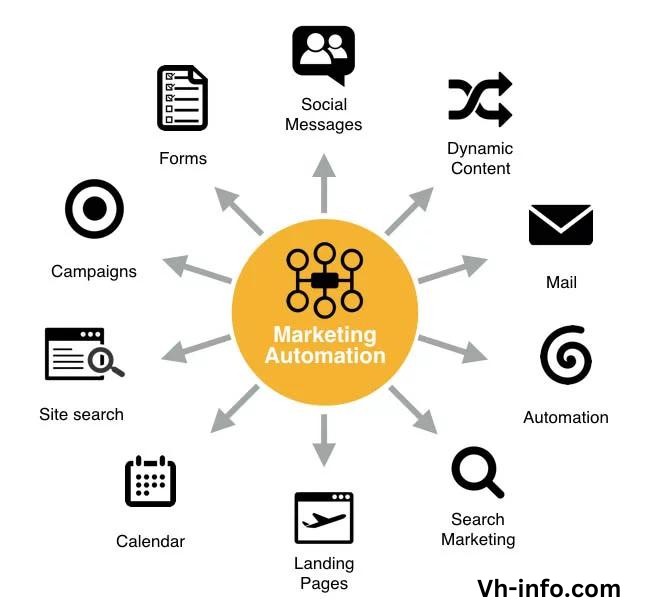
  2. They can teach you how to do it yourself or give you advice regularly.

A Marketing Consultant assists in creating marketing campaigns regularly or for specific tasks. They’ll discuss plans and strategies with you while they’re happening to suggest ways to improve your tactics.

Some marketing consultants also do market research. This means they check out other companies selling similar things. They might look at prices, check company profiles online, or even ask customers about what they need.

FAQ’s:

Who is a Marketing Consultant?

A marketing consultant is like a helpful guide for companies who wants to do better in their marketing.

They’re experts in different parts of marketing, like figuring out what customers want, making the company look good, and using data to make smart decisions.

These consultants look at a company from the outside and make plans to make it better. They help with online stuff, events, making content, and more.

By using their special skills, they make the company’s marketing work better and teach the company how to do it themselves.

Basically, they’re like a supercharger for a company’s marketing, making it way more effective because they know a lot of different things about how to do it right.

How a Marketing Consultant Can Help?

Here are some key ways a marketing consultant can help a business:

  1. Identify Opportunities – By analyzing the market context, company offering and customer needs, the consultant can identify new opportunities to reach and better serve target customer groups. This outside-in perspective provides fresh insights into growth possibilities.
  2. Create Strategic Marketing Plans – The consultant formulates structured marketing strategies spanning key areas including positioning, product mix, pricing, promotion and place backed by market research. This blueprint aligns marketing with wider business goals.
  3. Execute Campaigns – The consultant takes end-to-end ownership across brainstorming compelling ideas, copywriting, project planning, budgeting as well as tactically managing agencies or internal teams to execute integrated marketing campaigns across multiple channels.
  4. Setup Tracking – They institute processes leveraging analytics tools to continually measure campaign effectiveness through defined metrics. This allows for optimization and accountability for return on marketing investment.
  5. Build Marketing Assets – The consultant creates marketing deliverables like brand guidelines, content templates, email workflows, data models and dashboard reporting structures that continue enabling the team over time even after consulting engagement ends.

Is a Marketing Consultant a Good Job?

Yes, marketing consultant can be a highly rewarding career choice. It pays well to start, with average salaries ranging from $80k to $150k, going up to $200k+ for experienced consultants.

More so, it provides the flexibility to specialize, work across interesting industries, take on entrepreneurial projects and progress quickly to leadership roles.

For strategic thinkers who become trusted advisors guiding business success, the constantly evolving nature of marketing also makes it an engaging career full of continuous learning. The ability to see ideas impact growth and empower organizations provides great job satisfaction.

Do You Need Assistance With Marketing Consultancy?

Yes, an experienced marketing consultant can be very helpful for taking your business growth to the next level.

They bring a fresh viewpoint and know-how from different industries, which helps them find new chances and make smart plans using data.

Their work leads to better outcomes from your marketing spending by reaching more people, getting them involved, and turning them into customers.

When you bring in a consultant, it’s like adding rocket fuel to your marketing efforts because they have special skills, concentrate only on marketing tasks, and share their knowledge.

If your business is looking to expand in the market or your team is stretched thin, a consultant can give that extra push for better results.

Conclusion

In conclusion, a marketing consultant plays a crucial role in helping businesses achieve their marketing goals and drive growth.

With a combination of marketing expertise, digital skills, and a deep understanding of consumer behavior, they are able to develop effective strategies and campaigns that resonate with the target audience.

Whether it’s optimizing websites for search engines, creating compelling content, analyzing campaign data, or providing valuable insights and recommendations, a marketing consultant brings a wealth of knowledge and experience to the table.

If you’re looking to take your business to the next level and need guidance from a marketing expert, consider hiring a marketing consultant. They can help you navigate the ever-evolving digital landscape, reach your target audience, and achieve measurable results.

Whether you’re a small business owner or a marketing professional looking to enhance your skills, a marketing consultant can provide valuable assistance and support. Don’t hesitate to reach out and explore the benefits of working with a marketing consultant.

The Ultimate Guide to SaaS Content Marketing

Are you a SaaS business owner or marketer aiming to enhance your content marketing efforts? Great news!

We’ve crafted the ultimate guide to SaaS content marketing just for you.

In this blog, we’ll delve into what SaaS content marketing involves and why it’s essential for your business. You’ll discover its advantages compared to traditional marketing approaches.

Plus, we’ll share successful examples and expert tips to help you create your own effective strategy.

We’ll even address common questions about SaaS content marketing’s impact on customer journeys and suggest top-notch tools for organizing your strategy. Don’t miss out on this comprehensive guide to elevate your SaaS business with powerful content marketing!

If you’re interested in link-building strategies specifically tailored for SaaS companies, VH-Info, a reputable agency in this field, can provide valuable assistance and expertise to further enhance your content marketing initiatives.

What Is SaaS Content Marketing?

What Is SaaS Content Marketing?

SaaS content marketing refers to creating and sharing valuable content to attract and retain users for your software-as-a-service (SaaS) product. It involves publishing blogs, ebooks, videos, and other type of content that educates your target audience on using your SaaS platform to solve their problems. The ultimate goal is to position your micro SaaS as an authority in your space and encourage sign-ups, retention, and effective content distribution for content marketers.

Why Is SaaS Content Marketing Important?

Why Is SaaS Content Marketing Important?

SaaS content marketing is important for several key reasons:

  1. Attracts qualified leads. High-quality, valuable content demonstrates your SaaS company’s expertise and helps attract leads that are more likely to convert to paying customers. Useful content earns trust and establishes credibility.
  2. Drives traffic and conversions. Well-executed content marketing increases website traffic, which provides more opportunities to convert visitors into leads and customers. Things like blogs, ebooks, and webinars give people content they find useful and want to share or link to from other sites.
  3. Enhances SEO and discoverability. Search engines like unique, fresh content. An ongoing stream of blogs, articles, and other content assets makes it more likely your pages will be indexed and ranked well in search engines. This improves visibility and makes it easier for ideal potential buyers to find your SaaS.
  4. Educates the buyer’s journey. From awareness to consideration to decision, good content offers education tailored to each phase of the buyer’s journey. Early on it establishes thought leadership and later helps guide buyers to choosing your SaaS and seeing the value it provides. Good content for a GCSE English tutor aligns with the buyer’s journey, guiding students from awareness to decision and showcasing the value of the tutoring service.
  5. Builds customer retention and loyalty. Existing customers also need ongoing education and communication. A content strategy provides this while demonstrating commitment to the industries and use cases you serve. This strengthens retention and loyalty.

Why Is Content Marketing for SaaS Companies Different?

SaaS content marketing is different from content marketing for non-SaaS companies in a few key ways:

  1. Highly educational focus – SaaS buyers need more education during the evaluation process as they are often buying something technical, intricate, and cannot hold in their hands. So SaaS content must walk through product functionality, integration needs, use cases, etc.
  2. Explaining value over time – The SaaS subscription model is paid for on an ongoing basis, so content must justify ongoing spend and long-term return on investment. This means demonstrating not just immediate value but continually evolving value.
  3. Comparing complex products – SaaS buyers tend to do more product research and compare complex products more rigorously before committing. So SaaS content frequently needs to differentiate against alternatives and directly compare product capabilities.
  4. Guide configuration/setup – Because SaaS solutions can often be complex to implement, content frequently is needed to guide customers on configuration, data migration, integration with other systems, and getting users rolled out successfully.
  5. High adoption focus – Since SaaS solutions rely on ongoing renewals for revenue, there is a heavy focus in content on driving user adoption, training, and guiding customers to get maximal value from the platform.

Benefits of SaaS Content Marketing

Here are some of the key benefits of SaaS content marketing:

  1. Lead generation – Content like blog posts, eBooks, and whitepapers, especially when sourced through a content marketplace, allow you to demonstrate expertise and value to potential customers. This helps convert website visitors into leads.
  2. Lower customer acquisition costs – Quality content attracts and converts leads more cost-effectively than relying solely on paid ads or a sales team. The content does some of the heavy lifting.
  3. Brand building – Consistent, useful content allows you to build awareness and trust in your SaaS product and company. You establish thought leadership in your niche.
  4. SEO value – Search engines reward websites with fresh, updated content. This content can help improve rankings and organic traffic to your site over time.
  5. Customer retention – Existing customers benefit from continued education through your various content assets. This strengthens the relationship and improves customer lifetime value.
  6. Upsells/expansion revenue – Good content helps customers continually see the value in your SaaS, making them more likely to upgrade plans or add on additional capabilities as they’re released.
  7. Competitive differentiation – Your educational content and messaging sets you apart from competitors and demonstrates why customers should choose your solution over alternatives.

Why is content marketing important for SaaS companies?

Content marketing is crucial for SaaS companies for a few key reasons:

  1. Lead generation and nurturing – The SaaS buying process often has a long sales cycle and requires building awareness and trust before a purchase. Ongoing useful content that offers value helps capture, nurture, and qualify leads over time.
  2. Product education – SaaS products tend to be relatively complex or technical compared to some other offerings. Quality content helps educate prospective customers on how the product works, what problems it addresses, proper configuration, use cases, integration requirements etc. This level of education is usually required before a SaaS purchase.
  3. Driving adoption and renewals – Since SaaS relies on ongoing renewals for long-term revenue, content plays a big role in driving user adoption, helping customers gain increasing value from the product over time, and building loyalty – leading to retention and expansion revenue.
  4. SEO visibility – Content marketing gives SaaS companies an opportunity to strengthen SEO and organic visibility. This can be a key channel driving awareness and leads. Ranking well for relevant buyer keywords can pay dividends.
  5. Competitive differentiation – The right content strategy helps SaaS companies stand out from competitors by demonstrating deeper expertise around customer pain points and industry-specific use cases. Becoming a true thought leader via content is powerful.

Partnering with a link building agency such as VH-Info can make a big difference in how well a SaaS company’s content strategy works.

VH-Info helps by getting important links from trusted industry websites to the SaaS company’s top-notch content. This boosts the content’s ranking in search results and helps more people find it.

As a result, the SaaS company attracts more of the right customers to their helpful content, showing expertise and credibility in their field. Combining VH-Info’s services with content marketing can supercharge the benefits, making it even more impactful for SaaS brands.

How to distribute your SaaS content?

How to distribute your SaaS content?

Making sure lots of people see your content is just as important as making the content itself. You should plan how to share your content even before making it.

There are three main ways to share content:

  1. Your own places: These are places that belong to you, like your podcast, blog, email list, and social media accounts. You can post whatever you want there because they’re yours!
  2. Other people’s places: These are places owned by others, like blogs, news sites, forums, and review sites. You can post things there for free, but you don’t own the content.
  3. Paying for places: These are places or people who will share your stuff for money. Sometimes, this can be really good for reaching lots of people, but it’s important to be careful about who you work with so you reach the right audience.

Remember, each place where you share stuff has its own rules and ways of doing things. This means you need to adjust your content to fit each place.

If you do it well, lots of people will see and like your content. But if you don’t think about what each place needs, your content might not get noticed. For instance, long articles won’t work well on Instagram or Twitter, but you can turn them into shorter, easier-to-read graphics. It’s really important to change your content to fit each place’s style and the people who use it, ensuring a great user experience.

How does content marketing help SaaS businesses?

How does content marketing help SaaS businesses?

Here’s a deeper look at how content marketing helps SaaS businesses in 3 key areas – brand, ROI, and customer connection – especially when combined with the services of a link building agency like VH-Info:

Increased Brand Awareness & Authority

Creating a steady stream of educational blogs, ebooks, webinars, and other content establishes a SaaS company as a thought leader in their space. It demonstrates deep understanding of customer pain points. Over time, this builds significant brand awareness and trust in the company’s expertise. However, partnering with VH-Info takes it a big step further by getting existing content placed on and linked from major industry media sites. This massively amplifies reach and cements perception as a top authority.

A Higher ROI Without a Massive Budget

Great content attracts and nurtures leads more cost-effectively than traditional sales and marketing methods alone. Then VH-Info maximizes ROI further through higher-converting organic traffic from SEO rankings and backlinks. The compounding effect is a higher volume of customers without linearly scaling budgets and teams. Execution with precision trumps excessive spend.

A Powerful Connection With Customers

Truly helpful, empathetic content builds an emotional connection and community around a SaaS brand. When customers feel their problems are understood and automated solutions carefully considered, it fosters loyalty. This effect becomes even more scalable when VH-Info pushes SaaS content out to broader, engaged industry audiences through securing backlinks. It grows connection beyond existing channels.

Best SaaS Content Marketing Examples

Best SaaS Content Marketing Examples

Here are some excellent examples of effective content marketing from leading SaaS companies:

  1. HubSpot – Produces a vast amount of marketing, sales, and service content like blogs, ebooks, courses, and videos. Their content strategy fuels their growth and they educate on implementing inbound marketing.
  2. Moz – Well known for data-driven content all about SEO, inbound marketing, and analytics. Moz shares optimization best practices and also uses content to position their software tools as go-to solutions.
  3. Drift – Leverages blogs, videos, podcasts and more on conversational marketing, sales, and business leadership. Their regular streaming and audio content has allowed them to rapidly become a thought leader.
  4. Mailchimp – Email marketing focused content helps attract their target SMB customers. Their blog and guides demonstrate expertise on optimizing campaigns while humanizing their brand.
  5. Slack – Slack uses their blog and social channels to produce bite-sized, engaging content that highlights use cases, tips, and learnings around improving workplace productivity and communication.

Each of these SaaS leaders produce regular, high-quality content that aligns closely with their product solutions and buyer needs.

This is where a link building agency like VH-Info can help take content performance to the next level. By pursuing strategic backlink placements from industry authority sites to this compelling SaaS content, VH-Info makes this content more visible in organic search.

Higher authority backlinks result in improved search rankings and increased qualified organic traffic – amplifying the lead generation and branding power of the content tenfold. VH-Info’s link building specialists essentially get these SaaS companies’ amazing content in front of a lot more of their target audience.

What makes a SaaS content marketing strategy successful?

What makes a SaaS content marketing strategy successful?

Here are the key ingredients for a successful SaaS content marketing strategy, made even more impactful when combined with the services of a link building agency like VH-Info:

  1. Customer-centric – The content should focus squarely on target customer pain points, challenges, and the ways the SaaS solution helps address those specific issues. All content stems from a deep understanding of the ideal buyer.
  2. Educational over promotional – While some content will necessarily discuss product capabilities, the content should aim to truly teach, inform, entertain or inspire. Pure product pitches alone don’t build relationships.
  3. Thought leadership – Position subject matter experts and company leaders as trusted advisors that prospects can rely on. Demonstrate expertise around industry trends and customer needs.
  4. Varied formats – Leverage diverse content types like long-form guides, brief visual content, videos, podcasts, webcasts, one-pagers, blogs, and more. You can even work with a 2D animation studio to make your video content more engaging and dynamic. So, try to integrate different formats in your content marketing. Different formats appeal in different contexts.
  5. Promoted across channels – Make sure content gets visibility. Promote it via email nurturing streams, social media, paid ads, contributor networks, website banners, sales enablement tools and anywhere else it will reach customers.
  6. Aligned to buyer’s journey – Early stage content should build awareness, while later stage content helps guide detailed product evaluation and purchase decisions. Map content to each buyer stage.
  7. Results measured – Analytics should track content engagement across formats and stages of the funnel. Continually optimize based on performance data.

So, VH-Info supercharges a SaaS content marketing strategy by securing high quality backlink placements and dramatically improving search visibility – this compounds all the existing benefits of strategic, customer-focused content creation. The awareness building and lead generation scale massively.

A Step-by-Step Guide to Creating a Killer SaaS Content Marketing Strategy

A Step-by-Step Guide to Creating a Killer SaaS Content Marketing Strategy

Here is a step-by-step guide to creating a killer SaaS content marketing strategy:

  1. Identify Your Target Audience: Start by getting crystal clear on who your ideal customers are. Define their demographics, challenges, and goals. Create detailed buyer personas and user stories to help you really understand what your target audience is looking for. This will inform the types of content you create.
  2. Set Your Content Marketing Goals: Now determine what the goals of your content marketing program will be. Do you want to increase signups? Boost renewals or upsells? Reduce customer churn? Increase search engine traffic? Get more inbound links? Set specific, measurable goals that tie to your revenue objectives.
  3. Audit Your Existing Content: Take a close look at your existing content. Identify strengths and weaknesses. Look for areas to improve and opportunities to repurpose or promote additional content. Use Google Analytics and internal search data to see what content performs best. Something like a content audit is essential.
  4. Map Out Your Content By Buyer Journey Stage: Map out your content to the typical buyer journey from awareness to consideration to decision. Identify gaps in your content where prospects may likely seek information. Determine what types of content will resonate best at each stage and will help move prospects to the next stage.
  5. Develop Compelling Content Pillars & Topics: Determine your core content pillars and topics that align to your business goals and buyer needs. Consider trending topics, commonly asked questions, search volume and competitors. Leverage tools like BuzzSumo and AnswerThePublic to find gaps and opportunities. Develop document types like blogs, ebooks, guides around these topics.
  6. Create a Content Production Schedule: Plan your editorial calendar for the next 12 months. Choose key themes, topics and content types for each month or quarter. Maintain a healthy mix of new thought leadership and repurposed, evergreen content. Aim for a regular cadence, at least 4x new content per month.
  7. Promote and Repurpose Your Content: Amplify your content reach by promoting it across your website, email, social media, and more. Repurpose your content by turning a blog post into a video, podcast, or infographic. For instance, you can use tools like AI text to video to easily transform written content into engaging videos. Additionally, continue optimizing and updating evergreen content to boost its lifespan and effectiveness.
  8. Analyze and Refine Your Efforts: Use Google Analytics, social media statistics, subscriber growth, and sales data to determine your most effective pieces of content. See what converts and engages your audience best. Keep experimenting with new content formats and ideas informed by the data. Continually optimize your content marketing strategy over time.

FAQ’s:

Why does SaaS content marketing work?

Using SaaS content marketing is a great way to steadily promote and sell your SaaS product without relying on paid ads. It helps grow your audience naturally through different marketing channels, including search engine optimization. This strategy focuses on creating content that stays valuable for a long time, making it more popular as days go by. If you’re curious about how a content marketing plan can benefit your SaaS company, let’s talk today with vh-info, the top link-building agency for SaaS businesses specializing in saas marketing, product updates, and the sales funnel.

Can SaaS content marketing affect the customer buyer journey?

SaaS content marketing plays a big role at every stage of the funnel, how customers decide to buy. It helps from the start when people are just looking (TOFU), all the way to when they’re about to decide (MOFU), and even after they’ve chosen (BOFU). By optimizing marketing content for each stage of the marketing funnel, including top, middle, and bottom of the funnel content, it creates a better and more tailored journey for customers, making their experience more personal and complete.

Best tools for SaaS content marketing?

Some of the most helpful tools for executing effective content marketing for SaaS companies include:

  • HubSpot – An all-in-one inbound marketing platform that covers content creation, optimization, analytics, landing pages, social media, email, and more. Very useful for integrated SaaS content strategies.
  • Mailchimp – Great email marketing and automation tool for sending content like guides, blogs, or webinar promos to targeted subscriber lists. Helps turn content into leads.
  • Buffer – Makes scheduling and publishing content across different social channels much easier through one centralized platform.
  • BuzzSumo – Analyze what specific blog content and broader topics within an industry are resonating most across social media. Provides content inspiration.
  • Canva – Easy to use graphic design tool for building infographics, presentations, ebook layouts, social media graphics, and any other visual content, but if you’re looking for more options, there are several best alternatives to Canva that might better suit your specific needs.
  • Semrush – For in-depth keyword research and digging into SEO and content gaps versus competitors. Helps refine content creation.
  • ScreamingFrog – On-page SEO spidering tool that helps analyze technical SEO issues that could limit organic reach and engagement for published content.
  • Google Analytics – Essential for tracking all website content performance data including traffic sources, engagement metrics, funnel conversion rates, etc.

How to organize a content marketing strategy?

To set up a content marketing plan, create a hub where you keep all important info. Use a tool like Slite to store links, guidelines, and research about customers and competitors. This central place helps organize everything crucial for your piece of content strategy, including customer service, online communities, in one spot, making it easier to manage and plan your marketing efforts effectively.

Are you looking to hyper scale and validate your SaaS SEO channel?

Yes, search engine optimization can provide a major leverage point for rapidly scaling a SaaS business. The key is mapping out a data-driven SEO strategy focused on ranking your best content assets for commercial keywords that attract qualified organic traffic. This approach allows you to continually expand visibility and leads through search engines in a scalable, targeted way over time.

I’d highly recommend exploring how VH-Info, a top link building agency, can accelerate your SEO strategy. By securing authoritative backlinks from industry publications to your targeted SaaS content, VH-Info can massively strengthen domain authority signals and accelerate those pages’ rankings for your core SaaS keywords. This compounds organic visibility and lead gen exponentially faster than content creation alone.

I’m happy to audit your site’s technical SEO foundations, analyze content gaps, benchmark against competitors and structure an airtight optimization roadmap that integrates VH-Info’s link building firepower. My goal, whether executed internally or with an agency, is validating SEO/organic search as a high-ROI channel that delivers tangible business impact for SaaS brands. VH-Info can get you there faster.

Conclusion

In conclusion, SaaS content marketing is a powerful approach that can help your business grow and succeed in the competitive market.

By creating valuable and relevant content, you can establish your brand as an authority in your industry, increase brand awareness, and connect with your customers on a deeper level.

Additionally, SaaS content marketing allows you to achieve a higher return on investment without the need for a massive budget.

To create a successful SaaS content marketing strategy, it’s important to understand the unique challenges and opportunities that come with marketing for SaaS companies.

By following a step-by-step guide and using the right tools, you can create a killer content marketing strategy that drives results for your business.
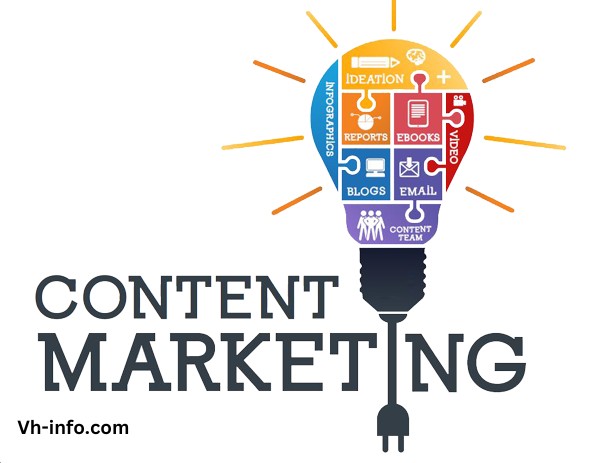
Rise Up Quotes

Life is full of challenges that can test our spirit and resolve. 

Whether you’re facing a personal setback, a professional hurdle, or simply a difficult day, the right words can be a powerful catalyst for change. They remind us of our inherent strength and our capacity to rise above any circumstance.

This collection of rise up quotes is created to serve as your source of strength. 

From timeless wisdom about overcoming adversity to short, punchy phrases that fuel your resilience, let these words be the spark that helps you get back up, stronger than ever before.

Let’s embark on this journey together, harnessing the strength of inspiring quotes and the prowess of strategic link-building to propel your online success.

Rise Up Quotes
Rise Up

Every morning is like a fresh start for us. It’s a chance to chase after our dreams and make the most of the day ahead. Don’t dwell on the past or the things that didn’t work out. Instead, focus on moving forward with determination to show your real strength.

Working towards new goals and dreams is the key to turning failures into successes. From deciding on what we want to achieve to actually reaching those goals, this journey is important.

Well-known people like writers, leaders, actors, and others have said inspiring things about rising after falling down. Their words encourage us to keep trying, even when things get tough, and to keep pushing forward without giving up.

Here below I have given all types of Rise Up Quotes:

Short Rising Up Quotes

Short Rising Up Quotes

Here are some short and impactful quotes about rising up:

  1. “Rise above the storm, and you will find the sunshine.”
  2. “She remembered who she was and the game changed.”
  3. “When life knocks you down, roll over and look at the stars.”
  4. “Stronger than yesterday, weaker than tomorrow.”
  5. “Grow through what you go through.”
  6. “Fall seven times, stand up eight.”
  7. “Stars can’t shine without darkness.”
  8. “Keep your head high, and your heart higher.”
  9. “Resilience is my superpower.”
  10. “Difficult roads often lead to beautiful destinations.”

Encouraging Rise Quotes

Encouraging Rise Quotes

  1. “Some rise by sin, and some by virtue fall.” – William Shakespeare
  2. “Rise and rise again until lambs become lions.” – Robin Hood
  3. “Every fall is a chance to rise.” – Unknown
  4. “What defines us is how well we rise after falling.” – Zig Ziglar                                                             
  5. “We rise in glory as we sink in pride.” – Andrew Young
  6. “To rise from error to truth is rare and beautiful.” – Victor Hugo                                                 
  7. “How can you rise, if you have not burned…” – Hiba Fatima Ahmed
  8. “Burn, if you must. But, rise from the dust.” – Parul Nigam
  9. “No one rises to low expectations.” – Les Brown
  10. “What seems to us as bitter trials are often blessings in disguise.” – Oscar Wilde

Women Rise Up Quotes

Women Rise Up Quotes

Here are some empowering quotes that encourage and celebrate the strength, resilience, and empowerment of women:

  1. “The question isn’t who’s going to let me; it’s who’s going to stop me.” – Ayn Rand
  2. “I am not free while any woman is unfree, even when her shackles are very different from my own.” – Audre Lorde
  3. “A woman is like a tea bag; you never know how strong it is until it’s in hot water.” – Eleanor Roosevelt
  4. “Women are the real architects of society.” – Harriet Beecher Stowe
  5. “Feminism isn’t about making women stronger. Women are already strong. It’s about changing the way the world perceives that strength.” – G.D. Anderson
  6. “The most courageous act is still to think for yourself. Aloud.” – Coco Chanel
  7. “You are more powerful than you know; you are beautiful just as you are.” – Melissa Etheridge
  8. “I am a Woman Phenomenally. Phenomenal Woman, that’s me.” – Maya Angelou
  9. “The most effective way to do it, is to do it.” – Amelia Earhart
  10. “There is no limit to what we, as women, can accomplish.” – Michelle Obama

Rising Quotes in Life

Rising Quotes in Life

Here are some quotes about rising in life, overcoming challenges, and embracing personal growth:

  1. “The only way to do great work is to love what you do. If you haven’t found it yet, keep looking. Don’t settle. As with all matters of the heart, you’ll know when you find it.” – Steve Jobs
  2. “No matter how hard the past is, you can always begin again.” – Buddha
  3. “Life isn’t about waiting for the storm to pass; it’s about learning to dance in the rain.” – Vivian Greene
  4. “Strength does not come from winning. Your struggles develop your strengths. When you go through hardships and decide not to surrender, that is strength.” – Arnold Schwarzenegger
  5. “Success is not final, failure is not fatal: It is the courage to continue that counts.” – Winston Churchill
  6. “The comeback is always stronger than the setback.” – Unknown
  7. “Challenges are what make life interesting, and overcoming them is what makes life meaningful.” – Joshua J. Marine
  8. “Every adversity, every failure, every heartache carries with it the seed of an equal or greater benefit.” – Napoleon Hill
  9. “You may encounter many defeats, but you must not be defeated. In fact, it may be necessary to encounter the defeats, so you can know who you are, what you can rise from, how you can still come out of it.” – Maya Angelou
  10. “Life is not about waiting for the storms to pass but learning to dance in the rain.” – Vivian Greene

Inspirational Quotes to help you Rise and Shine

Inspirational Quotes to help you Rise and Shine

  1. “We do not need magic to change the world, we carry all the power we need inside ourselves already: we have the power to imagine better.” –  J.K. Rowling
  2. “No one can make you feel inferior without your consent.” – Eleanor Roosevelt
  3. “The power you have is to be the best version of yourself you can be, so you can create a better world.” – Ashley Rickards
  4. “When one door of happiness closes, another opens; but often we look so long at the closed door that we do not see the one which has been opened for us.” – Helen Keller
  5. “The most common way people give up their power is by thinking they don’t have any.” – Alice Walker
  6. “If you’re not making mistakes, then you’re not making decisions.” – Catherine Cook
  7. “I choose to make the rest of my life the best of my life.” – Louise Hay
  8. “In the future, there will be no female leaders. There will just be leaders.” –  Sheryl Sandberg
  9. “Passion is energy. Feel the power that comes from focusing on what excites you.”- Oprah Winfrey
  10. “Make the most of yourself by fanning the tiny, inner sparks of possibility into flames of achievement.” – Golda Meir

Best Motivational Quotes to Rising Up Again

Best Motivational Quotes to Rising Up Again

  1. “No matter what life throws at you, declare you will never surrender until you rise up from it.” ― Hiral Nagda
  2. “To fall down is never fatal. Find the force within to rise up.” ― Lailah Gifty Akita
  3. “Once we accept our limits, we go beyond them.” – Albert Einstein
  4. “The way for a young man to rise is to improve himself in every way he can, never suspecting that anybody wishes to hinder him.” – Abraham Lincoln
  5. “Take the high road. People will rise up to join you or fall out of sight.” ― Shannon L. Alder
  6. “Do not judge me by my success. Judge me by how many times I fell down and got back up again.” – Nelson Mandela
  7. “Today if anything is trying to hold you back, give no attention to it. Get your hopes up, get your faith up, look up, and get ready to rise up.” ― Germany Kent
  8. “Everyone can rise above their circumstances and achieve success if they are dedicated to and passionate about what they do.” – Nelson Mandela
  9. “Rise up, chase your dreams.” ― Lailah Gifty Akita
  10. “The turning point in the process of growing up is when you discover the core of strength within you that survives all hurt.” – Max Lerner

Rise above Quotes about the World and Life

Rise above Quotes about the World and Life

  1. “It is best to rise from life as from a banquet, neither thirsty nor drunken.” — Aristotle
  2. “If you will not rise above the things of this world, they will rise above you.” — Hazrat Inayat Khan
  3. “Life is nothing but an occasional burst of laughter rising above the interminable wail of grief.” — Henry Roth
  4. “You ought to know how to rise above the trivialities of life, in which most people are found drowning themselves.” — D.T. Suzuki
  5. “Rise in your mind, in your heart, in your soul and you will rise in your world.” — Matshona Dhliwayo
  6. “You have to trust in something, your gut, destiny, life, karma, whatever. This approach has never let me down, and it has made all the difference in my life.” — Steve Jobs
  7. “Anyone who rises above the things of this world, to which you kneel, is mightier than you.” — Ibn Hazm
  8. “The greatest victory in life is to rise above the material things that we once valued most.” — Muhammad Ali
  9. “To succeed it is necessary to accept the world as it is and rise above it.” — Michael Korda
  10. “Life’s rewards go to those who let their actions rise above their excuses.” — Lee J. Colan

Thought-Provoking Rise above Quotes

Thought-Provoking Rise above Quotes

  1. “It’s when ordinary people rise above the expectations and seize the opportunity that milestones truly are reached.” — Mike Huckabee
  2. “You will never reach higher ground if you are always pushing others down.” — Unknown
  3. “I’m going to always rise above the doubt that may exist about me.” — T.I.
  4. “We can rise above our limitations, only once we recognize them.” — B.K.S. Iyengar
  5. “Truth will rise above falsehood as oil above water.” — Miguel de Cervantes
  6. “Forgiveness does not overlook the deed. It rises above it.” — Pumla Gobodo-Madikizela
  7. “Little minds are tamed and subdued by misfortune, but great minds rise above them.” — Washington Irving
  8. “No sun outlasts its sunset but will rise again and bring the dawn.” — Maya Angelou
  9. “It is always legitimate to wish to rise above one`s self, never above others.” — Julia Ward Howe
  10. “It’s a fine thing to rise above pride, but you must have pride in order to do so.” — Georges Bernanos

Rise above Yourself and Others Quotes

Rise above Yourself and Others Quotes

Here are some quotes that emphasize the importance of rising above oneself and others, focusing on personal growth and transcending limitations:

  1. “To be yourself in a world that is constantly trying to make you something else is the greatest accomplishment.” – Ralph Waldo Emerson
  2. “The only person you should try to be better than is the person you were yesterday.” – Unknown
  3. “You have to believe in yourself when no one else does – that makes you a winner right there.” – Venus Williams
  4. “One who scorns the power of intuition will never rise above the ranks of journeyman calculator.” — Albert Einstein
  5. “No one can make you feel inferior without your consent.” – Eleanor Roosevelt
  6. “It is not our abilities that show what we truly are… it is our choices.” – Dumbledore (Harry Potter series by J.K. Rowling)
  7. “Be yourself; everyone else is already taken.” – Oscar Wilde
  8. “All adverse and depressing influences can be overcome, not by fighting, but by rising above them.” — Charles Caleb Colton
  9. “Imagination gives the man the ability to project himself through time and space and rise above all limitations.” — Charles Fillmore
  10. “Reality is something you rise above.” — Liza Minnelli

Rise above Quotes from Famous People

Here are some quotes about rising above challenges and achieving greatness from various famous individuals:

  1. “The only way to discover the limits of the possible is to go beyond them into the impossible.” – Arthur C. Clarke
  2. “Our greatest glory is not in never falling, but in rising every time we fall.” – Confucius
  3. “Success is not final, failure is not fatal: It is the courage to continue that counts.” – Winston Churchill
  4. “The ultimate measure of a man is not where he stands in moments of comfort and convenience, but where he stands at times of challenge and controversy.” – Martin Luther King Jr.
  5. “I am not a product of my circumstances. I am a product of my decisions.” – Stephen R. Covey
  6. “It is not the mountain we conquer but ourselves.” – Sir Edmund Hillary
  7. “The future belongs to those who believe in the beauty of their dreams.” – Eleanor Roosevelt
  8. “Once we accept our limits, we go beyond them.” — Albert Einstein
  9. “Do not judge me by my success. Judge me by how many times I fell down and got back up again.” — Nelson Mandela
  10. “All the adversity I’ve had in my life, all my troubles and obstacles, have strengthened me…. You may not realize it when it happens, but a kick in the teeth may be the best thing in the world for you.” — Walt Disney

Rise Up Quotes for Overcoming Adversities

Rise Up Quotes for Overcoming Adversities

Here are quotes that specifically focus on rising up and overcoming adversities:

  1. “Life’s challenges are not supposed to paralyze you; they’re supposed to help you discover who you are.” – Bernice Johnson Reagon
  2. “Hard times may have held you down, but they will not last forever. When all is said and done, you will be increased.” – Joel Osteen
  3. “The only way out is through.” – Robert Frost
  4. “Everything negative ― pressure, challenges ― is all an opportunity for me to rise.” – Kobe Bryant
  5. “The darkest hour has only sixty minutes.” – Morris Mandel
  6. “All the adversity I’ve had in my life, all my troubles and obstacles, have strengthened me…. You may not realize it when it happens, but a kick in the teeth may be the best thing in the world for you.” – Walt Disney
  7. “The moment you give up is the moment you let someone else win.” – Kobe Bryant
  8. “Rock bottom became the solid foundation on which I rebuilt my life.” – J.K. Rowling
  9. “The world helps you to keep evolving and hope it’s for the better. You have to rise above all the tragedies in life. You have to grow, and if you stop growing, you are old.” – Hrithik Roshan
  10. “The comeback is always stronger than the setback.” – Unknown

Best Quotes About Fall down and Rise up

Best Quotes About Fall down and Rise up

Here are some powerful quotes that illustrate the essence of falling down and rising up:

  1. “Success is not final, failure is not fatal: It is the courage to continue that counts.” – Winston Churchill
  2. “I can’t change the direction of the wind, but I can adjust my sails to always reach my destination.” – Jimmy Dean
  3. “Do not come into agreement with fear. Activate your faith, live in victory, speak over your life, and expect great things to come your way.” ― Germany Kent
  4. “It’s not whether you get knocked down, it’s whether you get up.” – Vince Lombardi
  5. “Chasing a person doesn’t give you value or build values in you. You earn your value by chasing morality and practicing dignity.” ― Shannon L. Alder
  6. “The comeback is always stronger than the setback.” – Unknown
  7. “Be careful the rise might be the fall” ― Tamerlan Kuzgov
  8. “When life knocks you down, try to land on your back. Because if you can look up, you can get up.” – Les Brown
  9. “Rock bottom became the solid foundation on which I rebuilt my life.” – J.K. Rowling
  10. “You may encounter many defeats, but you must not be defeated.” – Maya Angelou

Best Quotes about Rising up from Failure

Best Quotes about Rising up from Failure

Here are some powerful quotes about rising up from failure:

  1. “With pride, you rise when you conquer the difficulties and become an example of a legacy builder.” ― Hiral Nagda
  2. “The greatest glory in living lies not in never falling, but in rising every time we fall.” – Nelson Mandela
  3. “Wake up for your call no matter how many times you fall; Stand tall and stretch yourself once more. Rise up from the ground, roll the ball and be hopeful you will score!” ― Israelmore Ayivor
  4. “The only real mistake is the one from which we learn nothing.” – Henry Ford
  5. “I have not failed. I’ve just found 10,000 ways that won’t work.” – Thomas A. Edison
  6. “Success is not final, failure is not fatal: It is the courage to continue that counts.” – Winston Churchill
  7. “It’s fine to celebrate success, but it is more important to heed the lessons of failure.” – Bill Gates
  8. “Failure should be our teacher, not our undertaker. Failure is delay, not defeat. It is a temporary detour, not a dead end.” – Denis Waitley
  9. “When you take risks, you learn that there will be times when you succeed and there will be times when you fail, and both are equally important.” – Ellen DeGeneres
  10. “Failure is not the opposite of success; it’s part of success.” – Arianna Huffington

Conclusion

Rising up in the face of challenges is a powerful act of resilience and determination. 

These rise up quotes serve as a reminder that no matter how difficult life may get, there is always the opportunity to overcome adversity and shine. They provide encouragement and inspiration to push through obstacles, embrace personal growth, and strive for greatness. 

Whether you’re seeking motivation to pursue your dreams, rise above external pressures, or simply find strength in tough times, these quotes offer guidance and wisdom from both famous individuals and everyday heroes. 

So, let these thought-provoking rise-above quotes inspire you to rise above yourself and the world around you. Keep pushing forward, grinding, and shining because your journey to success starts with a single step.

Mamba Mentality Quotes

What does a legendary basketball icon have in common with a world-class link building strategy? Everything.

In the highly competitive arena of digital marketing, where every ranking and backlink is hard-won, a simple mindset can be the ultimate differentiator. 

That mindset is the Mamba Mentality. The powerful Mamba Mentality quotes left behind by the legendary Kobe Bryant are more than just motivational phrases; they are a blueprint for relentless improvement, strategic execution, and unwavering resilience.

At VH Info, as a leading provider of SaaS link building services, white label link building services, and SEO for startups, we don’t just admire this ethos—we live it. 

The daily grind of securing high-authority backlinks, navigating algorithm changes, and delivering results for our clients requires the same obsession with greatness that Kobe Bryant brought to the court.

This post isn’t just another list of inspirational quotes. 

We will delve deep into the most impactful Kobe Bryant quotes and translate them into actionable strategies for your digital success. You will learn how to:
  • Embrace the “Hard Work” Quote: Turn challenging outreach campaigns into high-value wins.
  • Apply the “Resilience” Mindset: Use failed link requests and setbacks as data to refine your approach.
  • Channel the “Obsession” Philosophy: Master the fine details of anchor text, domain authority, and content quality.

Join us as we explore how the wisdom of the Black Mamba can transform your approach to link building and help you dominate the digital landscape.

What exactly is the Mamba Mentality?

What Exactly is the Mamba Mentality?

The Mamba Mentality, as described by Kobe Bryant, is more than a catchy phrase—it’s a mindset focused on constant self-improvement and relentless dedication to one’s craft. Inspired by his alter-ego “The Black Mamba,” Kobe embodied this mentality by striving to be better each day than he was the day before, emphasizing the importance of the journey rather than just the end result. It’s a way of life, a commitment to excellence, and a continuous pursuit of being the best version of oneself, applicable not only in basketball but in every aspect of life. Practice and dedication in daily activities build this mentality, making it a natural part of your approach, just like it was for Kobe.

Kobe Bryant Quotes on Mamba Mentality

Kobe Bryant Quotes on Mamba Mentality

  1. “We can always kind of be average and do what’s normal. I’m not in this to do what’s normal.”
  2. “I can’t relate to lazy people. We don’t speak the same language. I don’t understand you. I don’t want to understand you.”
  3. “The moment you give up is the moment you let someone else win.”
  4.  “My approach always was that I’d rather risk embarrassment now than be embarrassed later when I’ve won zero titles.”
  5. “Each moment of my life I was dreaming of how great I could be, and continued working hard. Each time I closed my eyes I could see me shining bright like a sun.”
  6. “To sum up what mamba mentality is, it means to be able to constantly try to be the best version of yourself.”
  7. “I never tried to prove anything to someone else. I wanted to prove something to myself.”
  8. “Everything negative – pressure, challenges – is all an opportunity for me to rise.”
  9. “If you see me in a fight with a bear, pray for the bear.”
  10. “The moment you give up is the moment you let someone else win.”

More Mamba Mentality How I Play Quotes

More Mamba Mentality How I Play Quotes

Kobe Bryant’s “Mamba Mentality: How I Play” book is a collection of his thoughts, insights, and philosophies about basketball and life.

Here are some additional quotes from the book that exemplify his Mamba Mentality:

  1. “If you want to be a better player, you have to prepare, prepare, and prepare some more.”
  2. “The mindset isn’t about seeking a result—it’s more about the process of getting to that result. It’s about the journey and the approach. It’s a way of life.”
  3. “I never tried to prove anything to someone else. I wanted to prove something to myself.”
  4. “I’ll do whatever it takes to win games, whether it’s sitting on a bench waving a towel, handing a cup of water to a teammate, or hitting the game-winning shot.”
  5. “I can’t relate to lazy people. We don’t speak the same language. I don’t understand you. I don’t want to understand you.”
  6. “From the beginning, I wanted to be the best. I had a constant craving, a yearning, to improve and be the best. I never needed any external forces to motivate me.”
  7. “I don’t want to be the next Michael Jordan, I only want to be Kobe Bryant.”
  8. “One thing I learned a lot about is that it’s not the destination, it’s the journey. That’s what makes it fun. It’s not about what you do, but how you do it.”
  9. “It’s a constant quest to try to be better today than I was yesterday.”
  10. “The last dance has a different meaning for me. It’s about leaving it all on the floor. Knowing that you’ve given everything you had to give.”

BEST Kobe Bryant Quotes on Success and Leadership (INSPIRATIONAL)

BEST Kobe Bryant Quotes on Success and Leadership

Kobe Bryant was known for his leadership qualities and motivational insights.

Here are some of his best quotes on success and leadership that continue to inspire many:

  1. “Leadership is lonely. I’m not going to be afraid of confrontation to get us to where we need to go.”
  2. “The most important thing is you must put everybody on notice that you’re here and you are for real.”
  3. “Leadership is responsibility. It’s not about what you say, it’s about what you do.”
  4. “Great things come from hard work and perseverance. No excuses.”
  5. “The moment you give up is the moment you let someone else win.”
  6. “I create my own path. It was straight and narrow. I looked at it this way: you were either in my way, or out of it.”
  7. “Winning takes precedence over all. There’s no gray area. No, almost.”
  8. “The beauty in being blessed with talent is rising above doubters to create a beautiful moment.”
  9. “The important thing is that your teammates have to know you’re pulling for them and you really want them to be successful.”
  10. “I can’t relate to lazy people. We don’t speak the same language. I don’t understand you. I don’t want to understand you.”

Motivational Kobe Bryant’s Quotes on Teamwork and Winning (MAMBA MENTALITY)

Motivational Kobe Bryant's Quotes on Teamwork and Winning

Kobe Bryant’s motivational quotes embody the essence of the Mamba Mentality, fostering teamwork and winning. 

In his top 10 quotes, he emphasizes practice, dreams, and life, illustrating how dedication in basketball and love reflects the Mamba Mentality. His words transcend the game, inspiring a relentless pursuit of excellence in every aspect of life.

Here are some motivational quotes from Kobe Bryant that emphasize teamwork and winning:

  1. “The most important thing is that your teammates have to know you’re pulling for them and you really want them to be successful.”
  2. “I’ll do whatever it takes to win games, whether it’s sitting on a bench waving a towel, handing a cup of water to a teammate, or hitting the game-winning shot.”
  3. “Great things come from hard work and perseverance. No excuses.”
  4. “I’ve played with teammates who, in my opinion, have more talent than I do. But I can count on one hand the number of teammates that I’ve played with that work harder than I do.”
  5. “Trust is built through accountability.”
  6. “It’s not about the number of hours you practice, it’s about the number of hours your mind is present during the practice.”
  7. “It’s a team game, but it’s about having that mentality to go out there and win. Every single day.”
  8. “The important thing is that you have a faith in people, that they’re basically good and smart, and if you give them tools, they’ll do wonderful things with them.”
  9. “You always have to be on edge. You always have to take every practice, every game, like it is your last.”
  10. “We don’t quit. We don’t cower. We don’t run. We endure and conquer.”

Mamba Mentality Quotes about Working Hard and Making Sacrifices

Mamba Mentality Quotes about Working Hard and Making Sacrifices

Kobe Bryant’s Mamba Mentality was deeply rooted in hard work, dedication, and making sacrifices to achieve success.

Here are some quotes that reflect his perspective on working hard and making sacrifices:

  1. “I have nothing in common with lazy people who blame others for their lack of success. Great things come from hard work and perseverance. No excuses.”
  2. “It’s the one thing you can control. You are responsible for how people remember you—or don’t. So don’t take it lightly.”
  3. “Use your success, wealth, and influence to put them in the best position to realize their own dreams and find their true purpose.”
  4. “I’ll do whatever it takes to win games, whether it’s sitting on a bench waving a towel, handing a cup of water to a teammate, or hitting the game-winning shot.”
  5. “I’ll do whatever it takes to be the best basketball player I can be. Whether it’s sitting on a bench waving a towel, handing a cup of water to a teammate, or hitting the game-winning shot.”
  6. “The important thing is that your teammates have to know you’re pulling for them and you really want them to be successful.”
  7. “I can’t relate to lazy people. We don’t speak the same language. I don’t understand you. I don’t want to understand you.”
  8. “If you’re afraid to fail, then you’re probably going to fail.”
  9. “The moment you give up is the moment you let someone else win.”
  10. “My brain cannot process failure. It will not process failure. Because if I have to sit there and face myself and tell myself, ‘You’re a failure,’ I think that’s a worse, that’s almost worse than death.”

Mamba Mentality Quotes about Greatness and Being the Best

Mamba Mentality Quotes about Greatness and Being the Best

Kobe Bryant’s Mamba Mentality was synonymous with striving for greatness and being the best. 

Here are some quotes from Kobe Bryant that encapsulate his mindset about greatness and pursuing excellence:

  1. “I’ll do whatever it takes to be the best basketball player I can be. Whether it’s sitting on a bench waving a towel, handing a cup of water to a teammate, or hitting the game-winning shot.”
  2. “The important thing is that your teammates have to know you’re pulling for them and you really want them to be successful.”
  3. “I have nothing in common with lazy people who blame others for their lack of success. Great things come from hard work and perseverance. No excuses.”
  4. “The moment you give up is the moment you let someone else win.”
  5. “I can’t relate to lazy people. We don’t speak the same language. I don’t understand you. I don’t want to understand you.”
  6. “I’ll do whatever it takes to win games, whether it’s sitting on a bench waving a towel, handing a cup of water to a teammate, or hitting the game-winning shot.”
  7. “I create my own path. It was straight and narrow. I looked at it this way: you were either in my way, or out of it.”
  8. “I realized that intimidation didn’t really exist if you’re in the right frame of mind.”
  9. “The mindset isn’t about seeking a result—it’s more about the process of getting to that result. It’s about the journey and the approach. It’s a way of life.”
  10. “Winning takes precedence over all. There’s no gray area. No, almost.”

Mamba Mentality Quotes about Coaches and Players

Mamba Mentality Quotes about Coaches and Players

Kobe Bryant often emphasized the importance of coaches, mentors, and teammates in achieving success. 

Here are some quotes from Kobe Bryant about coaches and players that reflect his Mamba Mentality:

  1. “The most important thing is that your teammates have to know you’re pulling for them and you really want them to be successful.”
  2. “Leadership is responsibility. It’s not about what you say, it’s about what you do.”
  3. “The important thing is that your teammates have to know you’re pulling for them and you really want them to be successful.”
  4. “It’s the one thing you can control. You are responsible for how people remember you—or don’t. So don’t take it lightly.”
  5. “I’ll do whatever it takes to win games, whether it’s sitting on a bench waving a towel, handing a cup of water to a teammate, or hitting the game-winning shot.”
  6. “Trust is built through accountability.”
  7. “The last dance has a different meaning for me. It’s about leaving it all on the floor. Knowing that you’ve given everything you had to give.”
  8. “Use your success, wealth, and influence to put them in the best position to realize their own dreams and find their true purpose.”
  9. “I’ve played with teammates who, in my opinion, have more talent than I do. But I can count on one hand the number of teammates that I’ve played with that work harder than I do.”
  10. “The important thing is to try and inspire people so that they can be great in whatever they want to do.”

What did you Learn from these Mamba Mentality Quotes?

The Mamba Mentality Quotes from Kobe Bryant provide invaluable wisdom for how to succeed through sheer determination. One major takeaway is that we should adopt an unrelenting grind pushing us to work harder than anyone else. Kobe emphasized the importance of an obsessive commitment to perfecting your craft and out-preparing the competition. He lived the mindset that slacking off or coasting even for a moment means falling behind. Another core lesson is learning to push through any pain or adversity without letting up or making excuses.

The Mamba Mentality means not just wanting to win, but needing to win at all costs. It is an intense killer instinct combined with laser focus on your goals. Final key aspects are competitiveness with yourself to keep improving, while also maintaining confidence in your abilities no matter what anyone else says. Embracing all these principles can help unlock our true greatness. When we apply such self-belief paired with tireless effort, Kobe showed nothing is impossible.
Sure, from these quotes about the Mamba Mentality, it’s clear that Kobe Bryant’s way of thinking was about more than just working hard. He showed that facing challenges with determination and not giving up, whether in basketball or in life, is crucial. 

Kobe’s “Black Mamba” attitude wasn’t just about dominating on the basketball court; it was also about dealing with difficulties in his personal life. He taught us that being strong when things get tough and not being afraid to take risks is important. 

He worked really, really hard and was super focused, which is what the Mamba Mentality is all about. It’s not just about wanting something; it’s about having a real passion for it, just like Kobe had for basketball.

Conclusion

The Mamba Mentality is a mindset that embodies dedication, hard work, and a relentless pursuit of excellence. 

Through the quotes shared in this blog, we have gained insight into Kobe Bryant’s unwavering commitment to success, leadership, teamwork, and personal growth

These quotes serve as powerful reminders of the importance of pushing ourselves beyond our limits and embracing challenges in order to achieve greatness.

By embodying the Mamba Mentality in our own lives, we can strive for excellence in everything we do.

So let these quotes inspire and motivate you to work hard, make sacrifices, and become the best version of yourself.

Quotes About Focusing On Yourself

As VH Info, we understand the challenges of navigating a world that constantly pulls our attention. That’s why we’re passionate about empowering individuals through our SaaS link building services, White label Link building services and SEO For Startups allowing them to focus on what truly matters.

In a world filled with constant notifications, endless social feeds, and the pressure to keep up, do you ever feel like you’re losing track of your own path? It’s easy to get lost in the noise and focus on everything and everyone but yourself. That’s why taking a step back to concentrate on your own growth isn’t just a luxury—it’s essential for your well-being.

If you’re searching for powerful quotes about focusing on yourself, you’ve found the perfect place to recharge. This collection is a dedicated resource to help you shift your energy inward and rediscover your personal power.

In this post, you will find:

  • A wide array of positive focus on yourself quotes to inspire motivation and self-love.
  • A section of quotes about focusing on yourself instead of others to help you tune out distractions and comparisons.
  • Many focus on yourself quotes short and memorable, ideal for daily affirmations or a quick boost of confidence.
  • A selection of short quotes about myself that you can use as personal mantras on your journey of self-discovery.

Let these words be a beacon, guiding you back to your goals, your peace, and your progress. It’s time to invest in you.

Short Quotes About Focusing on Yourself

Short Quotes About Focusing on Yourself

Let’s keep the momentum going with some more quick and impactful quotes that encourage focusing on yourself.

  1. “Focus on yourself. No one can do it better.” ~ Unknown
  2. “It is never too late to be what you might have been.” ~ George Elliot
  3. “Focus on you until the focus is on you.” ~ Unknown
  4. “You have your own life, why waste it focusing on others.” ~ Nitin Namdeo
  5. “The successful warrior is the average man, with laser-like focus.” ~ Bruce Lee
  6. “You’ve sacrificed too much for others. Now do the same for yourself.” ~ Mitta Xinindlu
  7. “You are never too old to reinvent yourself.” ~ Steve Harvey quote
  8. “What lies behind us and what lies before us are tiny matters compared to what lies within us.” ~ Ralph Waldo Emerson
  9. “When you say ‘yes’ to others make sure you are not saying ‘no’ to yourself.” ~ Paulo Coehlo
  10. “Always remember, your focus determines your reality.” ~ George Lucas

Inspirational Focus on Yourself Quotes

Inspirational Focus on Yourself Quotes

Each person has their own journey and things they do that matter in life. Sometimes, things happen that make you feel down, but remember, you have the ability to look inside yourself and concentrate on what really matters to you.

Here are some great quotes that can motivate you to follow your dreams.

  1. “Don’t focus on the competition, focus on ways to make yourself better.” – Hopal Green
  2. “I am the only person in the world I should like to know thoroughly.” – Oscar Wilde3
  3. “I learned that focus is key. Not just in your running a company, but in your personal life as well.” – Tim Cook
  4. “Life isn’t about finding yourself. Life is about creating yourself.” – George Bernard Shaw
  5. “Your life is controlled by what you focus on.” – Tony Robbins
  6. “Until you value yourself, you won’t value your time. Until you value your time, you will not do anything with it.” – M. Scott Peck
  7. “The best way to predict your future is to create it.” – Abraham Lincoln
  8. “The more you are like yourself, the less you are like anyone else, which makes you unique.” – Walt Disney
  9. “Always remember, your focus determines your reality.” – George Lucas
  10. “I think everybody’s weird. We should all celebrate our individuality and not be embarrassed or ashamed of it.” – Johnny Depp

Motivational Focus on Yourself Quotes

Motivational Focus on Yourself Quotes

Motivational quotes about focusing on yourself encourage individuals to prioritize personal growth, self-improvement, and well-being.

These quotes emphasize the importance of introspection, self-care, and staying true to your goals and aspirations amidst distractions or external pressures.

They serve as reminders to invest time and energy into one’s own development, acknowledging that by nurturing oneself, individuals can achieve greater fulfillment, success, and a more balanced life.

  1. “I learned long ago to focus on things you can control and don’t even pay attention to things you don’t.” – Bryan Cranston
  2. “Real change will come when you focus on yourself.” – Ritu Ghatourey
  3. “Good things happen when you narrow your focus.” – Al Ries
  4. “Knowing others is wisdom, knowing yourself is Enlightenment.” – Lao Tzu
  5. “Your life is the fruit of your own doing. You have no one to blame but yourself.” – Joseph Campbell
  6. “I’d rather have the whole world against me than my own soul.” – Dr. John
  7. “Friendship with one’s self is all important, because without it one can not be friends with anyone else in the world.” – Eleanor Roosevelt
  8. “For the moment I’m just focusing on my own stuff.” – Cheryl James
  9. “The difference between the impossible and the possible lies in a man’s determination.” – Tommy Lasorda
  10. “Always putting others first creates deep resentment, destroys your happiness, and is unsustainable.” – Aziz Gazipura

Self-Love & Self-Care Quotes About Focusing On Yourself

Self-Love & Self-Care Quotes About Focusing On Yourself

Self-love and self-care quotes centered on focusing on yourself highlight the significance of nurturing a positive relationship with oneself. These quotes emphasize the importance of self-compassion, acceptance, and taking intentional steps to prioritize mental, emotional, and physical well-being. They encourage individuals to engage in self-care practices, set boundaries, and prioritize their needs, recognizing that by cultivating self-love and prioritizing self-care, one can lead a more fulfilling and balanced life, ultimately enhancing their ability to care for others and navigate life’s challenges more effectively.

  1. “You, yourself, as much as anybody in the entire universe, deserve your love and affection.” – Buddha
  2. “When you focus on yourself, and love yourself, some relationships have to go.” ~ Adrian Michael
  3. “No one can make you feel inferior without your own consent.” – Eleanor Roosevelt
  4. “Focus on your opinion of yourself and not the opinion others have of you.” – Winnie Harlow
  5. “I keep myself motivated by attempting to control three areas of my life; focus, confidence, and direction.” ~ Anya Graham
  6. “Success is liking yourself, liking what you do, and liking how you do it.” ~ Maya Angelou
  7. “Your greatest responsibility is to love yourself and to know you are enough.” ~ Unknown
  8. “Don’t sacrifice yourself too much, because if you sacrifice too much there’s nothing else you can give, and nobody will care for you.” – Karl Lagerfeld
  9. “Genuine relationships depend first on healthy relationships with ourselves.” – Sonia Choquette
  10. “To fall in love with yourself is the first secret to happiness.” – Robert Morley

Positive Focus on Yourself Quotes for Personal Growth

Positive Focus on Yourself Quotes for Personal Growth

Quotes about focusing on yourself for personal growth inspire individuals to invest in their self-development, encouraging introspection and intentional actions toward growth. These quotes emphasize the importance of self-reflection, continuous learning, and stepping out of comfort zones to achieve personal goals. They remind us that by prioritizing self-improvement and embracing opportunities for growth, individuals can unlock their full potential, enhance skills, and evolve into the best version of themselves.

  1. “When you undervalue what you do, the world will undervalue who you are.” – Oprah Winfrey
  2. “Success is liking yourself, liking what you do, and liking how you do it.” ~ Maya Angelou
  3. “Focus on your opinion of yourself and not the opinion others have of you.” ~ Winnie Harlow
  4. “Your greatest responsibility is to love yourself and to know you are enough.” ~ Unknown
  5. “Do not have an attitude, open yourself and focus yourself and express yourself. Reject external form that fails to express external reality.” ~ Bruce Lee
  6. “The earlier you learn that you should focus on what you have, and not obsess about what you don’t have, the happier you will be.” ~ Amy Poehler
  7. “When you focus on yourself, you create more self-worth.” ~ Nitin Namdeo
  8. “Love yourself first and everything else really falls into place. You really have to love yourself to get anything done in this world.” ~ Lucille Ball
  9. “The best day of your life is the one on which you decide your life is your own. No apologies or excuses. No one to lean on, rely on, or blame. The gift is yours – it is an amazing journey – and you alone are responsible for the quality of it. This is the day your life really begins.” ~ Bob Moawad
  10. “I believe the only thing that we really have control over is our attitude. If we focus on the positive things in our lives and learn how to cope with all the surprises, we will be happier people.” ~ Brandon Jenner

Focus on Yourself Quotes to Inspire Your Self-Empowerment

Focus on Yourself Quotes to Inspire Your Self-Empowerment

Quotes on focusing on yourself for self-empowerment serve as powerful, succinct reminders of personal agency and inner strength, often shared across platforms like Instagram and Pinterest. 

These short, deep, and positive quotes highlight the significance of self-reliance, confidence, and resilience. 

They emphasize self-love and encourage individuals to prioritize their own journey without comparison to others, embodying the essence of focusing on oneself for personal growth. 

These quotes convey the meaning of self-empowerment, inspiring individuals to believe in their abilities, set goals, and take decisive actions to shape their destinies with determination and empowerment.

  1. “Focus on yourself — do what you want, when you want, without having to consider anyone else’s agenda.” – Lauren Weisberger
  2. “It doesn’t matter what others think. This is about YOU. Create a life that you genuinely love with your whole heart and start with yourself.” – Brittany Burgunder
  3. “If you want to succeed focus on changing yourself, not others.” – Unknown
  4. “Often we look so long at the closed door that we do not see the one that has been opened for us.” – Helen Keller
  5. “You have to focus on yourself, feel as good as you can, and make your relationship with yourself a priority. When you do that, everything else will fall into place.” – Elizabeth Daniels
  6. “The more you are like yourself, the less you are like anyone else, which makes you unique.” – Walt Disney
  7. “If you don’t separate yourself from your distractions, your distractions will separate you from your goals.” – Unknown
  8. “Whatever you are, be a good one.” – Abraham Lincoln
  9. “Be the change that you wish to see in the world.” – Mahatma Gandhi
  10. “No one can make you feel inferior without your own consent.” – Eleanor Roosevelt

Quotes About Focusing on Yourself Instead of Others

Quotes About Focusing on Yourself Instead of Others

Quotes emphasizing focusing on yourself and not others stress the importance of self-directed growth and introspection.

These positive and deep quotes encourage individuals to prioritize their own journey, goals, and well-being rather than constantly comparing themselves or seeking validation from others on platforms like Instagram and Pinterest. 

They underscore the significance of self-awareness, self-acceptance, and personal development, reminding us that true fulfillment comes from within, independent of external judgments or expectations. 

Embracing self-love, these quotes inspire individuals to focus inwardly, embracing their uniqueness and pursuing their paths without being overly influenced by external opinions or comparisons to others, encouraging a mindset where the focus remains on personal growth and self-discovery.

Here are some quotes that emphasize the importance of focusing on yourself rather than on others:

  1. “Don’t let the noise of others’ opinions drown out your own inner voice.” – Steve Jobs
  2. “The only person you should try to be better than is the person you were yesterday.” – Unknown
  3. “You owe yourself the love that you so freely give to other people.” – Unknown
  4. “Your life is yours alone. Rise up and live it.” – Terry Goodkind
  5. “Don’t be distracted by criticism. Remember, the only taste of success some people get is to take a bite out of you.” – Zig Ziglar
  6. “Focus on your own happiness, focus on your own life, and do what you need to do in order to get where you need to be.” – Unknown
  7. “Comparison is the thief of joy.” – Theodore Roosevelt
  8. “Stop looking for happiness in the same place you lost it.” – Unknown
  9. “The moment you stop caring about what other people think is the moment you start being yourself.” – Unknown
  10. “Your time and energy are limited. Focus on what matters most and let go of what doesn’t.” – Unknown

Wise Focus on Yourself Quotes

Wise Focus on Yourself Quotes

The instagram reminders to positive inner growth before trying to please others with short inspiration for self-reflection so we can find meaning without getting caught up in unnecessary drama. The deep prompts to reveal our true notions encourages us to set boundaries and not compromise our well-being to meet expectations. It’s about tuning out the noise to connect with our inner wisdom and carefully tending to our personal and fulfillment. Ultimately, the call to self and not others is a wise that you must secure your own mask first before assisting others.

Here are some wise quotes that emphasize the importance of focusing on yourself:

  1. “The most powerful relationship you will ever have is the relationship with yourself.” – Steve Maraboli
  2. “Nourishing yourself in a way that helps you blossom in the direction you want to go is attainable, and you are worth the effort.” – Deborah Day
  3. “Invest in the development of your own character. The better you become, the better everything in your life will become.” – Brian Tracy
  4. “Your relationship with yourself sets the tone for every other relationship you have.” – Robert Holden
  5. “Fall in love with taking care of yourself. Mind. Body. Spirit.” – Unknown
  6. “The most important investment you can make is in yourself.” – Warren Buffett
  7. “The better you feel about yourself, the less you feel the need to show off.” – Robert Hand
  8. “Make yourself a priority. At the end of the day, you’re your longest commitment.” – Unknown
  9. “When you start taking care of yourself, you start feeling better, you start looking better, and you start to attract better. It all starts with you.” – Unknown
  10. “Self-care is not selfish. You cannot serve from an empty vessel.” – Eleanor Brownn

Best Focusing on Myself Quotes

Best Focusing on Myself Quotes

Thinking about yourself is really important. It lets you push away unimportant thoughts and pay attention to what matters. Take a look at these awesome quotes about focusing on yourself—they’ll help you stay clear-minded and not get distracted or confused by others.

Here are some empowering quotes specifically centered around focusing on yourself:

  1. “You yourself, as much as anybody in the entire universe, deserve your love and affection.” – Buddha
  2. “Focusing on yourself isn’t selfish. It’s self-preservation.” – Unknown
  3. “The only person you should try to be better than is the person you were yesterday.” – Unknown
  4. “Your time is limited, so don’t waste it living someone else’s life.” – Steve Jobs
  5. “Do something today that your future self will thank you for.” – Unknown
  6. “Your relationship with yourself sets the tone for every other relationship you have.” – Unknown
  7. “Make yourself a priority once in a while. It’s not selfish, it’s necessary.” – Unknown
  8. “Put yourself at the top of your to-do list every single day and the rest will fall into place.” – Unknown
  9. “Don’t wait for others to validate what you feel or do. Your truth comes from within; your validation comes from you.” – Unknown
  10. “Taking care of yourself doesn’t mean me first; it means me too.” – L.R. Knost

Positive Focus on Yourself Quotes

Positive Focus on Yourself Quotes

Positive focus on yourself quotes aim to inspire self-confidence, self-compassion, and self-improvement. These quotes uplift individuals by highlighting the importance of self-belief, self-love, and embracing one’s strengths and uniqueness. 

They encourage a mindset that values personal growth, resilience, and the pursuit of happiness by focusing on one’s own journey and potential, fostering a positive outlook on self-discovery and empowerment.

  1. “When you undervalue what you do, the world will undervalue who you are.” – Oprah Winfrey
  2. “We must not allow other people’s limited perceptions to define us.” – Virginia Satir
  3. “Only through focus can you do world-class things, no matter how capable you are.” – Bill Gates
  4. “Don’t wait for good things to happen to you. If you go out and make some good things, then it happens to you.” – Barack Obama
  5. “Be patient with yourself. Self-growth is tender; it’s holy ground. There’s no greater investment.” – Stephen Covey
  6. “You were born to be real, not to be perfect.” – Ralph Marston
  7. “Self-belief and hard work will always earn you success.” – Virat Kohli
  8. “Why should we worry about what others think of us, do we have more confidence in their opinions than we do our own?” – Brigham Young
  9. “Never say never because limits, like fears, are often just an illusion.” – Michael Jordan
  10. “Focus on doing the right things instead of a bunch of things.” – Mike Krieger

FAQ’s:

Why Do You Need to Focus on Yourself?

Focusing on yourself allows you to get to know who you truly are as a person. This self-awareness and self-care helps you pursue things that enrich your life and bring you purpose and meaning.

How Can I Focus On Myself Only?

Make time each day to do something just for you – whether it’s reading, exercising, journaling, or pursuing a hobby. Set boundaries with others when needed to protect this “me time.” Stay present during this time by silencing electronics and quieting your thoughts through meditation.

How Can I Improve Myself?

Identify areas in your life you’d like to work on – may be developing a new skill, breaking a bad habit, or improving relationships. Set realistic, measurable goals and break them down into small, manageable steps. Replace negative self-talk with kind affirmations. Regularly celebrate progress to stay motivated.

How Do You Love Yourself?

Accept yourself as you are – flaws and all – rather than being self-critical. Meet your own emotional needs through self-care activities like exercise, nourishing food, and relaxing bubble baths. Keep a gratitude journal to recognize the wonderful qualities you possess. Speak to yourself with the same kindness and respect you would a close friend.

Conclusion

Focusing on yourself is not selfish; it is an essential aspect of personal growth and self-care. 

By prioritizing your own needs, goals, and well-being, you can cultivate a stronger sense of self, improve your mental and emotional health, and ultimately lead a more fulfilling life. 

Embracing self-love and practicing self-care are crucial steps in this journey. Remember, it is okay to put yourself first and set boundaries with others. 

As you focus on yourself, you will discover new strengths, passions, and opportunities for personal development. 

So take the time to invest in yourself, nurture your own happiness, and watch as your life transforms for the better.