

A store owner publishes twenty blog posts in six months. Traffic to the blog grows every week. But her category pages, the ones that actually sell, still sit on page three of Google, and sales barely move. Her e-commerce SEO brings traffic, just not where it counts.
This happens to a lot of e-commerce websites. E-commerce SEO matters for stores, but only if the right pages rank.
Similarweb’s 2025 benchmark found that organic search brings in about 23.6% of e-commerce traffic, second only to direct visits. The question is which pages that traffic lands on.
That’s the real choice between links and content marketing for an online store. In this e-commerce SEO guide, you’ll see what each one does for a store, how they work together, and which to prioritize at each stage.
You’ll also get a 90-day playbook and a realistic timeline. Both strategies are covered only from a store owner’s point of view.
TL;DR
In e-commerce SEO, content helps stores win early research searches, like “how to choose running shoes”.
Links help category and product pages rank for buying searches, like “buy running shoes online”.
Category pages rarely earn links on their own, so they need content and outreach to get them. Supplier and brand listings are often the easiest links for ecommerce SEO.
New stores should lean on content first, then shift toward links as they grow.
The best results come from content that earns links, plus internal links that pass that value to the pages that sell.
Most stores see category pages move within two to six months, depending on competition.
What Do Links and Content Do for an Online Store?
In e-commerce SEO, links and content do two different jobs. Links come from other websites and tell Google your pages are trusted. Content lives on your own site and answers the questions shoppers ask before they buy. Below is what each one does, and why stores need both.
1. What Links Do for a Store
Links are what help your money pages rank for buying searches. Your category pages need high-quality backlinks to compete, but they rarely earn them on their own. Few bloggers link to a page that just lists products for sale, which is the core challenge of e-commerce link building.
2. What Content Does for a Store
Good SEO content for e-commerce brings in shoppers who are still researching, like someone reading a sizing guide. It also gives other sites a real reason to link to you. That’s why ecommerce link building usually starts with a guide, tool or comparison worth linking to.
3. Why Stores Need Both
Links without content have nothing useful to point at, and content without links struggles to rank. The best results come when your guides earn links and pass that value to your category pages. When link building and content marketing are planned together, each one makes the other work harder.
Not sure if your store needs links or content?
Book a quick call. We’ll check your category pages and show you what’s holding them back.
How Do Links and Content Work Together in a Store?
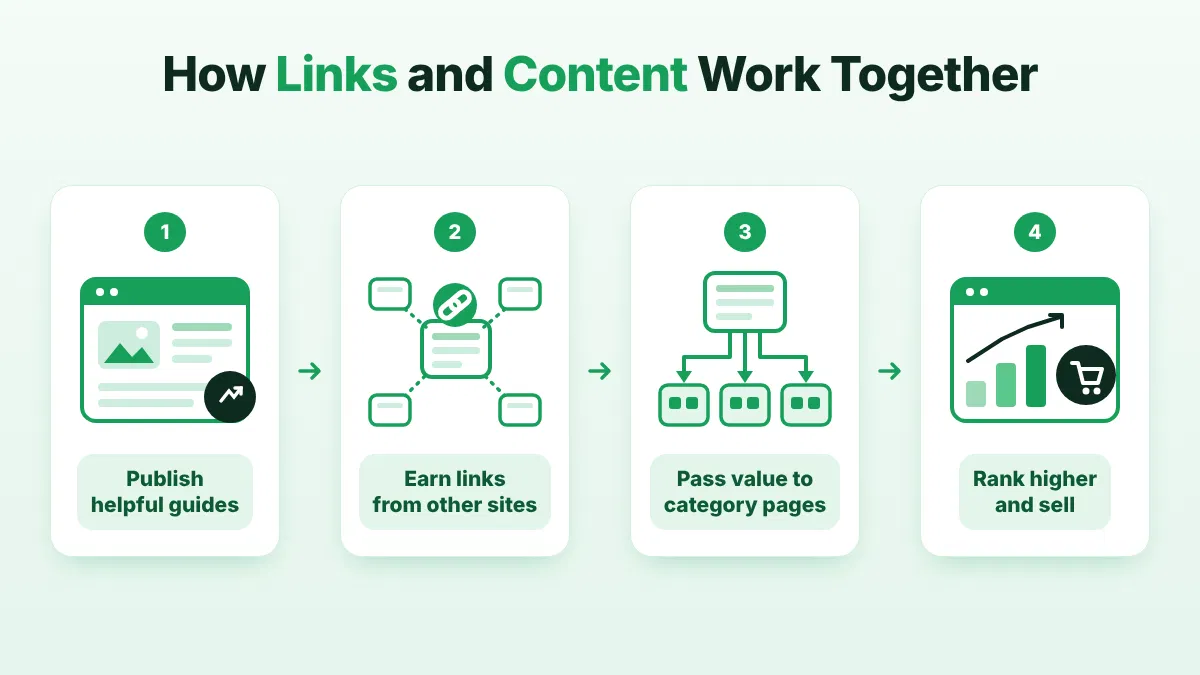
In e-commerce SEO, links and content follow a simple path from a helpful page to a sale. Content brings people and links in, and internal links carry that value to the pages that sell. Below are the main stages that turn one good guide into higher-ranking category pages.
1. You Publish Content Shoppers Need
Strong e-commerce SEO starts with a page that answers a real buying question, like a sizing guide or a “how to choose” post. This page brings in shoppers who are still researching. It also gives other sites a reason to link to you.
2. Other Sites Link to That Content
Bloggers, niche sites and journalists are happy to link to useful guides. They’re much less willing to link to a sales page. These links help your content improve their rankings and build your site’s overall authority.
3. Internal Links Pass Value to Categories
Each guide links to the category pages it talks about. This passes some of the guide’s authority to the pages that sell. It also sends ready-to-buy readers straight to your products.
4. Category Pages Rank and Sell
With more authority behind them, category pages start moving up for buying searches. By improving search engine rankings on these pages, you reach shoppers at the moment they’re ready to buy.
Why Does This Choice Matter More for Online Stores?
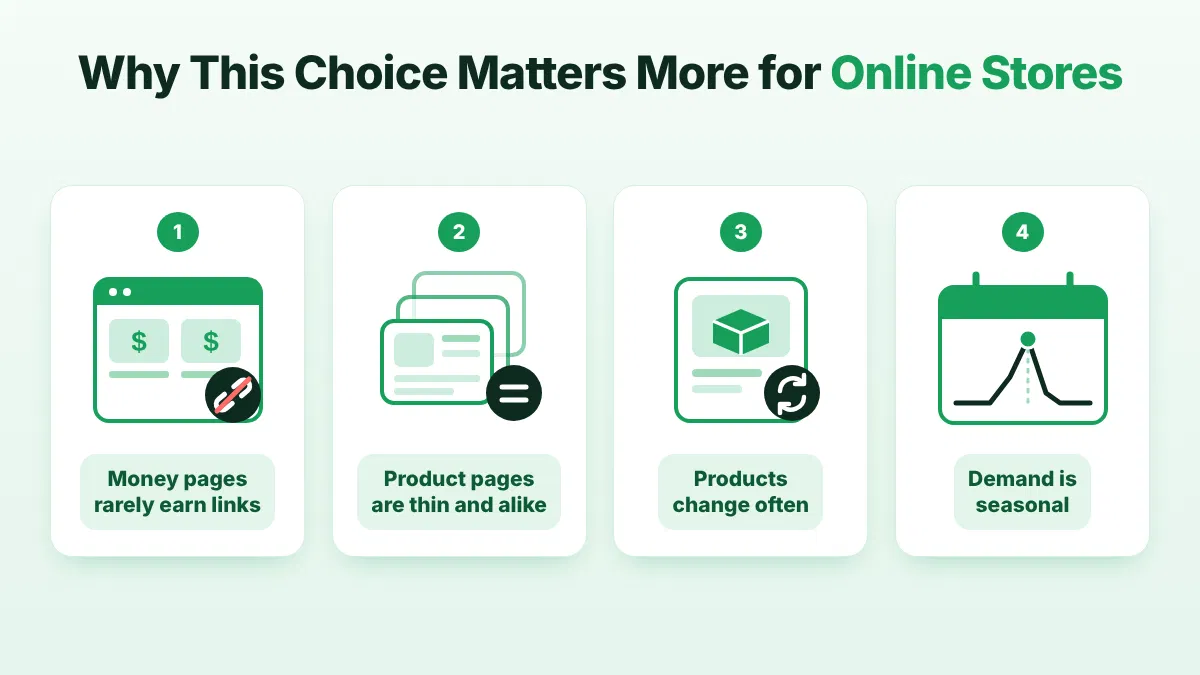
E-commerce SEO comes with problems that most other websites don’t face. These problems change how you should use links and content, and which pages each one should serve. Below are the four that matter most.
1. Money Pages Rarely Earn Links
Nobody links to a category page called “Women’s Sneakers” just because it exists. Bloggers link to guides, research and tools, not to pages built to sell. So your most valuable pages need an e-commerce SEO plan to get links.
2. Product Pages Are Thin and Similar
Many stores use the manufacturer’s product description. That means hundreds of sites share the same text. Without extra content, it’s hard for any of these pages to stand out.
3. Products Change Often
Items go out of stock, get discontinued or move to new URLs. A link pointing at a single product page can lose its value overnight. That’s why the usual link-building strategies for e-commerce focus on pages that last.
4. Demand Is Seasonal
Searches for gifts, sales and seasonal products spike for only a few weeks. Pages need authority before the peak, not during it. This timing is one more reason link building is an important part of store SEO, not an optional extra.
Links or Content: The Two Approaches for Stores
Most e-commerce SEO plans lean toward one approach, even if they use both. You can focus on earning links to your key pages, or on building content that attracts shoppers and links over time. Below is a side-by-side comparison, followed by a closer look at each option.
| Factor | Focusing on Links | Focusing on Content |
|---|---|---|
| Pages it helps most | Category pages and homepage | Guides, blog posts and product pages |
| Type of searches | Buying searches, like “buy hiking boots” | Research searches, like “best hiking boots for beginners” |
| Time and effort | Steady outreach every month | Writing and updating pages |
| Cost | Rises with competition | Lower to start, mostly writing time |
| Speed of results | 2 to 4 months for category pages | 3 to 6 months for guides |
| Best for | Growing and established stores | New stores and small budgets |
Approach 1: Focusing on Links
This approach puts outreach first. You earn links from blogs, roundups and supplier sites, and point them at the pages that sell. It’s the faster way to move category pages, and a key part of any serious SEO strategy for a store.
Approach 2: Focusing on Content
This approach puts your own pages first. You build guides, comparisons and better category copy that bring in shoppers and natural links. It’s slower, but cheaper to start and keeps working for years. Both are effective strategies when they match the gap your store actually has.
Core Link Strategies for E-commerce Stores
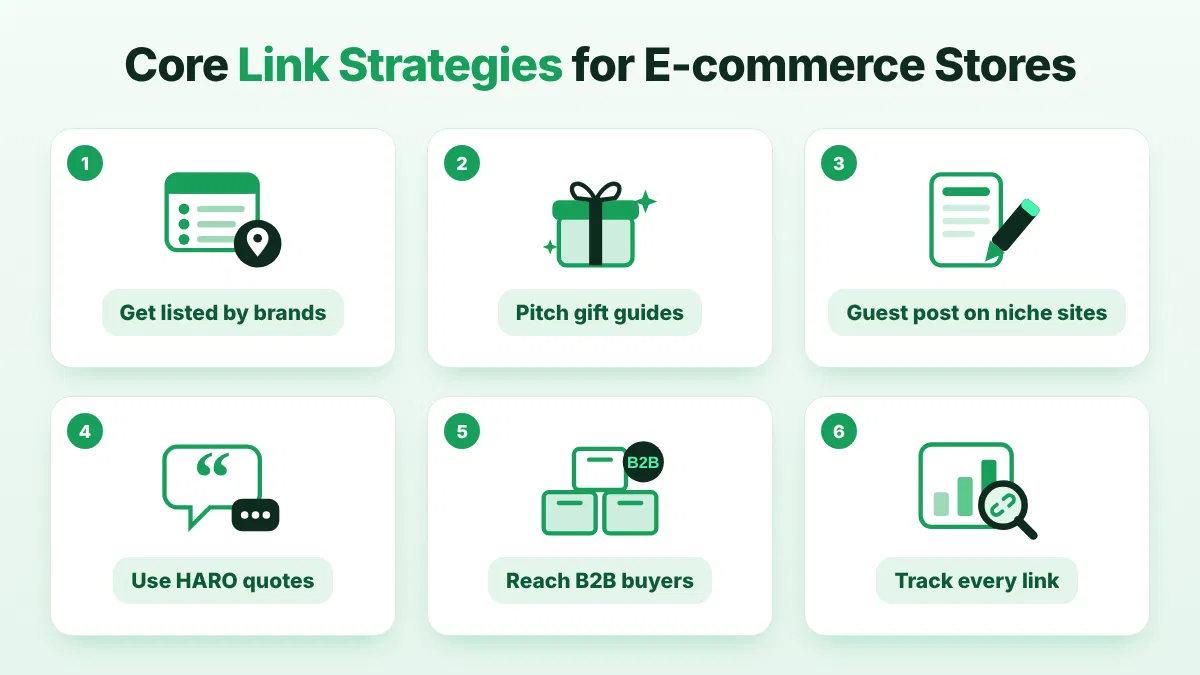
Good e-commerce link building comes down to earning links that point at pages that last. Random links to random products rarely move rankings or sales. Below are the core strategies that work best for online stores.
1. Get Listed by Brands and Suppliers
If you’re an authorized retailer, ask the brands you stock to list you on their “where to buy” page. These links are relevant, easy to get and point straight at your store. Many brands are happy to add you if you ask. It’s one of the quickest wins in e-commerce SEO.
2.Pitch Product Roundups and Gift Guides
Bloggers publish “best X” lists every season. Pitch your products a month or two early. Ask for a link to your category page, not a single product that may go out of stock.
3. Write Guest Posts for Niche Sites
Write useful, shareable and relevant pieces for sites your buyers read. Link back to a guide or category page, where it fits naturally.
Popular formats include blog posts, how-to guides and short videos.
3. Use HARO and Expert Quotes
Journalists often need quotes from store owners and product experts. HARO link building and similar platforms let you answer these requests and earn links from news sites. It’s a low-cost way to start.
4. Reach B2B and Wholesale Buyers
If you also sell wholesale, get featured on industry sites and trade directories. This puts you in front of more potential customers, like retailers and resellers, not just individual shoppers.
5, Track Every Link
Keep a list of every link you earn and the page it points to. A good backlink tool shows which category pages are gaining links and which still need work.
Core Content Strategies for E-commerce Stores
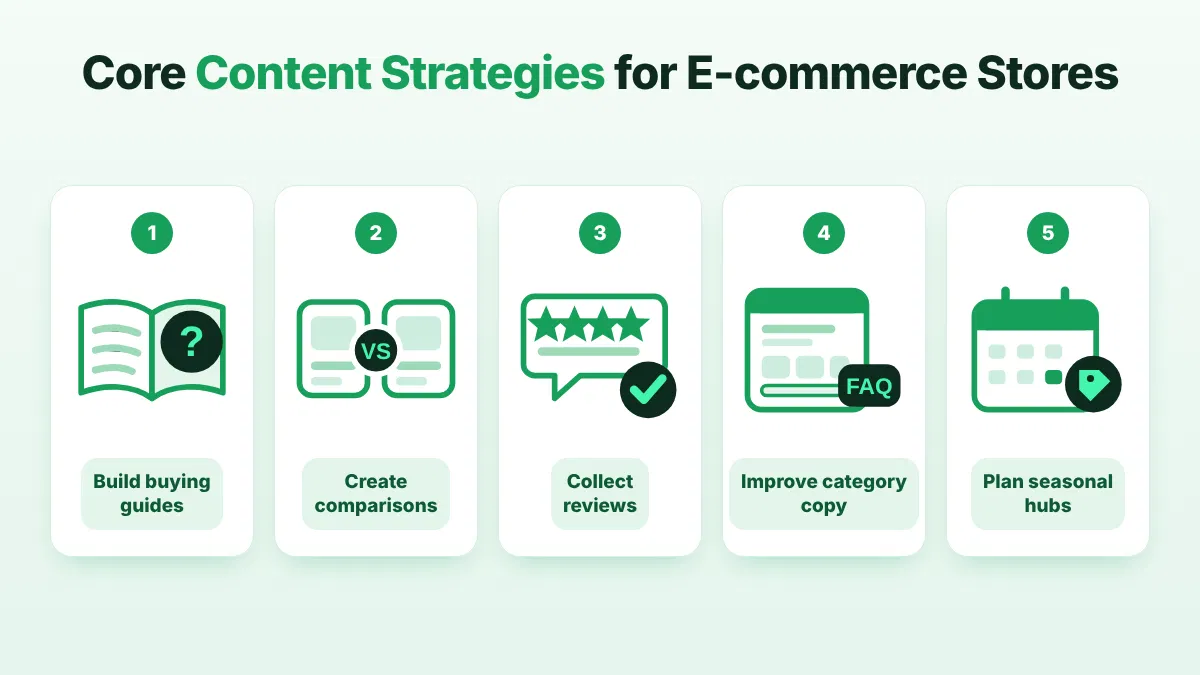
A good content strategy for e-commerce starts with your buyers, not with trending topics. In e-commerce SEO, every page should answer a question shoppers ask before they buy. Below are the content types that work best for online stores.
1. Build Buying Guides
Pages like “how to choose a mattress” or “road bike sizing guide” attract shoppers early and form the backbone of SEO blog content for ecommerce. They also link naturally to the right category pages. Knowing your target audience and creating content around their questions is what makes these guides work.
2. Create Comparison Pages
“Brand A vs Brand B” pages catch shoppers who are close to a decision. Keep them honest and clear. Link each product mentioned to its page in your store.
3. Collect Reviews and User Content
Customer product reviews, photos and Q&A add unique text to thin product pages. They also build trust with new shoppers. Ask for reviews after every order, so this content keeps growing.
4. Improve Category Page Copy
Add a short intro at the top of each category page and an FAQ block at the bottom. This simple e-commerce SEO fix helps the page rank for more long-tail searches. Keep it short, so products stay above the fold.
5. Plan Seasonal Hubs Early
Build gift guides and sale pages a month or two before demand peaks. Update them each year on the same URL, so they keep the links they’ve earned.
Good content marketing for a store isn’t about posting more. It’s about connecting every page to products.
Write for your target audience, and answer the questions they ask before buying.
Done right, content marketing can provide valuable reasons for other sites to link to you.
Which Should Your Store Prioritize at Each Stage?
Links and content are both important strategies for e-commerce websites, but the right balance changes as your store grows. Below is a rough split of effort and budget for each stage.
| Store Stage | Main Goal | Content | Links | Focus Pages |
|---|---|---|---|---|
| New store (0 to 12 months) | Get indexed and earn first rankings | About 70% | About 30% | Buying guides, category copy, supplier links |
| Growing store | Rank category pages for buying terms | About 50% | About 50% | Top 5 to 10 revenue categories |
| Established store | Beat larger competitors on big keywords | About 30% | About 70% | Homepage, main categories, seasonal hubs |
These e-commerce SEO splits are a starting point, not a rule. If a competitor outranks you with weaker content but more links, shift toward links. If you have links but thin pages, shift toward content.
A 90-Day Playbook for Online Stores
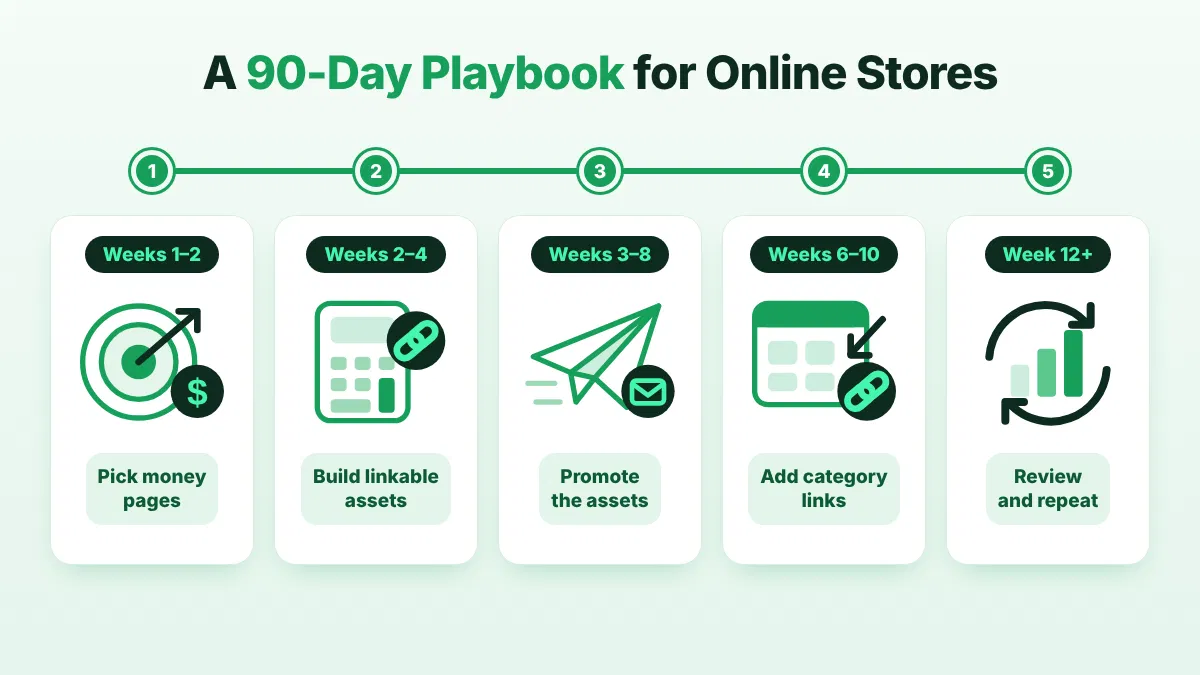
Knowing what works is one thing. Putting it into a plan is what gets results. This e-commerce SEO playbook combines links and content into 90 days you can repeat. Below are the main stages.
Weeks 1–2: Pick Your Money Pages
List the 5 to 10 categories that bring the most revenue or have the best margins. Check where each one ranks today. Then look at the sites linking to competitors, and note which ones you could reach. Our guide on What is the da and dr metrics helps you judge those sites.
Weeks 2–4: Build One Linkable Asset per Category
For a “camping tents” category, that could be a tent size calculator or a “how to choose a tent” guide. Add clear internal links from each asset to its category page. Also improve the category page copy while you’re there.
Weeks 3–8: Promote the Assets
Pitch each guide to bloggers, niche sites and journalists. Send 10 to 15 personal pitches a week. Follow up once if you haven’t heard back in five to seven days.
Weeks 6–10: Add Direct Category Links
Use supplier pages, gift guides and product roundups to point some links straight at your category pages. Keep a sheet of every link and the page it points to.
Week 12 and Beyond: Review and Repeat
Check which categories moved up and which guides earned links. Put more effort into what worked, then move to the next category on your list. If you’re short on time, an agency can earn high-quality backlinks for you while your team focuses on content.
Expected Timeline, Budget & SEO Impact
E-commerce SEO doesn’t work overnight, whether you focus on links or content. Each step takes time, from publishing to earning links to ranking. Below is a realistic timeline, followed by what to expect on cost and results.
| Stage | Typical Timing | What Happens |
|---|---|---|
| Publish guides and category copy | Weeks 1 to 4 | New pages go live and get indexed |
| Earn first links | Weeks 3 to 10 | Outreach, roundups and supplier listings land |
| Links get indexed | A few days to a few weeks | Google finds and counts the new links |
| Guides start ranking | 3 to 6 months | Research searches bring in new shoppers |
| Category pages move up | 2 to 6 months after links land | Buying searches bring in sales |
→ What Does Each Cost?
Content costs less to start. Most of the cost is writing time, product photos and yearly updates. Links cost more as competition grows, because outreach takes time and good sites are harder to win. Small stores can start with supplier links and expert quotes, which cost very little.
→ What SEO Impact to Expect?
The biggest gains come from a steady flow of links to category pages, backed by content that keeps earning more. Together, they bring increased traffic from both research and buying searches.
→ Traffic Is Not the Same as Sales
Rankings that bring more traffic, and higher conversion rates only pay off when the page loads fast, shows clear prices and makes checkout easy.
Good SEO gets shoppers to the page. The page itself has to close the sale.
Common Mistakes to Avoid
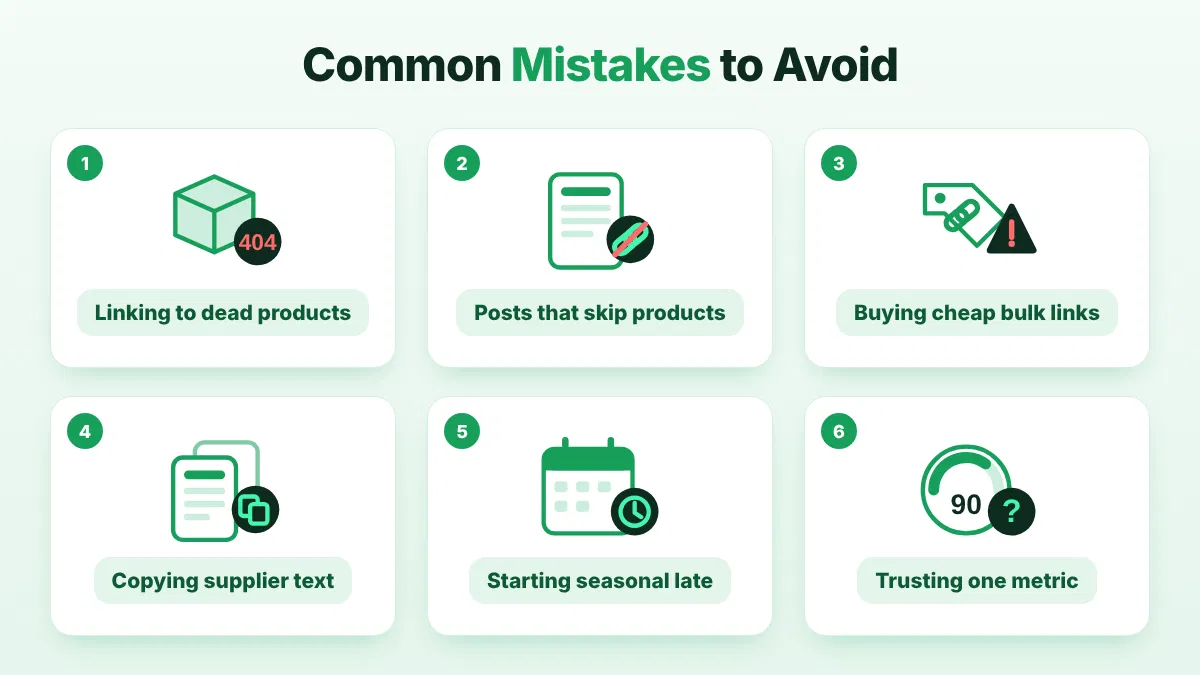
Most stores don’t fail at e-commerce SEO because they picked the wrong strategy. They fail because of a few simple mistakes. Below are the ones online stores make most often.
- Linking to products that disappear: When a product is discontinued, its links lose value unless you redirect the URL to the closest category.
- Writing posts that never link to products: Content that doesn’t connect to categories brings readers but no sales.
- Buying cheap bulk links: Links from private blog networks go against Google’s spam policies and can hurt the whole store.
- Copying manufacturer descriptions: Duplicate product text makes it hard for any page to rank, no matter how many links it has.
- Starting seasonal content too late: A gift guide published in December misses most of the season. Start in October.
- Judging links by one number: A link from a relevant site matters more than a high authority score from an unrelated one.
Not sure how to spot bad links? Our guide What are PBN Backlinks explains it.
Ready to get your category pages ranking?
We earn relevant links that point to the store pages that drive sales.
Final Thoughts
For online stores, the real question isn’t links or content. It’s which pages each one should serve. Content marketing reaches shoppers early and gives other sites a reason to link. Links give your category pages the authority they need to rank for buying searches.
Start your e-commerce SEO small, with your top categories, one guide for each and a short list of sites to pitch. Lean on content while your store is new, then shift toward links as you grow. Keep connecting the two with internal links, so the value your guides earn reaches the pages that sell.
At VH Info, we help brands earn relevant links that move the pages that matter. When link building and content marketing run as one plan, each one helps the other work even better.
FAQs
1. Should a New Online Store Focus on Links or Content?
For e-commerce SEO, a new store should usually focus on content first. Buying guides and better category copy can rank for easier searches and give other sites a reason to link. Add simple links from suppliers and brands from the start.
2. Should I Build Backlinks to Product Pages or Category Pages?
In most cases, build backlinks to category pages. They target bigger buying keywords and stay live much longer than single products. Only link to product pages for best-sellers that will stay in stock.
3. Can an E-commerce Store Get Backlinks Without a Blog?
Yes, an e-commerce store can get backlinks without a blog. Supplier “where to buy” pages, product roundups, gift guides, expert quotes and brand mentions all work. A blog makes it easier, but it isn’t required.
4. How Long Does E-commerce SEO Take to Show Results?
E-commerce SEO usually takes two to six months to show results. Category pages often move a few months after new links are found, while guides take three to six months to rank. Competitive keywords can take longer.
5. Can Content Alone Rank Category Pages?
Content alone can rank category pages only in low-competition niches. Strong copy and internal links help, but most buying keywords also need backlinks from relevant sites.
6. Is It Worth Paying for Links for an Online Store?
Paid links are risky for an online store. Under Google’s rules, paid links should be tagged as sponsored, so they pass little ranking value. Earned links from relevant sites are safer and usually work bet

 Vishal A.
 Share
 VH I.
