
Most agency owners do not lose clients because their SEO strategy is weak. They lose them when promised results start getting delayed. You can have a solid six-month SEO plan, a strong audit, and great content ready to publish, but if outreach keeps getting stuck at two placements a month, something eventually has to give. That is where many agencies start to outsource link building for agency delivery instead of building another in-house team.
But outsourcing is not as simple as picking a provider and ordering backlinks. The wrong partner can create more problems than it solves. So, what should you actually look for? In this guide, we’ll break down five partners worth considering, how white label delivery works, what reseller pricing really looks like, and the quality checks that can help you protect your clients.
Outsourcing means hiring an external team to handle prospecting, outreach, content, and link placements for your clients while your agency manages the client relationship.
Most campaigns work on a white-label basis. The partner works under your brand, so clients see your reports, emails, and branding—not the vendor’s. This is what makes a white label link building agency different from a regular link provider.
For example, if your team can build 25 links a month but a new client needs 15 more, hiring another employee may take months. When you outsource link building, you can use a partner’s existing publisher relationships and increase delivery without expanding your team.
In simple terms, you are not just buying backlinks. You are adding an experienced fulfillment team when you outsource link building for agency clients.
|
The global SEO services market, including link building and content marketing, is projected to grow at an annual rate of approximately 12% from 2026 to 2031.
|
There is no single best link-building partner for every agency. The right choice depends on your clients, budget, margins, and how much control you want.
Here are five providers worth considering if you plan to outsource link building for agency campaigns, along with their key strengths and where they fit best.
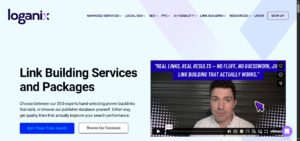
Loganix has been around since 2010 and works mostly with agencies and consultants. It is one of the older names in the space and has a wide product menu beyond links.
Guest posts, niche edits, digital PR style placements, and citation building. You buy by product rather than by campaign.
Full white label. Reports and deliverables can be sent without their branding, so you can pass them straight to clients.
Roughly $200 to $700 per link depending on the metrics you pick. Volume discounts exist for agency accounts.
Agencies that want a menu-style order system and steady, predictable delivery across many small clients.
Strong. Their whole model is built around resellers, so account managers understand agency timelines and margin pressure.
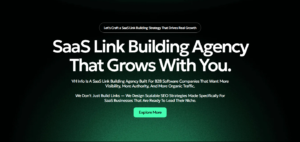
VH Info is a SaaS-focused link-building agency built for companies and agencies that need relevant, white-hat backlinks without managing the entire outreach process in-house. It works with SaaS, B2B software, AI, cybersecurity, and other technology companies to improve rankings, domain authority, organic traffic, and business growth.
As a SaaS link building agency, VH Info focuses on software, developer, security, B2B, and technology publications. This niche-focused approach helps agencies avoid the generic placements that may not make sense for technical clients.
Yes. Agencies can outsource fulfillment to VH Info while keeping the entire campaign under their own brand. Your team maintains the client relationship, while VH Info handles the outreach and placement work behind the scenes.
VH Info keeps pricing straightforward and based on the quality of the target website:
All plans include one link per domain, websites with at least 1,000 monthly traffic, dofollow links, a dedicated project manager, and monthly reports. There are also no hidden costs, making it easier for agencies to understand their margins before starting a campaign.
VH Info is a strong fit for SaaS, AI, fintech, cybersecurity, B2B software, and other technology-focused clients. It is especially useful for agencies and smaller teams that want to outsource link building without hiring additional outreach staff.
If you are still comparing providers, you can also see how the best SaaS link building agencies approach outreach before making a decision.
VH Info combines SaaS specialization with a white-hat, competitor-gap approach. Each project gets a dedicated project manager, and clients have approval before links are created.
With 5+ years of experience and 20,000+ links built, the team is equipped to handle ongoing link-building targets while keeping communication clear and straightforward.
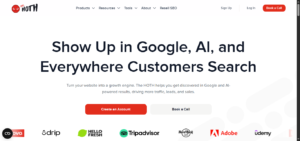
One of the largest and most recognised names among backlink companies in USA listings. The HOTH sells a very wide catalogue, from links to content to local SEO.
Guest posts, blogger outreach, foundation links, and packaged campaigns sold in tiers.
Strong white label system with a reseller dashboard, unbranded reports, and sub-accounts for clients.
Entry packages start low, often under $100 for basic placements, and climb for higher metric links.
Agencies handling many small or local clients who need volume at a controlled cost.
Very high volume. That is both the strength and the caution: you get speed and systems, but you should vet samples closely for relevance.
Rhino Rank is known mainly for curated links, also called niche edits, placed inside existing published articles.
Curated link insertions and guest posts, with traffic-based filtering on target sites.
Available for agency accounts, including unbranded reporting.
Often in the $100 to $350 range per curated link, based on the traffic tier you choose.
Agencies that want faster indexing and lower cost per link, since insertions skip the wait for a new post to gain traction.
Solid, with a clear focus on repeat reseller buyers rather than one-off brands.
A UK-based provider serving agencies worldwide, with one of the most polished self-serve ordering systems in the market.
Blogger outreach, niche edits, digital PR, content writing, and design add-ons.
Fully white label, with unbranded reports and a dashboard built for reselling.
Transparent public pricing, generally $75 to $500 per placement depending on domain metrics.
Agencies that want to see exact prices before ordering and need a simple system their junior staff can operate.
Extensive. FATJOE has served thousands of agencies and the whole product is designed around reseller workflows.
| Partner | Main Strength | White Label | Typical Price Per Link | Best Fit |
|---|---|---|---|---|
| Loganix | Wide product menu | Full | $200-$700 | Multi-client agencies |
| VH Info | SaaS and B2B tech focus | Yes | $100-$375 | SaaS and tech clients |
| The HOTH | Scale and volume | Full dashboard | $100-$500 | Local and SMB volume |
| Rhino Rank | Curated link insertions | Yes | $100-$350 | Fast, lower-cost links |
| FATJOE | Clear self-serve pricing | Full | $75-$500 | Lean agency teams |
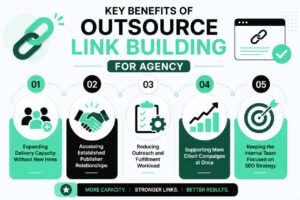
Outsourcing is not just about saving money. It helps agencies increase capacity, reduce repetitive work, and keep their teams focused on the SEO work that matters most. Below are some key benefits of outsource link building for agency growth.
Hiring an outreach specialist means paying for salary, tools, and training. When you outsource link building for agency retainers, you can increase or reduce link volume based on client demand without adding permanent staff.
Experienced partners already have relationships with publishers and editors, making it easier to secure relevant placements. This is also why comparing link building firms against in-house teams often comes down to publisher relationships and outreach experience.
Prospecting, checking metrics, writing pitches, managing follow-ups, briefing writers, and confirming live URLs can take hours every month. Choosing to outsource link building for agency fulfillment gives your team more time for strategy and client work.
Link building for SEO agencies can become difficult when several clients need placements at the same time. A reliable partner makes it easier to outsource link building for agency campaigns without putting unnecessary pressure on your internal team.
Your best people should focus on keyword mapping, technical SEO, content strategy, and client communication—not chasing publishers. When you outsource link building for agency clients, your team can spend more time on the work that drives retention and growth.
The process becomes much more structured when you outsource link building for agency campaigns. Below are the points walking you through each stage, from the brief to the client report.
You provide the target URLs, anchor preferences, niche, banned domain list, and monthly volume. Good partners review the brief, ask questions, and clarify requirements. A vendor that accepts a vague brief without any follow-up can be a warning sign. This stage sets the direction for the entire campaign.
The partner finds relevant websites and checks their traffic, topic fit, outbound link patterns, and spam signals. Any serious link building agency should filter out sites that exist only to sell links. Ask about their rejection rate. If almost every prospect passes, the filtering process may not be strong enough.
Emails are sent under a neutral or your-branded identity. Once an editor agrees, the content is written to the publisher’s standards, and the link is placed naturally within relevant body copy. Quality seo link building services focus on the host site’s readers first, helping placements remain useful and live.
Before publishing, you review and approve or reject the proposed domains. After publication, you receive live URLs with the anchor and target page confirmed. Always verify the clickable links yourself.
The final report arrives unbranded or with your logo. It usually includes the URL, anchor, target page, domain rating, traffic estimate, and publish date. You can forward it directly to clients. A true white label link building agency should never appear anywhere in the report.
Pricing can be confusing because every vendor structures its offers differently. Below are the points covering four common models and when each one fits.
You pay a fixed price for each placement, usually based on domain rating or traffic bands. It is easy to resell because your markup is simple to calculate. This model works best for agencies with irregular client demand.
You get a set number of links each month for a fixed fee. Most link building reseller packages use this model because it gives both sides predictable planning. Expect $1,500 to $8,000 per month depending on volume and quality tier.
The more links you order across all clients, the lower your per-link rate can become. An agency ordering sixty links a month might pay 25% less per link than one ordering ten. This model works well for agencies that outsource link building for agency clients through one partner.
This model is used for difficult niches, digital PR, or campaigns that require original research. There is no fixed catalogue price because the work varies. Most link building reseller packages for SaaS, fintech, or medical clients fall into this category because relevant publishers are harder to reach.
| Pricing Model | Typical Range | Predictability | Best For |
|---|---|---|---|
| Per-link | $75-$700 per link | Low | Irregular demand |
| Monthly retainer | $1,500-$8,000/month | High | Steady client base |
| Volume tiers | 10-30% discount | Medium | Multi-client agencies |
| Custom campaign | Quoted | Medium | Hard niches, PR |
Every vendor makes similar claims on their homepage. The real difference shows in the details. Below are the points covering the five checks worth making before you sign anything.
Ask for ten live links from the last sixty days in a niche similar to your client’s. Open each one and read the article. If the content is thin or the link feels forced, walk away. This simple check can filter out weak providers faster than any sales call.
Domain rating can be manipulated, while organic traffic and topical relevance are harder to fake. Learning how to judge link quality properly can help you avoid paying premium rates for pages nobody reads. Check whether the website actually ranks for relevant searches.
Ask what happens between prospecting and placement. Who approves the site? What gets rejected? Is there a second reviewer? A partner with a written QC process should be able to answer clearly. Vague reassurance is a warning sign.
Ask how long a link takes from the initial brief to going live. Four to eight weeks is common for editorial placements. Anyone promising fifty links in ten days is unlikely to be doing genuine outreach. Also ask about their monthly capacity so you know when they may reach their limit.
You need a clear point of contact, expected response times, and a standard reporting format. Also ask what happens if a link drops. A link building service without a clear replacement process can become difficult to deal with when something goes wrong.
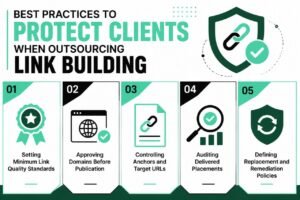
Your name is on the invoice, so the risk is yours. Below are the points covering five rules that can help keep client sites safe.
Set your quality standards before the campaign starts. Define minimum organic traffic, maximum outbound links per page, banned niches, and paid-post disclosure rules. Include these requirements in every brief. If they are not written down, they may not be followed.
Always keep veto power. Review the proposed domain list, reject anything that looks questionable, and approve the sites before content goes live. This simple step can prevent many poor placements.
Do not leave anchor decisions entirely to the vendor. Over-optimised anchors can increase SEO risk. Keep branded and natural anchors in the majority and distribute links across multiple pages instead of focusing only on the money page.
Check live links again after thirty and ninety days. Links can be removed, articles can change, and nofollow tags can be added without notice. A regular audit helps protect your reporting credibility with clients.
Get the guarantee in writing. Confirm how long each link is guaranteed to stay live, what the replacement window is, and who covers the replacement cost. Agencies that skip this step may end up paying for replacements themselves.
Most poor outcomes come from a few repeat mistakes. Below are the points covering four errors that can cost agencies clients.
A $40 link and a $400 link are rarely the same product. Cheap links often come from sites built mainly to sell links. You may save money initially, only to spend months cleaning up the backlink profile. Compare the value of each placement, not just the invoice total.
Fifty irrelevant links can be less valuable than five relevant ones because search engines consider context. Working with a blogger outreach agency for SaaS brands can make a bigger difference than simply increasing your monthly link count on generic sites.
Always verify publisher metrics using your own SEO tools. Inflated domain ratings are common and easy to manipulate. Look at organic traffic trends and overall site quality instead of relying on a single score in a spreadsheet.
Keep all communication routed through your agency. Direct vendor contact can confuse clients and expose your margins. Any partner that refuses to stay behind the scenes is not a reliable white label partner and may not be the right fit.
Outsourcing link building is not a shortcut. It is a practical way to add capacity and access publisher relationships without spending years building them in-house. Agencies that do it well treat their partner as an extension of the team, with clear briefs, quality standards, domain approvals, and regular audits.
The right partner should fit your clients, not simply have the biggest name. If you mainly work with software, AI, cybersecurity, or B2B tech companies, a specialist may be a better fit. VH Info is one option in this space, focusing on SaaS and technology companies with a white-hat approach to link building.
When considering link building for SEO agencies, compare providers based on relevance, transparency, placement quality, and communication. The best choice is the one that consistently meets your clients’ needs without compromising your agency’s standards.
Yes, in most cases. Outreach is slow and resource-intensive, while hiring an internal team can be expensive. When agencies outsource link building, they gain capacity without adding payroll costs. It works best when strategy, anchor decisions, and client communication stay in-house while the partner handles fulfillment.
Start with a clear brief covering target URLs, anchors, niche, and banned domains. Shortlist three vendors, request live samples from the last sixty days, and run a small paid test of five links. Then scale with the provider whose placements meet your quality standards.
Most placements cost $75 to $700 per link. Monthly link building reseller packages typically range from $1,500 to $8,000, depending on volume and quality. Harder niches such as SaaS, fintech, and healthcare can cost more because relevant publishers are harder to find.
It can be safe when you control quality. Approve domains before publication, set anchor rules, reject low-traffic sites, and audit links at thirty and ninety days. The main risk comes from cheap bulk placements on link-selling sites, so vet your partner carefully.
Look for live placement samples in your niche, a written quality control process, realistic turnaround times, white label reporting, and a clear replacement policy. Also ask about rejection rates during prospecting. If a partner rejects almost nothing, its filtering process may not be strong enough.
Yes. A white label link building agency works under your brand, provides unbranded reports, and avoids direct client contact. Your client sees your logo and account manager. This is a common model for link building for SEO agencies serving retainer clients.
Match the partner to your client mix. Volume providers can suit local and SMB work, while niche specialists may be better for SaaS, fintech, and technical B2B. Run a paid five-link test before committing, and compare placement relevance and traffic rather than domain rating alone.
Outsourcing offers speed, publisher relationships, and flexible costs, while in-house teams provide more control and can improve margins once volume is high and consistent. Many agencies outsource link building for agency fulfillment while keeping an internal lead to manage strategy and quality standards.
Every article dives deep into what works, why it works, and how to use it.
A security leader asks ChatGPT for the best SOC 2 compliance platforms for a 200-person startup. Within seconds, she has…
 Vishal ambani
October 08, 2026
Vishal ambani
October 08, 2026
TL;DR To monitor brand mentions in ChatGPT, run the prompts your buyers ask and record whether your brand appears.…
Vishal ambani
October 06, 2026
TL;DR AI brand monitoring tracks how ChatGPT, Perplexity, Gemini, and Google AI Overviews mention your brand. For SaaS companies, it…
Vishal ambani
October 01, 2026

 Share
Share