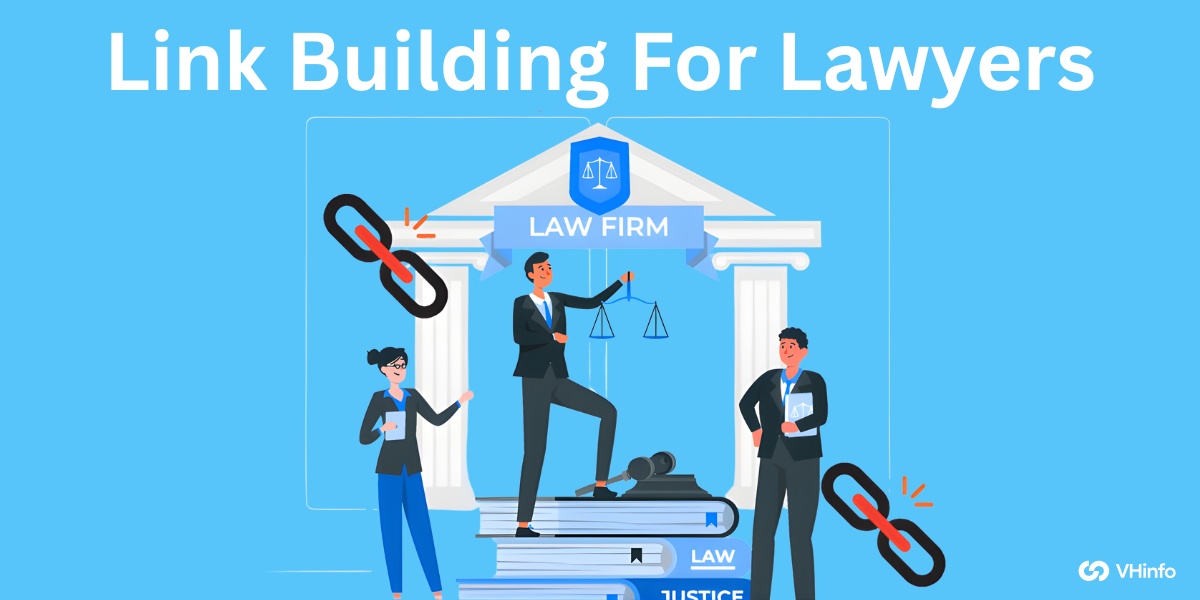
Getting new clients is the hardest part of running a legal practice. Most people looking for a lawyer start their journey on Google search. If your website does not show up at the top, you lose business to competitors. This is where link building for lawyers becomes very important.
At VH-info, we are a SaaS Link Building Agency. We spend every day helping companies rank higher. We know that the rules for search engine optimization (SEO) change often. However, one thing stays the same: you need quality backlinks to win.
Think of the internet as a high school popularity contest. If the cool kids (reputable websites) point at you and say, “Trust this person,” everyone else listens. When other websites link to your law firm’s website, Google sees this as a vote of confidence.
In this guide, we will explain exactly how building links works. We will keep it simple. We will show you how to improve your online visibility, get more organic traffic, and sign new clients. Whether you are a personal injury lawyer or handle family law, this guide is for you.
What Is Link Building For Lawyers?
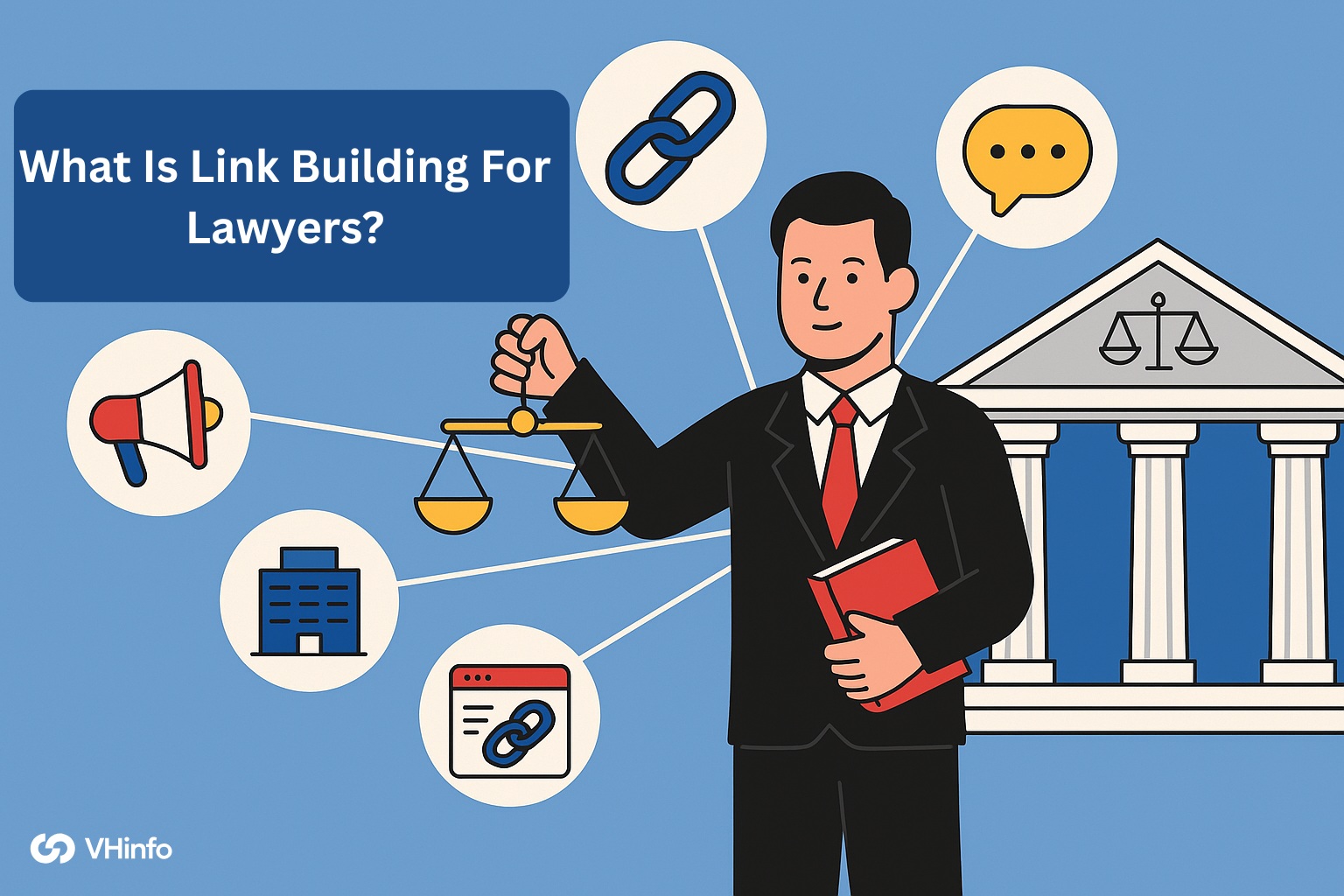
Link building is the process of getting other websites to link back to your web pages. These are called backlinks.
For a law firm, this means getting a link from a news site, a legal directory, or a business blog that points to your site. When search engines like Google crawl the web, they look at these links. They are looking for connections.
If a reputable website links to you, it passes “juice” or authority to your site. This is often called link equity. The more high-quality votes you have, the more Google trusts you. When Google trusts you, your search rankings go up.
For legal professionals, this is not just about vanity metrics. It is about getting your phone to ring. A strong link profile tells Google that your firm is a leader in the legal industry.
Why Link Building For Lawyers Is Essential For Law Firm SEO?
You might have a beautiful website. You might have great blog posts. But if you have no links, it is like having a billboard in the middle of the ocean. No one will see it. Here is why linking is vital for law firm SEO.
The Role of Backlinks in Google’s Ranking Algorithm
Google wants to show the best results to its users. To do this, it uses a complex system. Backlinks are one of the top three factors in Google search. When a site links to you, it tells Google two things:
- Your content is valuable.
- Your site is real and active.
Without links, search engines struggle to find your content. A solid SEO strategy must include a plan to get links. If you ignore this, your search engine rankings will stay flat.
Building Trust and Authority (E-E-A-T) in the Legal Niche
In the legal world, trust is everything. Google uses a concept called E-E-A-T. This stands for Experience, Expertise, Authoritativeness, and Trustworthiness. Because legal advice affects people’s lives (money, freedom, safety), Google treats legal websites strictly.
They call these “Your Money or Your Life” (YMYL) pages. You need to prove you are an expert.
When authoritative websites link to your legal content, it boosts your E-E-A-T. It shows you have years of experience.
For example, if a major city newspaper quotes you as a car accident expert and links to your site, Google sees you as an authority. This helps you rank for difficult terms like “personal injury attorney.”
How Quality Links Drive Referral Traffic to Your Firm?
SEO is great, but links do something else too. They bring people directly to your site. This is called referral traffic.
If you write a guest post on a popular legal blog, people reading that blog might click your link. These are people already interested in legal topics. They are highly likely to become potential clients.
A good link does double duty. It boosts your domain authority (helps you rank) and sends real people to your site (helps you sell).
How to Identify High-Quality Backlinks For Your Law Firm Website?

Not all links are good. Some links can actually hurt your law firm’s ranking. At VH-info, we focus on quality over quantity.
Here is how to spot a winner.
Topical Relevance
This is the most important rule. You want links from sites that talk about law, business, or your local area.
If you are a divorce lawyer, a link from a fishing blog does not make sense. It has no topical relevance. However, a link from a “Family Advice” blog or a “local business news” site is perfect. Search engines look at the context of the link.
Organic Traffic
A link is only valuable if the website giving it has visitors. If a website has zero organic traffic, Google likely does not trust it. We use tools to check if a site gets visitors from Google. If real people visit the site, it is a safe place to get a link.
Positive Traffic and Keyword Trends
You want to link to winners, not losers. Look at the history of the website. is their traffic going up? Or is it crashing? If a site lost 90% of its traffic recently, it might have been punished by Google. You do not want a link from a sinking ship.
We look for positive traffic and keyword trends to ensure stability.
Domain Rating (DR)
Domain Rating (DR) or Domain Authority (DA) are scores given by SEO tools. They measure the strength of a website’s backlink profile on a scale of 0 to 100. A DR of 90 is huge (like the New York Times). A DR of 0 is a brand new site.
Generally, you want links from sites with a decent DR. However, relevance is more important than just a high number.
Growing Backlink Profile
A healthy website gains new links naturally over time. If a site has not gained a new link in two years, it might be dead. We check to see if the site has a growing backlink profile. This shows it is active and respected in the legal community.
Outbound Link Quality and Linking Patterns
Who else does this website link to? This is a big clue.
If you see a site linking to gambling sites, shady pill sellers, or adult content, run away. This is a “bad neighborhood.” You do not want your law firm website associated with them. A good site links to other reputable sources.
Permanent Link
You want links that stay. Some shady sellers offer links that disappear after a month. This is a waste of money. You need a permanent link that will provide value for years.
Dofollow Backlinks
There are two main types of links: Dofollow and Nofollow.
- Dofollow links: These tell Google “Count this vote.” They pass link equity.
- Nofollow links: These tell Google “I am linking here, but don’t count it as a vote.”
For ranking power, you want dofollow backlinks. Nofollow links (like from social media) are good for traffic, but they don’t help your SEO as much.
Relevant Anchor Text
Anchor text is the clickable blue text of a link.
If the text says “click here,” it is weak. If the text says “personal injury lawyer in Chicago,” it tells Google exactly what the linked page is about. However, be careful. If you force too many keywords into the anchor text, it looks fake. It should look natural.
Relation Attributes
This is technical, but simple. Codes like “rel=sponsored” tell Google if a link was paid for. Google prefers natural links without these tags for organic ranking, but if you sponsor an event, a “sponsored” tag is the honest way to do it.
Proven Strategies For Effective Link Building For Lawyers

Now you know what a good link is. How do you get them? Here are the best methods we recommend at VH-info.
Using Legal Directories and Citations (Avvo, Justia, FindLaw)
This is step one. Legal directories are huge websites listing lawyers.
Sites like Avvo, Justia, and FindLaw are very powerful. You must claim your profile on these. They provide a high-quality backlink and help potential clients find you. Make sure your name, address, and phone number are correct on all of them. This helps your local SEO.
Guest Posting on Reputable Legal Blogs and News Sites
Guest posting is a classic strategy. You write an article for another website, and they let you put a link back to your site.
You can write for legal blogs, business magazines, or local news sites.
For example, you could write an article about “Safety Tips for Winter Driving” for a local news station. In the bio, you link to your car accident practice page. This positions you as an expert and gets you a link.
Using HARO (Connectively) to Gain High-Authority Media Mentions
HARO stands for Help A Reporter Out (now called Connectively). Journalists use it to find experts.
A reporter might ask, “I need a lawyer to explain the new tax law.” You answer their question. If they like your answer, they quote you in their article and link to your firm’s website. This is a great way to get links from massive news sites like Forbes or CNN.
Creating Linkable Assets: Legal Guides, Infographics, and Statistics
People love data. If you create valuable content that is better than everyone else’s, people will link to it naturally.
- Infographics: Make a visual chart of “Car Accident Statistics in 2026.”
- Legal Guides: Write a massive guide on “What to Do After a DUI.”
- Statistics: Gather data on local crime rates.
When other bloggers write about these topics, they will link to your data as the source. These are called linkable assets.
Local Link Building For Lawyers: Dominating Your Market

Most lawyers only need to find clients in their city or state. This means local link building is your secret weapon.
- Getting Listed in the Local Chamber of Commerce and Business Associations: Join your local Chamber of Commerce. They almost always have a member directory on their website. This link is very authoritative for local SEO. It tells Google you are a real business in that specific city.
- Sponsoring Local Events and Charities For Community Links: Sponsor a 5K run, a Little League team, or a charity food drive. Usually, the event website will put your logo and a link on its sponsor page. These links show you are part of the local community. They are trusted by Google because they are hard to fake. Plus, it is good PR for your firm.
- Alumni Directories and Law School Features: Reach out to the law school you attended. Reach out to your college. Many universities have “Alumni in the News” sections or directories. Since universities (.edu sites) have very high domain authority, these links are gold. It is an easy win for legal professionals.
Common Mistakes in Link Building For Lawyers to Avoid

Link building can be dangerous if done wrong. You do not want to get a penalty from Google. Avoid these traps.
- The Dangers of Buying Low-Quality Links: Do not go to sites like Fiverr and buy “500 backlinks for $10.” These are spam. They come from fake sites. Google is smart. They will ignore these links, or worse, they will punish you. Buying low-quality links is a waste of money.
- Use of Black Hat Tactics: “Black Hat” means breaking the rules. This includes hacking sites to insert links or using software to spam comments on blogs. At VH-info, we only use white-hat strategies. Search engine optimization is a long game. Cheating might work for a week, but it will kill your site for years.
- Avoiding Private Blog Networks (PBNs): A PBN is a network of fake websites created just to link to other sites. They look like real blogs, but they are hollow. Google hates PBNs. If they catch you using one, they can de-index your site (remove you from search results entirely). Stick to real website owners and real blogs.
- Over-Optimizing Anchor Text: We mentioned anchor text earlier. If every single link to your site says “Best Personal Injury Lawyer,” it looks suspicious. Real people use different words. They might use your brand name, “click here,” or the article title. Keep your anchor text diverse.
Law Firm SEO Best Practices For Building A Backlink Portfolio
A good portfolio has a mix of different link types. Here is how to balance it.
- Guest Posting: Do this consistently. Aim for one or two high-quality guest posts a month on relevant websites. Focus on sharing knowledge, not just getting the link.
- Social Media: While social links are usually “nofollow,” they are still vital. Share your blog posts on LinkedIn, Twitter, and Facebook. It increases visibility. If the right person sees your post on social media, they might link to it from their own website later.
- Directories: Get the big ones (Avvo, FindLaw) and then stop. You do not need to be in thousands of low-quality directories. Focus on the ones that rank in search engines.
- Help A Reporter Out (HARO): Make this a weekly habit. Check the requests for legal services or legal commentary. It takes time, but one big media link is worth ten small ones.
- Broken Link Building Practices: This is a clever trick. You look for relevant websites that have broken links (links that go to 404 error pages). You email the website owner: “Hey, I saw you have a broken link on your resource page. I have a similar article on my site that works. You can replace the broken one with mine.” This helps them fix their site and gets you a good link.
- Link Reclamation: Sometimes people mention your law firm but forget to link to you. You can use tools to find these “unlinked brand mentions.” Then, you send a polite email: “Thanks for mentioning us! Could you please add a link to our site so readers can find us?” This has a high success rate.
- Finally – Create Quality Content: None of this works if your content is bad. You need quality content that answers questions. If your page is helpful, people will want to link to it. Content marketing and link building go hand-in-hand.
How to Measure the Success of Link Building For Lawyers?

How do you know if your money is well spent?
- Tracking Domain Authority (DA) and Domain Rating (DR) Increases: Check your DR score every month. It should slowly go up. Remember, it moves slowly. Do not panic if it stays the same for a few weeks. Consistency leads to SEO results.
- Monitoring Referral Traffic and Keyword Rankings: Look at your Google Analytics. Are you getting traffic from the sites that link to you? Also, check your search rankings. Are you moving from page 2 to page 1 for keywords like “law firm SEO” or “lawyer near me“? If rankings and website traffic go up, the strategy is working.
FAQ’s:
Is Link Building Safe For Law Firms?
Yes, if done correctly. White-hat link building (earning links through merit and relationships) is safe and encouraged by Google. Buying spam links is not safe.
Is Link Building Still Important For Law Firm SEO In 2026?
Absolutely. Links remain a primary ranking factor. Without them, it is very hard to compete in the legal industry.
Which Types of Websites Are Best For Lawyers to Build Backlinks From?
The best sites are relevant and authoritative. Think of legal blogs, news outlets, universities (.edu), and government sites (.gov). Also, local business chambers are great.
Do Directory Listings Help Law Firms With Link Building?
Yes. Top-tier legal directories like Avvo and Justia provide strong links and send potential clients to you.
How Long Does It Take to See Results From Link Building?
SEO is slow. It usually takes 3 to 6 months to see significant movement in search engine rankings after starting a campaign.
Should Lawyers Buy Backlinks to Rank Faster?
No. Buying links is risky. It violates Google’s guidelines. It is better to invest in digital marketing strategies like content and PR.
How Much Does Professional Link Building For Lawyers Cost?
It varies. High-quality services are not cheap because they require manual work and outreach. Expect to pay for the expertise and the time it takes to secure reputable websites.
Are There Free Tools Lawyers Can Use to Find Backlink Opportunities?
Yes. You can use Google Search Console to see your current links. You can also use Google search operators to find guest posting opportunities. However, professional tools usually offer better data.
Conclusion
Link building for lawyers is not magic. It is hard work. It requires creating valuable content, building relationships, and proving to Google that you are a trusted authority.
When you build a strong backlink profile, you insulate your business. You stop relying on luck and start relying on data. You gain higher domain authority, better search results, and most importantly, more new clients.
The competition for legal services is fierce. The firms that invest in their online presence today will be the leaders tomorrow.
At VH-info, we understand the complexities of SaaS and high-stakes SEO. We know that being direct and knowledgeable is the only way to win. If you focus on quality, relevance, and persistence, your law firm’s website will become your best asset.
Start building links today, and watch your practice grow.

 Share
Share