
TL;DR
Cybersecurity SEO helps security vendors show up in search and AI answers while buyers research.
Trust decides the shortlist. Most security buyers skip vendors they have never heard of.
Start with compliance, comparison and problem-led keywords. Broad terms like “cybersecurity solutions” can wait.
Build authority through listicle placements, expert quotes, original research and relevant brand mentions.
A steady pace of quality links beats sudden bursts. Set your link building budget from the gap you need to close.
Security buyers make up their minds early. In its 2026 report, Vanson Bourne surveyed 300 senior IT and security decision-makers in the UK and US. Of those, 71% said they’re less likely to consider a cybersecurity vendor they haven’t heard of. Also, 97% want credible proof much earlier in the buying process.
That puts real pressure on search. If your brand is missing while a buyer’s team researches, you may never reach the shortlist.
This is where cybersecurity SEO comes in. It’s the work of ranking, and getting cited, for the questions security buyers ask before they talk to sales. This guide covers what to rank for and which content earns trust. It also shows how to build authority with links. You’ll learn how many backlinks per month you need and how to set a budget.

Cybersecurity SEO is the process of helping a security vendor rank in search and get cited by AI tools. It targets the questions buyers ask while they research. It covers keywords, content, technical health and authority, with extra weight on trust.
The mechanics are the same as any B2B SaaS program. The difference is the reader. Security buyers are paid to be skeptical, and a bad vendor choice can expose their whole company.
It applies to most security businesses, including:
If you’re new to the basics, start with our SaaS SEO guide
The rest of this article focuses on what changes in security.
Cybersecurity SEO is harder because buyers trust less, research alone, and judge content like experts. Three shifts explain it.
Buyers research without sales. A March 2026 Gartner survey of 646 B2B buyers found 67% prefer a rep-free experience. In the same survey, 45% used AI during a recent purchase. So your website, and what others say about you, does most of the early selling.
Trust carries the most weight. Google says of its E-E-A-T signals that “trust is most important”. It also gives extra weight to strong E-E-A-T on topics that affect people’s money or safety. Security advice often fits that description, so hold it to the same standard.
Buyers can spot weak content fast. A security engineer will notice a vague claim or an outdated threat example. Once that happens, the page loses credibility, and so does your brand.
Here’s how that changes the work compared with typical SaaS SEO:
| Area | Typical B2B SaaS SEO | Cybersecurity SEO |
|---|---|---|
| Main readers | Marketing, sales or ops leads | CISOs, security engineers, IT and risk owners |
| Content bar | Clear and helpful | Must survive review by a practitioner |
| Proof buyers want | Reviews and case studies | Named experts, certifications such as SOC 2, third-party coverage |
| Best link sources | General marketing and SaaS blogs | Security and tech publications, relevant SaaS sites, “best X” lists |
| Biggest content risk | Thin pages | Hype, fear-based claims and outdated threat details |
Start with keywords that show evaluation or buying intent. Broad terms like “cybersecurity solutions” are crowded and rarely bring a buyer who is ready to talk.
Instead, group your keywords by what the searcher is trying to do. Then match each group to one page type.
| Search type | Example query | Best page type |
|---|---|---|
| Compliance and frameworks | “SOC 2 compliance checklist” | Guide or checklist by an in-house expert |
| Problem or threat | “how to detect credential stuffing” | Technical explainer that links to your product |
| Category “best” lists | “best EDR for small business” | Placements on third-party lists, plus your own comparison page |
| Alternatives | “[competitor] alternatives” | Honest comparison page with a feature table |
| Integrations | “[your tool] Okta integration” | Integration or documentation page |
These queries are examples only. Check real volumes and difficulty in your keyword tool before you commit.
Also, give each search intent one page. Two pages chasing the same query usually split your rankings. Over time, a tight cluster of pages builds topical authority for your category.
Content written or reviewed by named practitioners, and backed by real data, earns trust fastest. Security buyers check who wrote a page before they believe it.
Focus on these five habits:
| Practice | How to Apply It |
|---|---|
| 1. Name your experts | Add author bylines and bios with real roles. List certifications only if the author actually holds them. |
| 2. Publish your own data | Anonymized findings from your product or research are hard to copy. They also attract links from journalists. |
| 3. Build proof pages | A trust center, a certifications page and case studies with numbers answer questions before sales does. |
| 4. Skip the fear | Scary headlines without data make buyers suspicious. Explain the risk, then explain the fix. |
| 5. Date your threat content | Attack methods change fast. Add a “last reviewed” date and update old posts on a schedule. |
One more thing: don’t gate everything. If every useful report sits behind a form, search engines and AI tools can’t see it. Publish a short, open summary and gate the full version if you need leads.
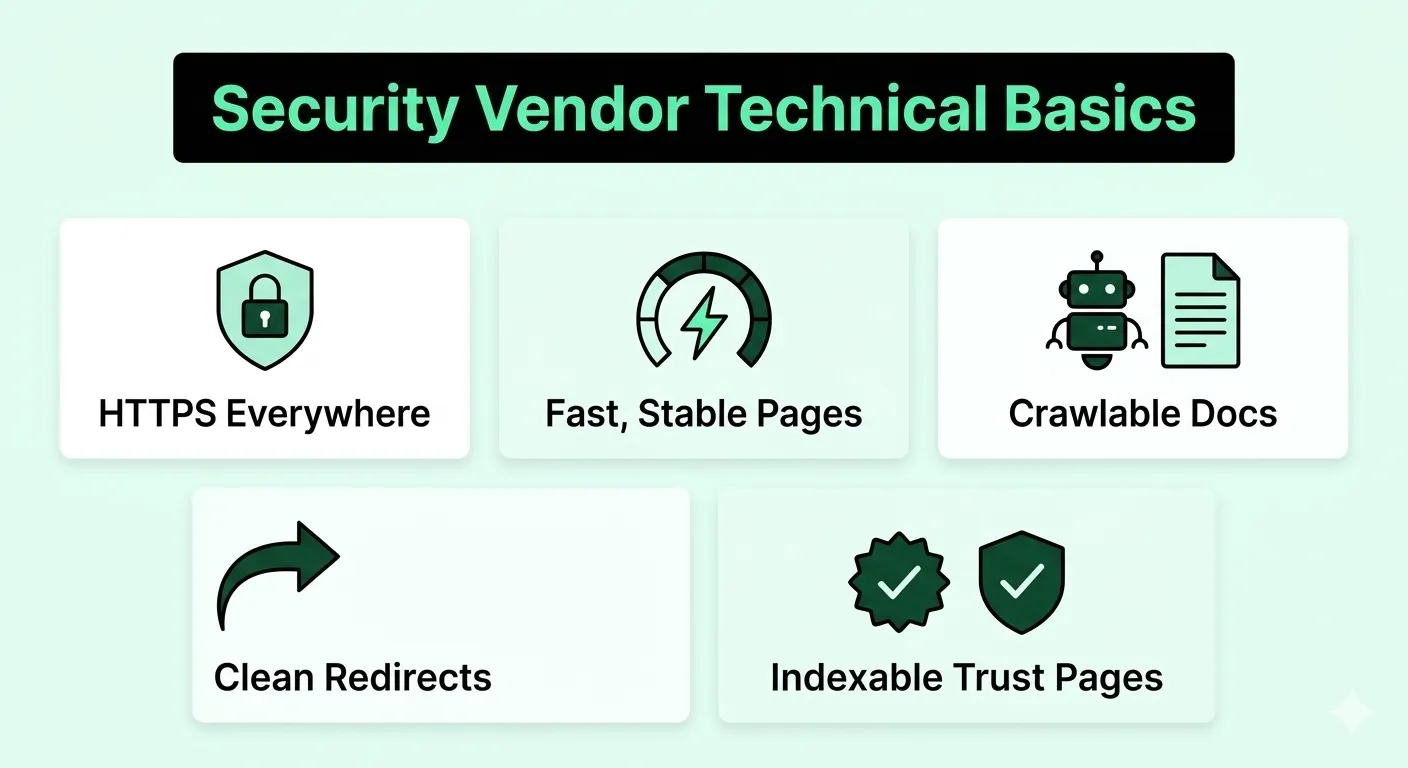
A security company with a sloppy website undercuts its own pitch. So fix these basics before you scale content or links:
For a fuller checklist, see our guide to SaaS technical SEO.
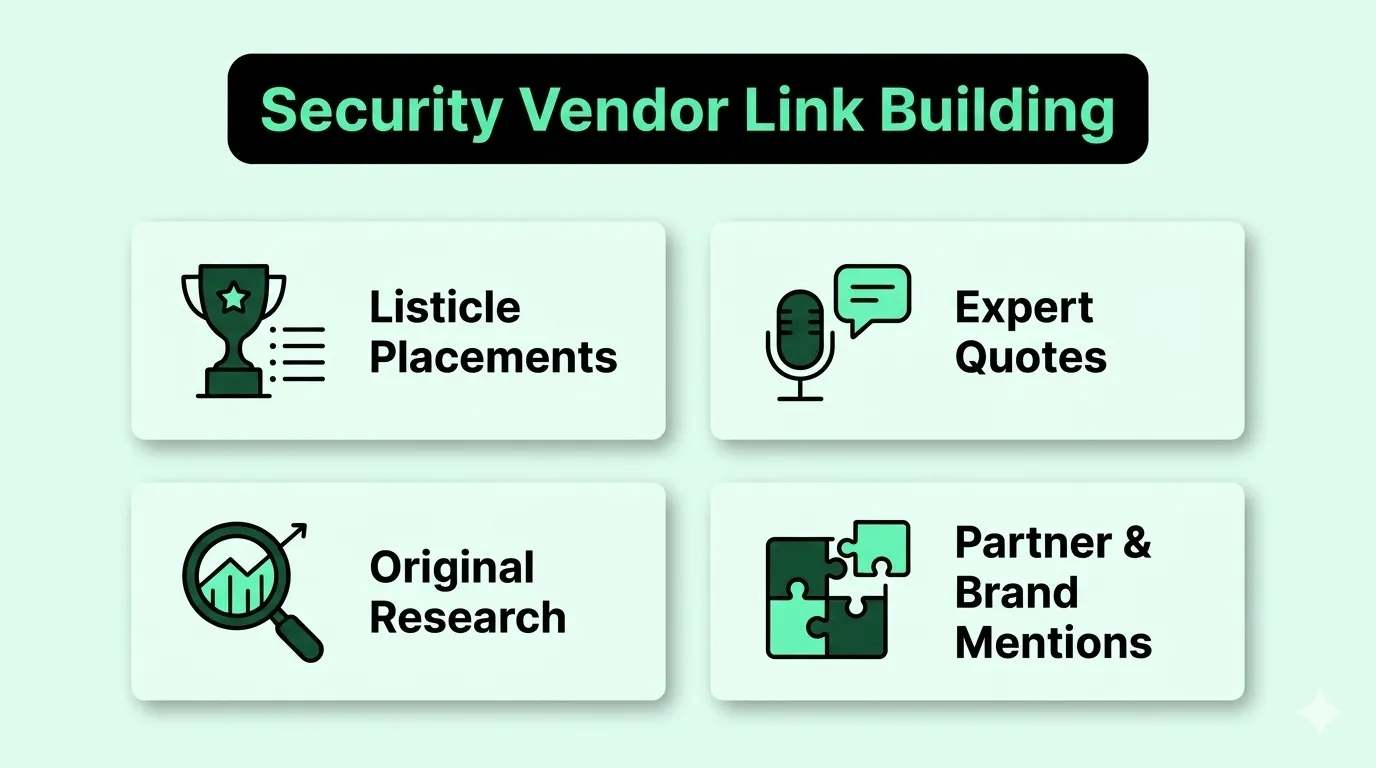
Security vendors build authority fastest through links and mentions from sources buyers already trust. That means industry lists, expert commentary, original research and relevant tech sites. This is the part of cybersecurity SEO most guides skip, so we’ll go deeper here.
At VH Info, this is the core of our cybersecurity SaaS link building work. Below are the four tactics we’d prioritize, and the ones to avoid.
Listicle link building means getting your brand included in “best X” articles on relevant sites. For security vendors, it now matters for AI search as much as Google.
The data is clear on this. An Ahrefs study reviewed ChatGPT answers to 750 top-of-funnel prompts. “Best X” blog lists made up 43.8% of all cited page types. Also, a separate Evertune review of about 25,000 URLs found half of LLMs’ most-cited URLs are listicles.
So imagine a buyer asks an AI tool for the best cloud security tools for startups. The answer often comes from lists. If you’re not on them, you’re likely not in the answer.
Here’s how to approach it:
One caution: Ahrefs also found 35% of cited lists sat on low-authority domains. Don’t chase every list. Pick relevant sites your buyers might actually read. Our brand listicle placements follow the same rule, and you approve every title and angle before anything goes live.
Expert quote link building means giving journalists useful comments in exchange for a mention, and often a link. Security is a strong fit, because breaches and new threats create constant demand for fast expert input.
Journalists post requests on platforms such as Qwoted, Featured, HARO, Source of Sources and Help A B2B Writer. A BuzzStream study compares them in detail. HARO now runs as a free daily email of media queries, powered by Featured.
To win more of these placements:
Results vary, and some publications use no-follow links. Still, a quote in a respected outlet builds the trust signals buyers look for. Our guide to HARO link building covers pitching in more detail.
Original research is the strongest option for security brands. In Editorial.Link’s survey of 518 SEOs, 48.6% chose digital PR as the most effective tactic. Your own threat data is ideal material for digital PR.
Two more tactics work well:
Google’s spam policies treat buying or selling links for ranking purposes as link spam. Paid links are allowed only when marked with rel=”sponsored” or rel=”nofollow”. For a security brand, getting caught in a link scheme is a trust problem as well as a ranking problem.
Avoid these:
At VH Info, we don’t use PBNs or link farms, and every placement needs your approval before it goes live.
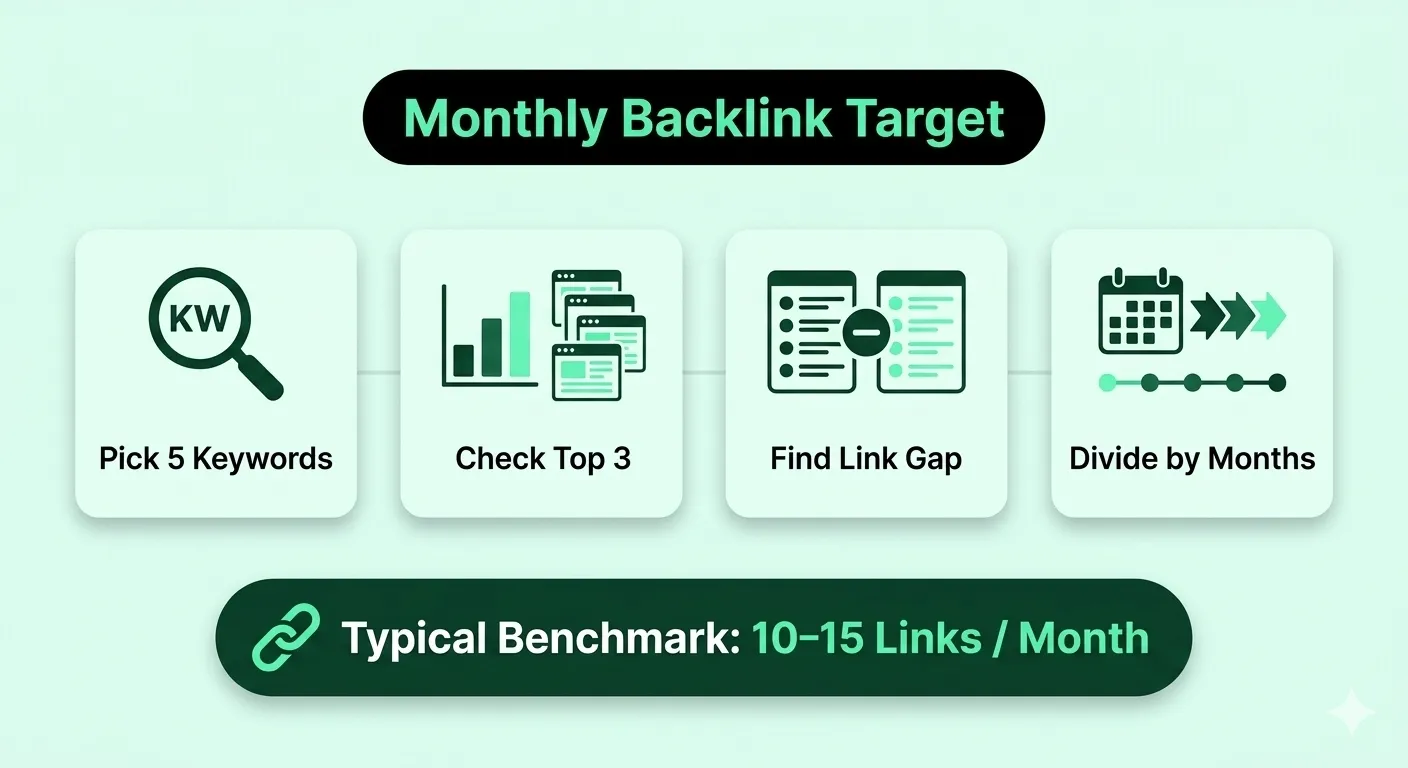
There is no fixed number. The right answer to how many backlinks per month you need depends on the pages ranking above you. Aim for a steady pace that closes that gap over a few months.
Competitors keep growing too. An Ahrefs study found most #1 pages gain followed links from new referring domains at +5% to +14.5% per month. The study is from 2018, but the logic still holds.
Here’s a simple example. Say the top page for your target keyword has 200 referring domains. At that growth rate, it adds roughly 10 to 29 new domains a month. You need to beat that pace to catch up.
Use this quick method to set your own target:
However, quality matters more than the raw count. Authority Hacker’s link building survey of 755 link builders found paying for links adds only about 2 links per month. In other words, more volume rarely fixes a weak strategy.
For most SaaS clients, we typically recommend 10 to 15 high-quality backlinks per month. We then adjust that to the budget and the competition. Keep the pace steady, because sudden spikes look unnatural. Our guide to link velocity explains why. For more on raw counts, see how many backlinks you need to rank.
Set your link building budget from the authority gap you need to close, then check it against market prices. Starting from a per-link price alone usually leads to cheap, irrelevant links.
First, know what the market looks like. Two surveys give useful reference points:
The gap between those numbers is mostly quality. Domain strength, real traffic and topic fit drive the price.
For comparison, here are VH Info’s public per-link rates:
| Service | DR 45 to 59 | DR 60 to 69 | DR 70 to 79 | DR 80+ |
|---|---|---|---|---|
| Link insertion | $100 | $150 | $200 | $300 |
| Brand mention | $150 | $200 | $300 (DR 70+) | Not listed |
| Brand listicle | $175 | $225 | $375 (DR 70+) | Not listed |
Every plan uses sites with 1,000+ monthly traffic and one link per domain. Custom plans are also available. There are no upfront fees; you pay after delivery.
Working example: Say a security startup needs 12 links a month. It picks eight DR 60 to 69 links (1,200)andfourDR70to79links(800). That’s a $2,000 monthly link budget. In the Editorial.Link survey, links took about a third of SEO spend. On that basis, total SEO spend lands near $5,550 to $6,230 a month.
Your numbers will differ. Still, working from the gap first keeps the budget tied to results. Our link building pricing guide breaks down costs further.
Measure cybersecurity SEO by pipeline first, then by rankings. Demo requests and qualified trials from search matter more than traffic alone.
Track these numbers:
| Metric | What it tells you | How often |
|---|---|---|
| Demo and trial requests from organic and AI referrals | Whether SEO creates pipeline | Monthly |
| Rankings for priority keywords | Visibility for buyer questions | Weekly |
| Visits to product, pricing and comparison pages | Buying-stage demand | Monthly |
| New relevant referring domains | Authority growth | Monthly |
| Brand mentions in AI answers for category prompts | AI search visibility | Monthly |
| Inclusions on “best X” lists | Shortlist presence | Quarterly |
Be patient with links. Authority Hacker also asked about timing in its link building survey. There, 618 of 755 respondents said links take one to six months to affect rankings. The average was 3.1 months. At VH Info, most clients see ranking and traffic movement within five to six months.
For AI visibility, test the same set of category prompts every month. Our guide to generative engine optimization shows how. For link reporting, see our link building metrics guide.
Security buyers shortlist brands they already know and trust. Cybersecurity SEO is how you become one of those brands before the first sales call.
Start with buyer-intent keywords and expert-led content. Then build authority steadily, through lists, quotes, research and relevant mentions. Track demo requests as closely as traffic, and give links a few months to work.
Want help building that authority without risky shortcuts?
Book a quick call. Talk to VH Info about a link building plan for your security brand.
Cybersecurity SEO is search engine optimization for security vendors, MSSPs and security consultancies. It helps them rank in Google and get cited by AI tools for buyer questions. It covers keywords, expert content, technical health and links. Trust matters more than in most niches, because security buyers are skeptical and research vendors carefully.
Most security vendors see early movement within three to six months. Links often take one to six months to affect rankings, with an average of about 3.1 months in one survey. At VH Info, most clients see ranking and traffic movement within five to six months. Competitive categories can take longer.
There is no universal number. Compare your referring domains with the top three pages for your priority keywords. Then spread the gap over a realistic timeline. For most SaaS clients, VH Info typically recommends 10 to 15 high-quality backlinks per month. A steady pace looks more natural than sudden spikes.
Yes, for most security brands. AI tools often build product recommendations from “best X” lists. An Ahrefs study found these lists made up 43.8% of page types cited by ChatGPT. Focus on relevant lists with real traffic and recent updates. Being included helps buyers find you during early research.
Expert quote link building means giving journalists expert comments in exchange for a mention, and often a link. Security experts can respond to requests on platforms such as Qwoted, Featured and HARO. Respond fast, use specific data, and avoid product pitches. The result is credible coverage that builds trust with buyers.
It depends on your authority gap and your market. In one 2026 survey, agencies put 32.1% of SEO budgets into link building, and in-house teams 36.03%. Quality links often cost a few hundred dollars each. Start from the number of links you need, then match that to market prices.
Get a free backlink gap analysis for your SaaS site. We'll show you the placements your competitors are winning and how to close the gap.
Book My Free Strategy Call →20,000+ white-hat links built for SaaS brands
Every article dives deep into what works, why it works, and how to use it.
Your founder gets quoted in an industry newsletter. A review site adds your tool to its “best software” roundup. Both…
 Vishal ambani
November 10, 2026
The best FatJoe alternative for a SaaS brand isn’t always the cheapest one. It’s the one that puts your links…
Vishal ambani
October 27, 2026
A SaaS founder spends forty minutes talking on a small industry podcast. She shares how she handles a problem her…
Vishal ambani
October 24, 2026

Find quick answers to your questions.
Questions and answers will appear here soon.
 Share