
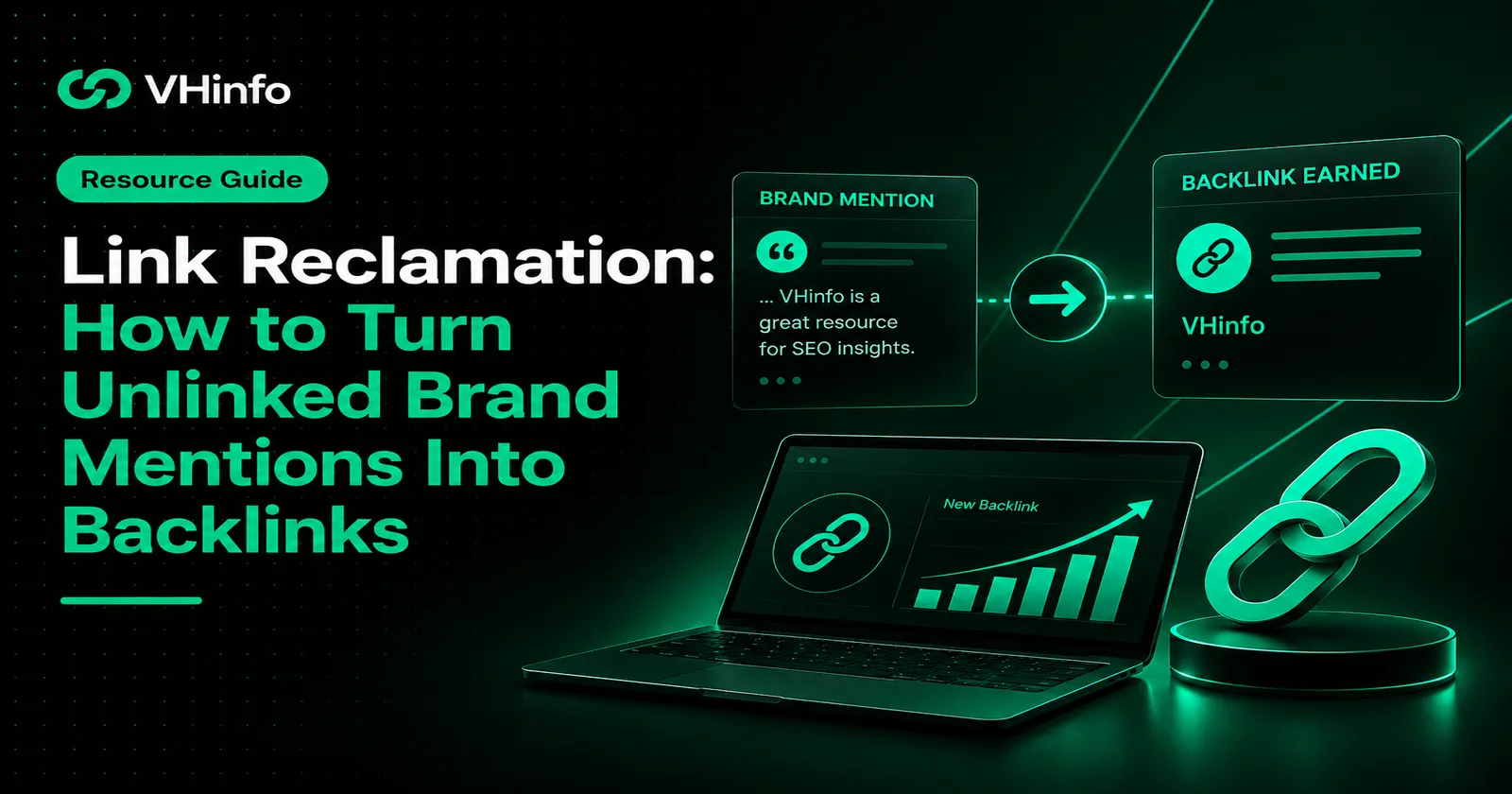
Your founder gets quoted in an industry newsletter. A review site adds your tool to its “best software” roundup. Both name your brand, but neither links to you.
Link reclamation fixes that gap. It’s the process of finding pages that mention your brand without a link, then asking for one. The writer already chose to cover you, so the ask is small.
Those mentions carry real weight. In Ahrefs’ study of 75,000 brands, branded web mentions had a 0.664 correlation with AI Overview visibility. Backlinks scored just 0.218. A mention helps AI tools recognize you. A link also sends readers and authority to your site.
This guide shows SaaS founders how to find unlinked mentions, pick the right ones, and turn them into backlinks.
TL;DR
Link reclamation turns existing brand mentions into backlinks by asking the publisher to add a link.
A plain-text mention isn’t a link, so search engines and readers can’t follow it to your site.
Mentions still matter for AI search, so the goal is a mention plus a link.
Only chase mentions on live, relevant pages where a link helps the reader.
Reach out the same day, quote the exact sentence, share the URL, and never offer payment.
Link reclamation means claiming link credit you should already have. However, SEOs use the term for two related jobs.
| Unlinked mentions (this guide) | Lost links | |
|---|---|---|
| Starting point | A page names you but never linked | A page linked to you, then stopped |
| What you ask | “Could you add a link here?” | “Could you restore the link?” |
| How you find it | Mention searches and alerts | Lost-link reports in a backlink tool |
This guide covers the first job. For links that vanished after a redesign, read our guide to reclaiming lost backlinks. For the basics, see our primer on unlinked mentions.
Not sure which links to reclaim first?
Book a quick call. We’ll audit your unlinked brand mentions and build a clear reclamation plan.
A plain-text mention isn’t a link. Search engines can’t follow it, and readers can’t click it. As a result, you lose value in three ways:
The mention itself still helps with AI answers, as the Ahrefs data shows. So keep earning mentions, then add links where you can. That’s why VH Info focuses on earned brand mentions on sites SaaS buyers read. For the AI side, see our guide to GEO for B2B SaaS.
Not every mention deserves a link reclamation email. In fact, emailing every name-drop annoys editors you may pitch later.
| Pursue it when… | Skip it when… |
|---|---|
| It’s a live article, review or roundup | It’s a social post, forum thread or scraped copy |
| The site covers SaaS or your buyer’s industry | The site has nothing to do with your market |
| The page ranks or gets real traffic | The site looks abandoned or spammy |
| A reader would want to click through | It’s a passing name in a long list |
| The mention is recent and positive | It’s years old, or it’s a complaint |
Here’s a simple rule. If you can’t explain how the link helps the reader in one sentence, skip it.
Every link reclamation campaign starts with a search list. Next, run it through a tool or two. Finally, check each page by hand.
Writers rarely stick to your official name, so search for:
| Method | Cost | Best for |
|---|---|---|
| Google search operators | Free | A quick first sweep |
| Google Alerts | Free | New mentions as they go live |
| Ahrefs Content Explorer | Paid | Large sweeps with traffic filters |
| Semrush Brand Monitoring | Paid | Ongoing tracking with a “without backlinks” filter |
On Google, search “Your Brand” -site:yourdomain.com to hide your own pages. Then use the Tools menu to filter results to the past month.
Tools can get this wrong. For example, a writer may link your logo, or add the link after the tool’s crawl.
Expert quote link building often produces mentions without links. You answer a journalist’s request, and the article runs. Then your founder appears with a name and title, but no link.
These are easy link reclamation wins. You supplied part of the content, and the link has an obvious home beside the quote.
For the pitching side, read our guide to expert quote link building. Our older post on HARO link building also helps.
Ask for the page that fits the sentence. Don’t ask for the page you most want to rank.
| If they mention… | Ask for a link to… |
|---|---|
| Your product or company | Your homepage or product page |
| A feature or integration | That feature page |
| A guide, template or free tool | That exact resource |
| Your data or study | The original report |
| Your founder | Their bio or your homepage |
Also, keep the writer’s own words as the anchor text. Our guide to anchor text ratio explains why a natural mix matters.
On blogs, start with the author, then the editor. On news sites, email the corrections or news desk instead. Page One Power found that journalists often move on after publishing. Meanwhile, desk staff handle the edits. Copy the journalist in.
A good link reclamation email stays under 100 words. It thanks the writer, quotes the sentence and shares the URL. Then it explains why the link helps readers.
Use these link building outreach email templates as a base. Rewrite the first line for every send.
Subject: Thanks for including [Brand] in your [topic] post
Hi [First name],
Thanks for mentioning [Brand] in “[Article title]”.
Would you be open to linking “[Brand]” to [URL]? It would help readers check [the feature / pricing] without searching.
Either way, thanks for the mention.
[Your name], [Role] at [Brand]
This structure comes from Page One Power’s case study. Their “Correction:” email got a reply within 11 minutes.
Subject: Correction: [Exact article title]
Hi [Name / News desk],
Thanks for covering [Brand]’s [report name] today.
Could you add a link to the original data at [URL]? Readers could then check the full numbers themselves.
[Your name], [Role] at [Brand]
Subject: [Founder name]’s quote in [Article title]
Hi [First name],
Thanks for including [Founder name]’s comments in your piece.
Could you link [Founder name] or [Brand] to [URL]? It shows readers who’s behind the quote.
[Your name]
Subject: Re: [original subject]
Hi [First name],
Just checking you saw my note about “[Article title]”. The link would be [URL].
No worries if it doesn’t fit your policy. Thanks again!
[Your name]
Notice what’s missing. There’s no SEO talk and no offer in return. For more formats, see our outreach email templates.
Most outreach emails never get a reply. In fact, Backlinko and Pitchbox studied 12 million emails, and only 8.5% got a response. The same study found two useful patterns:
For link reclamation, the article title is your easiest personalization. Good outreach subject lines tell the editor exactly which page you mean.
| Subject line | Characters | Use it for |
|---|---|---|
| Thanks for including Acme in your CRM roundup | 45 | Product in a roundup |
| Small edit on your 2026 CRM comparison | 38 | Review or comparison |
| Correction: Best Email Tools for Startups | 41 | News site desk |
Avoid a fake “Re:” on a first email. For more formulas, read our guide to outreach subject lines.
Timing has a big effect on link reclamation, so send on the day the mention goes live. Page One Power cites Digitaloft data from over 100 link reclamation campaigns. It shows same-day outreach almost doubles the success rate. In their own case study, 13 of 18 pieces of coverage became links. That’s a 72% success rate.
To move that fast:
Then follow up twice at most. The Backlinko study found that multiple follow-ups doubled the average response rate.
| When to send | |
|---|---|
| First email | The day the mention goes live |
| Follow-up 1 | 3 to 4 business days later |
| Follow-up 2 | 7 to 10 days after that, then close the record |
A solid link reclamation process won’t save a badly worded request. Watch for these five mistakes:
For broader tips, see our guide to link outreach.
Keep one row per mention, and update it after every email.
| Page URL | Mention | Contact | Link requested | Sent | Status | Live link checked |
|---|---|---|---|---|---|---|
| ://example.com | “Acme is a good pick for small teams” | Editor | acme.com | Nov 3 | Link added | Yes |
A link only counts once you’ve seen it live and pointing to the right URL. After that, re-check reclaimed links monthly with your backlink monitoring setup.
Each month, report five numbers: mentions found, mentions qualified, emails sent, replies, and links added. A link building report template keeps those numbers consistent. Try our link building report template. Our guide to link building metrics covers what else to track.
Block one afternoon this week. Search your brand, set up alerts, and check the ten most relevant pages. Then email anything published in the last month first.
Want SaaS links from sites your buyers actually read?
Keep in mind that link reclamation only works on mentions you already have. If your list is short, the next step is earning more links.
Link reclamation is the process of finding pages that mention your brand without linking to your site. You then ask the publisher to add a link. Some SEOs also use the term for restoring links you used to have. Both aim to turn existing references into backlinks that pass authority and traffic.
Not quite. Claiming unlinked mentions means asking for a link that never existed. Recovering lost backlinks means restoring a link that was removed, broken or redirected. People often group both under link reclamation. However, you find them with different tools, and each needs a different outreach email.
Search Google for “Your Brand” -site:yourdomain.com and filter results to the past month. Then set Google Alerts for your brand, products and founder. Before you email anyone, open each page and check the source code. That confirms the writer hasn’t already linked to you somewhere.
It varies with how fresh the mention is. In Page One Power’s case study, same-day outreach turned 13 of 18 pieces of coverage into links. By contrast, general outreach averages an 8.5% reply rate. Old, generic name-drops usually convert far less often than recent, specific mentions.
No. Asking a publisher to add a link to an existing mention is normal outreach. It becomes link spam when you offer money, goods or services for the link. That includes free accounts or upgrades. Keep the request about helping their readers, and you stay within Google’s policies.
Get a free backlink gap analysis for your SaaS site. We'll show you the placements your competitors are winning and how to close the gap.
Book My Free Strategy Call →20,000+ white-hat links built for SaaS brands
Every article dives deep into what works, why it works, and how to use it.
The best FatJoe alternative for a SaaS brand isn’t always the cheapest one. It’s the one that puts your links…
 Vishal ambani
October 27, 2026
A SaaS founder spends forty minutes talking on a small industry podcast. She shares how she handles a problem her…
Vishal ambani
October 24, 2026
A SaaS team publishes fifty blog posts in one year. The writing is good, the topics are useful, and the…
Vishal ambani
October 23, 2026

Find quick answers to your questions.
Questions and answers will appear here soon.
 Share