

TL;DR
- A manual link building service earns every link by hand through real research, real pitches and real editors
- Bots buy you speed, but those links rarely survive a core update
- VH Info prices per link by site authority, starting at $100 and going up to $300
- Every plan includes one link per domain, sites with 1,000+ traffic, dofollow links, a dedicated project manager and a monthly report
- First links land in 3 to 5 weeks and rankings move in month three to six
- SaaS brands should split links between blog posts and the pages that convert
- Vet any provider by asking for live URLs, who writes the pitches and how they price
Introduction
Most outreach fails for one dull reason. Nobody read the page they were pitching.
A bot cannot read a page. It cannot spot a real gap. It cannot win over a busy editor. So it sends the same email to 5,000 sites and hopes.
A person can do all three. That single gap is why a manual link building service still beats every shortcut on the market.
At VH Info, we build links by hand for SaaS, B2B and cyber brands. This guide shows you how a manual link building service works, what it costs per link, and how to spot a good one from a bad one.
Table Of Contents
- What Is A Manual Link Building Service?
- How A Manual Link Building Service Works
- Manual Vs Automated Link Building
- What A Manual Link Building Service Gives You
- Manual Link Building Service Pricing
- Manual Link Building For SaaS
- Tactics That Work In 2025
- How To Vet A Provider
- In-House Vs An Agency
- FAQs
What Is A Manual Link Building Service?
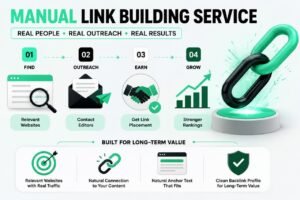
A manual link building service is an SEO service where real people find relevant websites, contact editors, and earn backlinks through genuine outreach. Instead of relying on bots or bulk submissions, each potential link is researched and evaluated before anyone reaches out.
For example, if you publish a guide about SaaS tools, an outreach specialist might find a relevant industry website, contact its editor, and explain why your guide would be useful to their readers. If the editor agrees to include it, you’ve earned a backlink through manual outreach.
The key difference is simple: every link is earned through human judgment, not automatically generated at scale.
A good manual link building service focuses on:
- Relevant websites with real organic traffic
- A natural connection between the linking page and your content
- Natural anchor text that makes sense to readers
- A clean backlink profile built for long-term value
This approach takes more time than automated link building, but the goal is to earn links that are genuinely useful, relevant, and valuable to your website.
How A Manual Link Building Service Works
A strong manual link building service follows a structured process to find relevant opportunities and earn quality backlinks. The first step is understanding where you currently stand compared with your competitors.
1. Audit and Benchmark
We compare your backlink profile with those of your top three competitors to identify gaps and opportunities. The websites linking to your competitors but not to you become a starting point for your outreach list.
This gives the campaign a clear direction instead of relying on random websites or pre-built link lists.
2. Research Prospects
Next comes the filter. A manual link building service checks real signals: traffic, topic fit, link hygiene, and growth over 12 months.
Domain Rating alone is not enough. A DR 70 site with no readers is worth less than a DR 50 site with 8,000 visits a month. That is why every site we pitch must clear 1,000+ monthly traffic before it goes on your list.
3. Build the Asset
Editors need something genuinely useful to link to. Depending on the campaign, this could be an original data study, guest post, expert quote, research report, or free template. The goal is to create an asset that gives the website a clear reason to link to you.
4. Reach Out by Hand
This is where manual outreach link building makes the biggest difference. Each pitch is personalized to the website, highlights a specific opportunity, and explains how your content can help its readers. Follow-ups remain timely, limited, and respectful.
5. Check and Report
Once a link goes live, the team checks the URL, anchor text, dofollow status, and whether the page has been indexed. The placement is then added to your monthly report so you can clearly see what was earned.
The realistic timeline: A manual link building service may secure its first links within 3–5 weeks, while noticeable ranking improvements typically take three to six months. Anyone promising major results within 14 days should be treated with caution.
|
A U.S. government study analyzed 32.5 million webpages and 110 million hyperlinks across 47,631 government agencies
|
Manual Vs Automated Link Building
Factor |
Manual Link Building Service |
Automated Tools |
| Method | People. Real research. Real pitches. | Bots. Bulk sends. |
| Link quality | Relevant pages an editor approved | Often odd, spammy or footer links |
| Vetting | Every site checked first | Little to none |
| Anchor control | Full control | Same anchor, over and over |
| Risk | Low. It fits Google’s rules. | High. Link schemes break them. |
| Speed | 3 to 5 weeks | Hours |
| Cost per link | Higher now | Cheap now, costly later |
| After 12 months | Authority builds | Traffic drops after an update |
The trade-off is simple: automated tools give you speed, while a manual link building service focuses on earning links that can continue providing value long after they’re published.
Three reasons the manual approach wins over time:
- Editorial approval: When a real editor chooses to publish your link, it adds a layer of quality that automated links can’t easily replicate.
- Relationships compound: A successful placement can lead to future guest posts, interviews, podcast opportunities, or industry mentions.
- Less cleanup: Low-quality links can create problems that require time and effort to fix. Earning quality links from the start reduces that risk.
What A Manual Link Building Service Gives You
Vague promises are a major red flag. Before signing a contract, ask the provider to clearly outline what you’ll receive.
Deliverables
- A link-building plan connected to your key money pages—the foundation of any complete link building service
- A prospect list you can review and approve before outreach
- One link per domain to maintain a natural backlink profile
- Websites with at least 1,000 monthly organic visitors
- Dofollow links placed on live, indexed pages
- Outreach researched, written, and sent manually
Reporting and Support
- A dedicated project manager who oversees your campaign, as you’d expect from a managed link building service
- Monthly reporting showing each new link, its anchor text, and target URL
- Key site metrics, including traffic, topical relevance, and DR
- Ranking changes for the pages receiving links
- Regular backlink profile checks and competitor gap updates
A trustworthy provider should also let you review the target list before outreach begins. If they won’t show you where they’re planning to build links, you may be dealing with a black box rather than a complete link building service.
Manual Link Building Service Pricing
We charge for each link, not a monthly fee. You only pay for the links you actually receive, and the price depends on the quality and strength of the website.
Plan |
Price Per Link |
Site Authority |
Best For |
| Starter Plan | $100 | DR 45 – 59 | First campaigns and channel testing |
| Value Plan | $150 | DR 60 – 69 | Steady growth on mid-tier terms |
| Best Value | $200 | DR 70 – 79 | Crowded SaaS and B2B keywords |
| Enterprise | $300 | DR 80 + | Top-tier authority and brand trust |
Every plan includes the same six things:
- One link per domain
- Sites with 1,000+ traffic
- Dofollow links
- A dedicated project manager
- A monthly report
- SaaS-relevant sites
What that means for your budget: Ten Value Plan links cost $1,500 a month. Five Best Value links cost $1,000. You can mix different tiers in one campaign, and most brands do.
Two notes on how the tiers work:
A managed link building service means one project manager handles your roadmap, approvals, and report. You review the work, but you do not have to manage it. Every VH Info plan is managed this way.
Enterprise link building services focus on the DR 80+ end. These sites are useful for building brand trust and targeting difficult keywords, which is why the price per link is higher.
Manual Link Building For SaaS
SaaS is where a manual link building service can show results quickly. It is also where automated methods often perform poorly.
Here is why a SaaS campaign needs a different approach.
The buying process takes time. Someone may read a comparison post in March and book a demo in June. Building links to that post can help shorten the path from reading to taking action.
Competitors often control the main review sites. G2, Capterra, and industry roundups are important near the end of the buying process. Getting listed usually requires a genuine relationship with the person who manages the page. That is exactly what manual outreach link building is designed for.
Product pages also need authority. Many agencies send all their links to blog posts. A proper manual link building service spreads links across blog posts, feature pages, integration pages, and pricing pages that can bring in customers.
SaaS link types that drive revenue
- Alternatives and comparison posts — the “best tools” lists you are not on yet
- Integration partners — every tool you plug into has a directory and a blog
- Data-led PR — turn your own product data into a study writers cite
- Founder quotes — expert input in trade press, sourced from reporter platforms
- Brand mentions with no link — turn them into links via unlinked mentions outreach
A complete link building service for SaaS guards against one common trap. Odd links from broad marketing blogs send no real buyers. Fit beats volume in every niche, but in SaaS it wins by a mile. That is why we place links on SaaS-relevant sites only.
Manual Link Building Tactics That Work In 2025
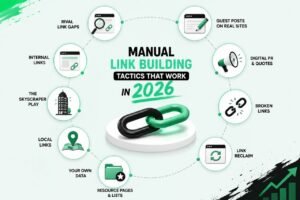
These are the methods a manual link building service uses regularly. Each one needs a person to check whether the opportunity is a good fit.
1 – Rival link gaps:
Find websites that link to three competitors but not to you. Contact each site and suggest a stronger page.
2 – Guest posts on real sites:
Guest blogging can still work when the website has real readers. Avoid sites that only have a “write for us” page but little or no traffic.
3 – Digital PR and quotes:
Engage in public relations activities to gain media coverage and backlinks from reputable media outlets. Respond to reporter requests with useful, original insights. One good quote can earn a link from a major publication.
4 – Broken links:
Find dead links on useful resource pages and offer your page as a replacement. You are helping solve a problem, which can lead to better response rates.
5 – Link reclaim:
Recover links that were lost because of website moves, redirects, or deleted pages. This can be one of the most valuable tasks in link building, but many teams overlook it.
6 – Resource pages and lists:
Ask to be included in resource pages and roundups where your content genuinely fits.
7 – Your own data:
Survey your users, study your product data, and publish the findings. Writers often use useful statistics in their content, which can bring links for years.
8 – Local links:
If you have a shop or office, local directories, community websites, and local lists can still help improve your map-pack reach.
9 – The skyscraper play:
Create a better version of a popular page, then contact the websites that already link to it.
10 – Internal links:
Make sure each new link leads visitors and value toward other important pages. Add internal links from that page to the pages you want to rank.
How To Vet A Manual Link Building Service
Run this checklist on every firm you shortlist. Ours too.
1 – Ask for live links:
Not a case study PDF. Ask for real URLs from the last 90 days, then check each one for traffic.
2 – Ask who writes the pitch:
If a tool writes and sends pitches in bulk, it is not a manual link building service.
3 – Ask about sign-off:
You should be able to reject any site before a pitch is sent.
4 – Ask about pace:
Going from zero to 40 links a month is not a normal pattern. Good teams increase the pace slowly, and strong enterprise link building services plan that growth with you.
5 – Ask how they price:
Per-link pricing shows you what you are getting. A vague retainer without a clear link count does not.
6 – Ask what they refuse to do:
Any firm worth hiring should clearly explain which tactics they avoid, such as link farms, comment spam, bulk swaps, and black hat tricks that can lead to a manual action.
Walk Away If You See
- A promise of fixed DR numbers or guaranteed rankings
- Two or more links sold from the same domain
- Websites that sell links directly on their home page
- The same exact-match anchor text used on every link
- Hidden paid links that break Google’s rules and can lead to a penalty
In-House Vs A Manual Link Building Service
Basis |
In-House |
Manual Link Building Service |
| Cost | 1 to 2 salaries plus tools | $100 to $300 per link, pay as you go |
| Ramp | 3 to 6 months to build systems | Live in two weeks |
| Contacts | Start from zero | Editor network in place |
| Tools | Ahrefs, Semrush, outreach app — all yours to fund | Included |
| To scale | Hire more people | Order more links |
Most teams under 50 people find a manual link building service cheaper and faster than a new hire. Above that, a mix works well. One in-house lead sets the plan. An agency runs the volume.
The Bottom Line
A manual link building service is slower, costs more per link, and can be harder to scale. But it is also the approach that continues to work after a core update.
Want links that keep their value? Choose a manual link building service that shows you the list, writes every pitch by hand, and reports on real traffic instead of numbers that only look good.
VH Info provides this type of manual link building service for SaaS and B2B brands. Plans start at $100 per link. See how our SaaS link building services work, or book a call and we will identify your rival link gap before you commit to anything.
FAQs
1. What is manual link building?
Manual link building is the process of earning links through research, personal outreach, and genuine relationships. At VH Info, we identify relevant websites, review their quality, and contact the right people instead of relying on automated or bulk methods to secure valuable placements.
2. How much does link building cost?
Link building costs depend on website quality, industry, link type, and placement difficulty. At VH Info, plans start at $100 per link, with pricing based on the website and opportunity. Higher-authority websites generally cost more because they require more effort to secure.
3. What is a link building service?
A link building service helps businesses earn links from relevant websites through research, outreach, and relationship building. VH Info manages the process for SaaS and B2B brands, from finding suitable opportunities and writing outreach to securing placements and reporting the results.
4. Are backlinks still relevant in 2025?
Yes, backlinks remain relevant in 2025 when they come from useful, trustworthy, and relevant websites. VH Info focuses on earning quality placements rather than collecting links in bulk. A smaller number of strong, relevant links can be more valuable than many low-quality ones.
5. What are your top 3 link building strategies?
VH Info focuses on strategies that prioritize relevance and quality. Three strong approaches are guest posts on genuine websites, digital PR and original data that attract natural mentions, and broken or lost link opportunities where useful pages can provide a better replacement.
6. What are the three types of links?
Three common types are dofollow, nofollow, and sponsored links. Each has a different purpose and signals different information to search engines. VH Info considers the right type based on the website, placement, campaign goals, and overall link profile rather than using one approach.
7. Is link building the same as backlinking?
No. Backlinking refers to links that point from other websites to your website, while link building describes the work involved in earning those links. At VH Info, this includes researching prospects, creating outreach, building relationships, securing placements, and monitoring results.

 Vishal ambani
  Share
Share
 VH Info