
Creating a useful SaaS resource is only half the job. The bigger challenge is getting that resource in front of websites that already help their audiences discover trusted information. That is where resource page link building can create an opportunity worth exploring.
According to Ahrefs, citing Aira’s 2022 State of Link Building Report, 24% of SEOs used resource page link building. This approach combines two important activities: creating genuinely useful resources and conducting focused outreach to relevant resource pages. The goal is not simply to collect backlinks, but to earn relevant mentions where the resource makes sense for readers.
But what is resource page link building beyond finding a list of pages and sending emails. This guide explains what it is, how it works, what makes a SaaS resource link-worthy, how to find and qualify opportunities, and how to build an effective outreach process for the US market.
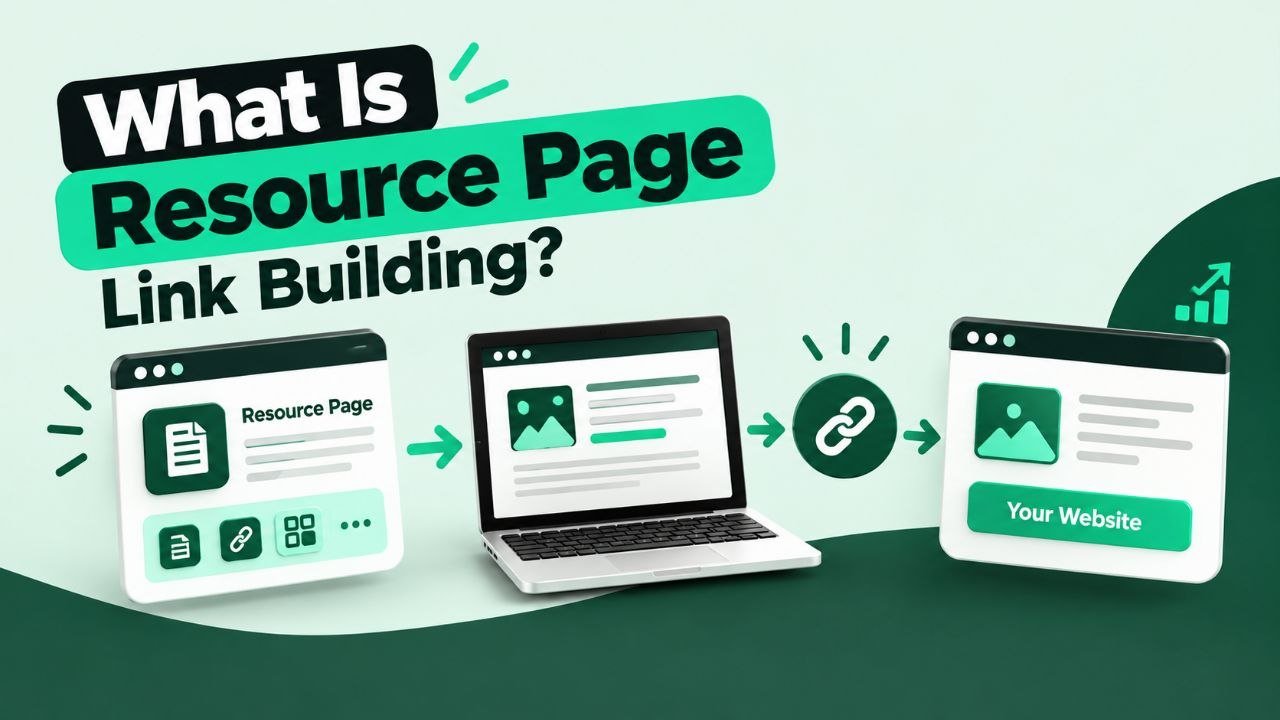
Resource page link building is an outreach method where a website asks to have a genuinely useful page included on a relevant resource list. The goal is to earn a reference because the asset improves the resource page for its readers.
SaaS resource pages collect guides, tools, templates, research, documentation, or educational references around a specific topic. The strongest opportunities are pages where the resource, subject, and audience naturally align.
A resource page link building strategy typically works like this:
For SaaS teams, resource page link building works best when every placement has a clear connection between the resource and the people using the page.
Resource page backlinks can place a SaaS website alongside references that readers already use to research a topic. Their value depends on relevance, context, and usefulness rather than simply the number of backlinks a website earns.
They can help by:
However, resource page backlinks do not automatically improve rankings. Google says links are one signal used to understand pages and discover content, while its systems also work to identify and prevent link spam.
Resource pages differ from other link building tactics because the target page already exists as a collection of useful references. The outreach usually focuses on suggesting an existing asset that naturally fits that collection.
The main differences are:
Resource page link building therefore depends heavily on finding the right existing page and showing why the resource adds value for its readers.
The comparison below shows the basic difference.
| Method | Typical starting point | Main opportunity |
| Resource pages | Existing resource collection | Add a relevant SaaS asset |
| Guest posting | Publisher content brief | Contribute useful expertise |
| Digital PR | Research, data, or story | Earn editorial coverage |
| Partner links | Genuine relationship | Reference a relevant partner |
| Industry listings | Organization or directory | Establish a relevant business reference |
SaaS products often solve problems that require research before buyers make a decision. Helpful guides, calculators, templates, research reports, comparisons, and checklists can help a brand become part of that process and give other websites a reason to reference its content.
A website can build stronger topical relevance by consistently covering related subjects with useful content. Mentions from relevant websites can support those connections when both pages cover closely related topics.
For example, an email automation company could create a checklist for improving email delivery, which a marketing education website may find useful for its readers. Relevance matters more than simply collecting a large number of links.
SaaS buyers often compare solutions, explore workflows, and look for practical information before contacting a company. Useful content can help a brand reach them earlier in this process.
For example, a CRM company could create a sales pipeline template that helps teams understand what they need. This makes the brand useful without turning every mention into a sales message.
A resource page can send relevant visitors when its audience actively uses the listed references. Traffic quality depends on the page topic, audience, visibility, and placement.
A smaller industry website with an active audience may be more valuable for a specialist resource than a large website with little connection to the topic. For SaaS brands serving specific markets, Local link building for SaaS can also support research into geographically relevant opportunities.
Links can help search systems discover and understand relationships between pages, but they are only one part of a wider visibility strategy. Google recommends helpful, reliable, people-first content and warns against manipulative link practices.
For AI search visibility, resources should clearly answer real questions and provide useful evidence, instructions, or information that other sites can understand and reference. Resource page link building can therefore support a broader content and search strategy.
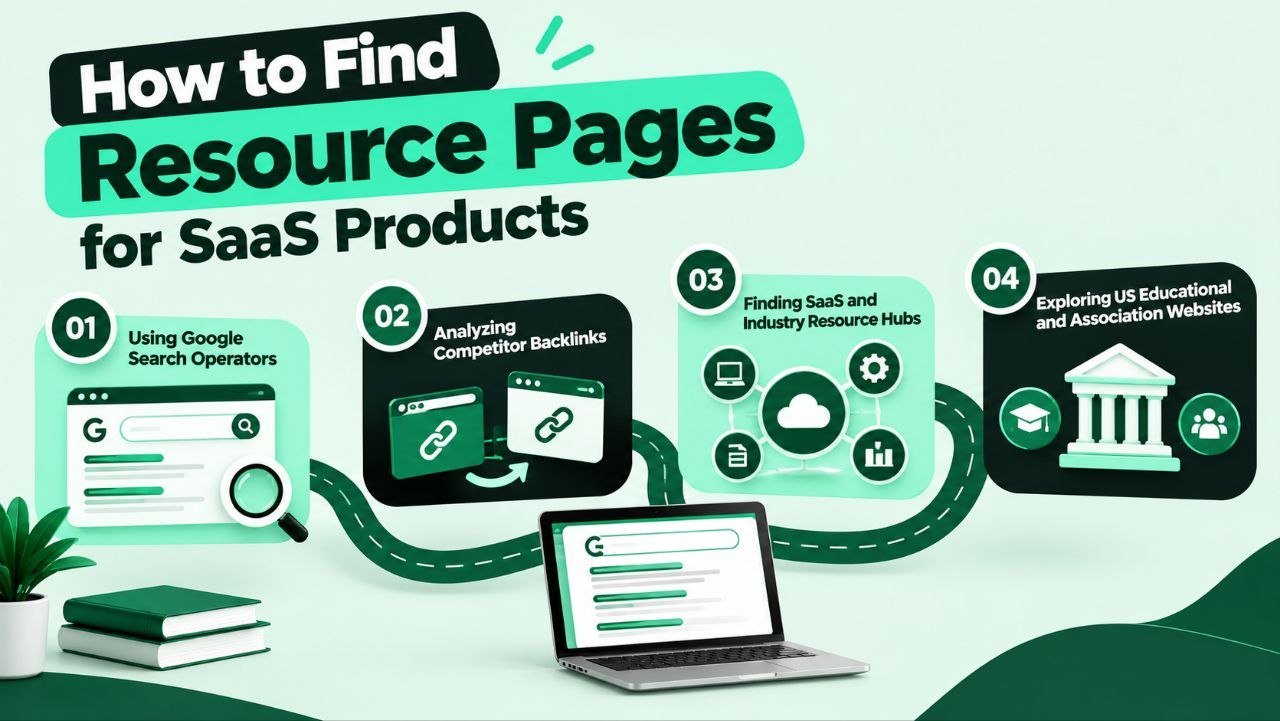
Finding prospects starts with search patterns, competitor research, industry hubs, and educational organizations. Using several methods together can create a stronger prospect list than relying on one search method.
Search operators can find pages using terms such as “resources,” “useful links,” “helpful websites,” “recommended tools,” and “further reading.” Combine these terms with your SaaS topic and target market.
Examples include:
Review each result for relevance, activity, audience, and editorial fit instead of collecting every result.
Competitor backlink analysis can reveal resource pages linking to similar products, guides, or industry content. Check several competitors for:
Use competitor research to find relevant opportunities rather than simply copying every backlink.
Industry hubs can appear on software communities, professional organizations, educational websites, associations, publications, and specialist companies. They may be called resource centers, learning hubs, toolkits, knowledge bases, or recommended resources pages.
Focus on topic relevance and look for:
Educational institutions and professional associations may publish guides, directories, reading lists, research collections, and student resources. A relevant page should fit your topic and audience.
Check the actual page rather than assuming a .edu or .org domain is valuable. Review its audience, topic, update history, outbound links, and editorial purpose before adding it to your prospect list.
A practical resource page link building process moves from asset creation to prospecting, qualification, outreach, and tracking. Each step helps remove weak opportunities before they take up outreach time.
A link-worthy asset should solve a specific problem better than a basic sales page. Examples include original research, detailed tutorials, templates, calculators, checklists, implementation guides, and practical frameworks.
Before outreach, check the asset from the reader’s perspective. Is it clear, current, useful, and detailed enough to deserve a reference? The asset should provide value even if no backlink is earned.
Build the list around topic, audience, geography, page type, and editorial fit. Record details such as:
A clear prospect sheet keeps resource page link building organized and helps prevent repeated or poorly matched outreach.
Vetting separates resource link building from bulk prospecting. Review the actual page instead of relying only on a domain-level score.
Check:
A smaller, active niche page may be more useful than a high-authority site with little relevance to your audience.
A good outreach message explains why your resource fits the page. Mention the relevant section and show how the asset can help readers.
For example, if a page already lists workflow templates, explain how your free implementation checklist fills a useful gap. Keep the message short and focused on reader value rather than a long company description.
Keep follow-ups limited, spaced out, and relevant. Avoid sending repeated messages that add no new information.
After a placement is accepted, check the published URL, destination page, anchor text, surrounding context, and link status. A resource page link building campaign should track both activity and placement quality, not just outreach volume.
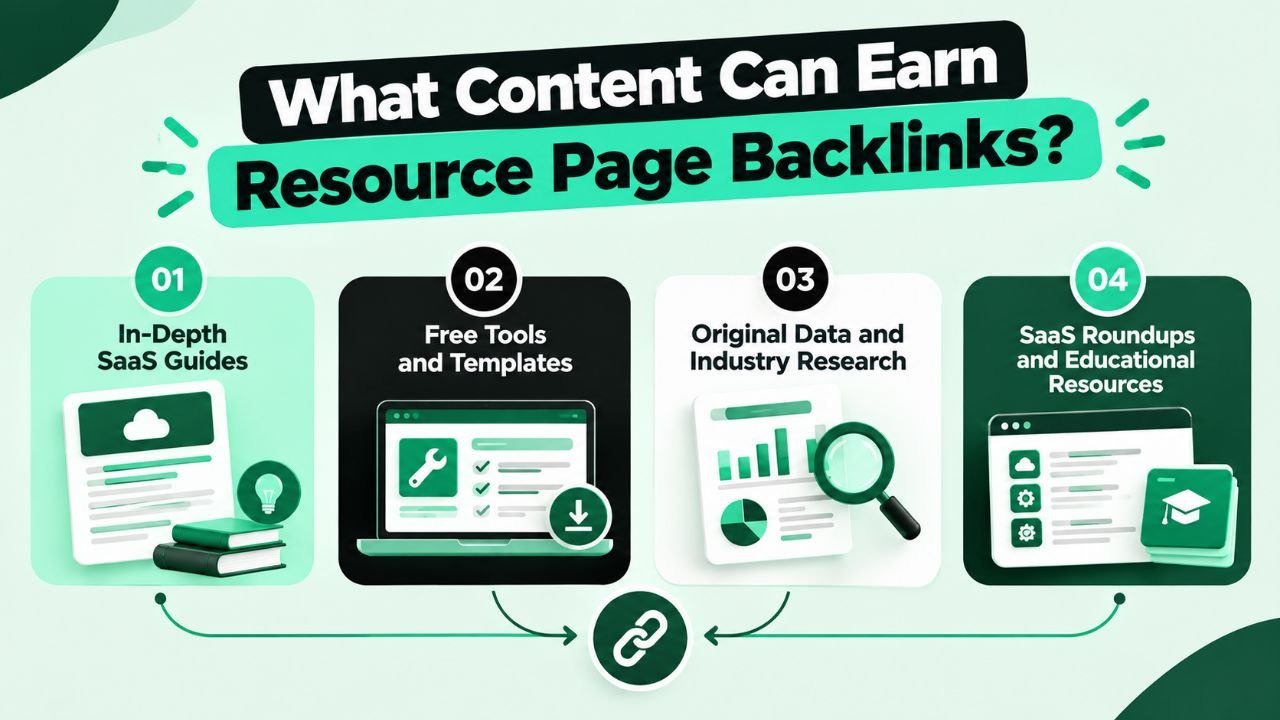
Content earns relevant backlinks when it gives editors a clear reason to recommend it. The format matters less than usefulness, originality, clarity, and how well it fits the existing resource collection.
Detailed guides can earn links when they solve a specific problem and provide practical steps. A SaaS guide should go beyond product features and explain a process, decision, implementation issue, or technical concept.
For example, a customer-support platform could create a guide to reducing ticket backlog. A support operations resource page may reference it because it directly supports a topic its audience needs.
Free tools and templates can attract links because readers can use them immediately. Examples include audit checklists, calculators, planning sheets, scoring templates, forecasting spreadsheets, and workflow documents.
The resource should be easy to access and understand. If visitors must book a sales call before using it, its value as a neutral resource recommendation may be weaker.
Original research can earn backlinks when it provides information other writers need to cite. Surveys, anonymized product data, industry benchmarks, and structured analyses can create useful citation opportunities.
Explain the methodology and limitations clearly. A small internal dataset should not be presented as a universal market truth. Good context helps publishers judge the research accurately.
Roundups and educational collections can earn links when they solve a real reader problem. A SaaS resource might organize learning materials, explain workflow options, or bring useful implementation tools together for a specific audience.
The goal is to create something editors can reasonably recommend. A focused educational resource is more useful than a thin list of commercial pages with little original value.
Qualification should consider the page, domain, audience, and link context together. No single metric can show whether a prospect is worth contacting. Below are the points that will help you to understand about this.
Topical relevance means the resource page and your asset cover connected subjects. Always read the page before deciding.
For example, a cybersecurity SaaS guide about phishing awareness may fit a security education resource but not a generic software list without a security section.
A simple test is to ask whether the link would still make sense to readers without considering SEO.
Authority metrics can help compare prospects, but they should not replace manual review. Check organic visibility, ranking pages, publishing activity, content quality, and audience relevance.
Ahrefs describes Domain Rating as its own website-level metric, not a Google ranking factor. Metrics can support prioritization, but they are not direct measurements of Google’s ranking systems.
A resource page that has not been updated for years may be harder to maintain. Check publication dates, broken links, recent edits, current references, and whether the organization still maintains the page.
Freshness does not always mean being new. An evergreen page can remain useful when its information and links are regularly maintained.
Review the number and type of outbound references. Pages that naturally link to useful third-party resources may be more open to another relevant addition.
However, many unrelated commercial links can indicate a different purpose. Check whether existing links are contextual, editorial, and useful to readers.
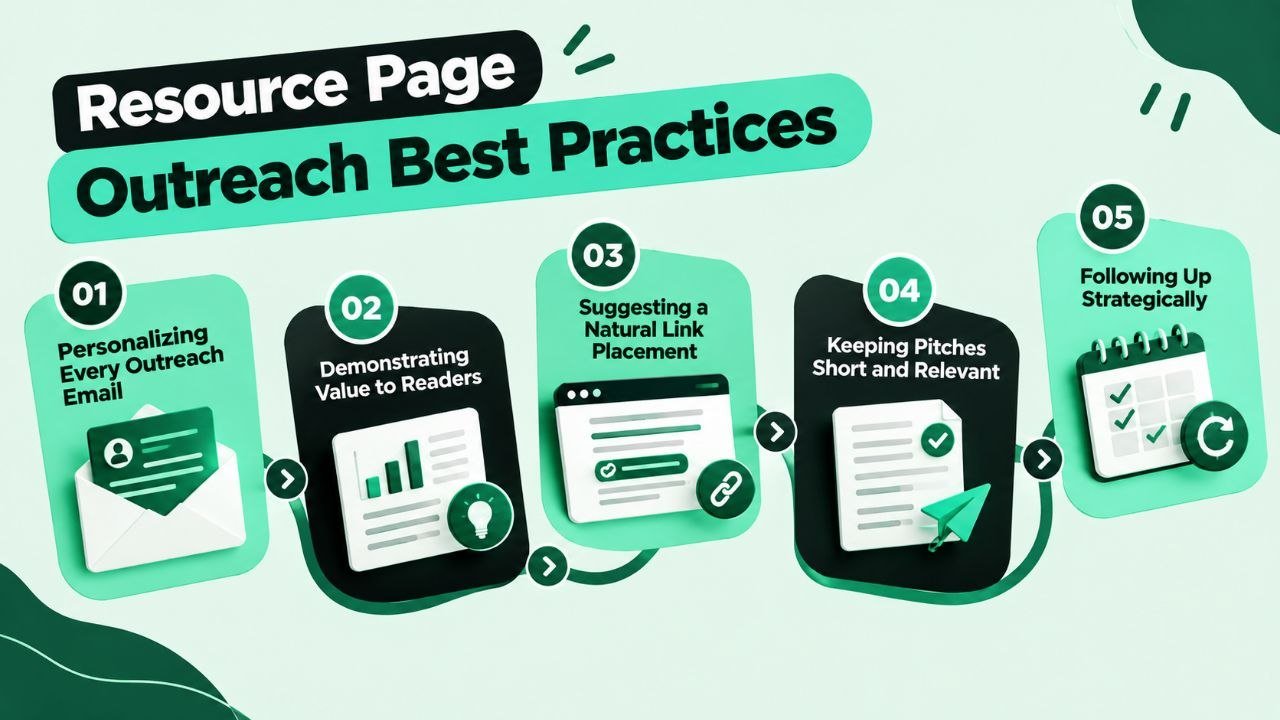
Good outreach is specific, brief, and focused on the value of the proposed resource. These practices cover personalization, reader value, natural link placement, short pitches, and strategic follow-ups so editors can quickly understand why a resource fits their page.
Mention the exact page and section that makes the opportunity relevant. You can also point out a topic gap or explain how your asset complements an existing reference.
Avoid sending the same paragraph to hundreds of sites. Personalization can be simple; one accurate observation is often better than several generic compliments.
Explain what readers can gain from the resource, such as a checklist, new data, calculator, detailed explanation, or free template.
Avoid leading with domain authority or backlink requirements. Editors manage pages for their audiences, so reader value should be the main reason for inclusion.
Suggest a placement only when the page has a logical place for the resource. The editor should remain free to decide whether and where to add the link.
Google recommends natural, descriptive anchor text and warns against filling link text with keywords.
A useful pitch can usually include three things: the relevant page, why the asset fits, and the resource URL.
Remove company history, long service descriptions, and unrelated achievements. Keep the message focused so the editor can quickly understand the opportunity.
Follow up when the original message may have been missed, but avoid repeated pressure. A simple reminder can mention the resource and relevant page again.
For larger campaigns, US outreach link building agencies can be part of the wider vendor landscape. The same standards still matter: relevant prospects, useful assets, clear approvals, and transparent reporting.
VH Info is positioned as a SaaS-focused link-building provider for B2B and B2C SaaS brands, technology companies, and agencies. Its services include link building, brand mention link building, tool listicle link building, and white-label link building.
A SaaS campaign can start with target URLs, audiences, publisher types, and content assets. It can then move through prospect research, qualification, outreach, approvals, placements, and reporting.
VH Info’s supplied positioning covers SaaS, AI, cybersecurity, CRM, hosting, sales, marketing, and other technology niches.
Resource prospecting involves finding pages where a suggested asset genuinely fits the topic and audience. Each prospect should have a clear reason for inclusion rather than being added from a search list alone.
A resource page link building company can manage this research at scale, while still showing clients why each opportunity was selected.
US-focused outreach should consider the publisher’s audience, location, subject, and editorial standards. A SaaS product targeting US buyers may need relevant technology, business, educational, and industry publishers rather than a general international list.
A link building agency or saas link building agency can provide another operating model when specialist prospecting and outreach require additional resources.
Scaling should increase qualified opportunities rather than simply increase email volume. Quality checks should remain consistent throughout resource page link building, even as campaign volume grows.
A SaaS link building agency can support teams that have limited time for prospect research and publisher communication. The supplied VH Info information specifically positions its services for companies with limited internal resources and provides client approval before links are created.
Tools can speed up research, but they do not replace manual judgment. Below are the tools that are essential for resource page link building.
Backlink databases can show referring domains, linking pages, anchor text, and competitor patterns. Search engines can also uncover resource pages that databases may miss.
Use these sources to build a candidate list, then manually check each page before adding it to the outreach queue.
Prospecting tools help organize URLs, contacts, categories, and campaign stages, while outreach platforms can manage messages and follow-ups.
Automation should reduce repetitive work, not replace relevance checks. Each personalized pitch still needs a human review of the target page.
Competitor analysis can reveal resource pages that already link to similar SaaS products and show what types of content publishers reference.
Instead of asking how to copy a link, ask why the publisher chose that resource and whether your asset can provide similar or greater value to readers.
Check contact details before outreach and use the relevant editorial, content, marketing, or site-management contact instead of a generic address.
Keep contact records organized and remove duplicate or invalid entries. Good data hygiene reduces wasted outreach and makes campaign reporting clearer.
Resource pages are one part of a broader SaaS acquisition mix. Resource page link building can work alongside guest posting, digital PR, partnerships, and content promotion. The main difference is how each method earns and supports a link.
Resource pages usually need an existing asset that fits an established collection, while guest posting requires a contribution that meets another publisher’s content requirements.
Resource opportunities can work well when a strong guide already exists. Guest posting can be useful when a company has subject-matter expertise to create a genuinely valuable article.
Digital PR often relies on a story, data point, expert opinion, or research finding that journalists may cover. Resource pages focus more on whether an asset is useful for an existing resource collection.
A SaaS brand can use both methods. Original research, for example, may earn editorial coverage while also becoming a useful reference for educational resource pages.
Partner links can come from genuine relationships with integrations, customers, associations, vendors, or other organizations. Resource pages are generally based on content relevance rather than a commercial relationship.
These methods can work together when each link has a clear reason to exist. The same asset may support partner education while also being useful for independent resource discovery.
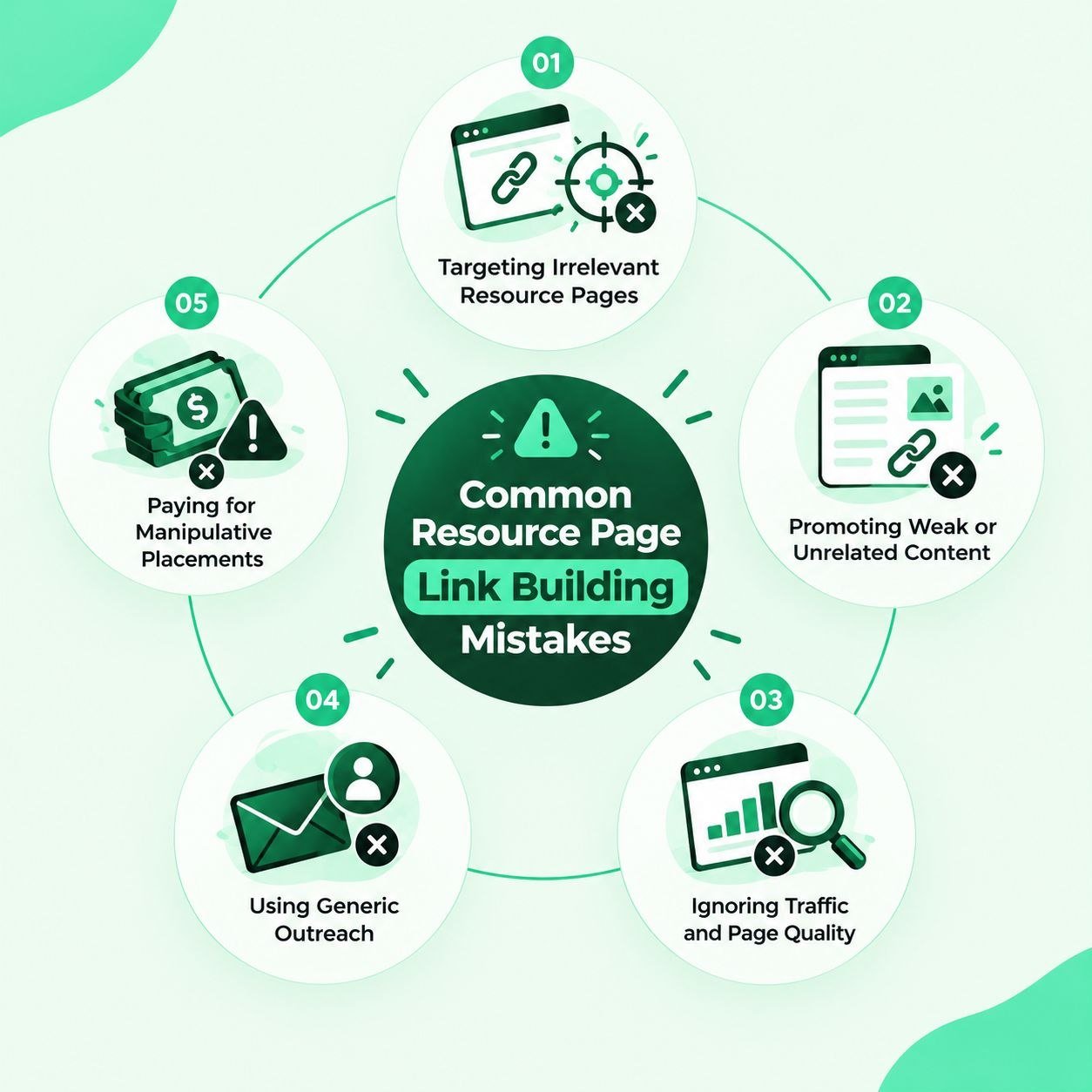
Most problems happen when resource page link building is treated mainly as a volume exercise. The points below cover the main mistakes around relevance, content quality, page quality, outreach, and placement practices, along with what to check before moving forward.
An irrelevant page may offer little value to readers or the SaaS brand. A high authority metric cannot make an unrelated topic relevant.
Check the page, section, audience, and surrounding links. If the resource would look out of place to readers, remove the prospect.
A weak asset gives editors little reason to add it. Product pages may work in some cases, but educational resource collections usually need content that helps readers solve a problem.
Improve the asset before increasing outreach volume. Stronger content makes its value and relevance easier to explain.
Traffic is only one signal. Also check content quality, page activity, relevance, and outbound-link patterns.
Do not reject a page only because it has modest traffic. A specialist resource can still be useful when its audience closely matches the SaaS topic.
Generic outreach makes it harder for editors to understand why a link belongs on their page. It can also show that the same request was sent to many websites.
Reference the exact page, explain the fit, and focus on reader value. This is a basic part of effective link building tactics.
Google defines link spam as links created mainly to manipulate search rankings. Its policies cover buying or selling links for ranking purposes, excessive link exchanges, automated link creation, and other schemes. Paid or sponsored links used for advertising should use qualifying attributes such as sponsored or nofollow where applicable.
A sustainable resource page link building campaign should focus on genuine relevance rather than treating every placement as a ranking transaction.
Outside support can help when a SaaS team understands the strategy but lacks the time or capacity to manage prospecting and outreach consistently. The points below cover workload, scalable prospecting, qualified opportunities, and consistent link acquisition, so teams can decide when additional support fits their workflow.
When comparing Top US link building providers, review their prospecting process, publisher standards, approval workflow, reporting, and approach to link quality.
Small marketing teams may already manage content, technical SEO, paid acquisition, product marketing, and sales support. Resource prospecting can easily become an irregular task.
An external team can handle research and outreach while the SaaS company controls its assets, target pages, and approval standards. The goal should be to reduce workload without reducing visibility.
Larger campaigns may require hundreds of potential pages to be reviewed before finding suitable outreach prospects. Manual research becomes difficult when one person handles it alongside other marketing tasks.
Structured link building services US campaigns can help with prospect discovery, filtering, outreach coordination, and reporting.
Finding pages is easy; finding pages where the asset genuinely belongs is harder.
A team may understand its product category but still struggle to find educational hubs, associations, niche publications, and resource collections across the US. Specialist research can reduce time spent on irrelevant results.
Consistency means maintaining a repeatable process for finding, reviewing, pitching, approving, and monitoring opportunities. A consistent workflow makes resource page link building easier to measure over time.
It does not mean forcing a fixed number of links regardless of quality. Before outsourcing, define target pages, audience, acceptable publishers, approval standards, reporting format, and disallowed tactics.
Resource page link building works best when the resource is genuinely useful and the target page already serves a related audience. The strongest campaigns focus on relevance, useful assets, careful qualification, and personalized outreach instead of chasing backlink volume.
For SaaS companies in the US, the process can start with a small set of strong assets and a tightly qualified prospect list. From there, teams can expand the campaign based on placement quality, referral relevance, editorial fit, and resource pages SEO considerations such as page quality, relevance, and search visibility.
If your team needs outside support, compare providers by their actual workflow, transparency, publisher standards, and approval process. VH Info is one example of a SaaS-focused link-building provider that can be reviewed alongside other options when evaluating support for these campaigns.
Natural links are references that a website adds because the linked content is useful to its readers, rather than because someone created the link mainly to manipulate rankings. A natural link can point to a guide, research report, tool, definition, or other resource that genuinely supports the surrounding content.
When one website links to a resource on another website, the link is generally called a backlink or inbound link from the perspective of the receiving site. The clickable words are called anchor text. If the reference is earned because the resource is useful, it may also be described as an editorial or natural link.
Natural link building focuses on earning references through useful content, relationships, publicity, and genuine editorial relevance. Instead of creating links through automated schemes or manipulative exchanges, the process gives publishers a reason to reference a resource. Google recommends creating unique, compelling content that people want to link to naturally.
Create resources that solve specific problems and make them easy for relevant publishers to discover. Original research, useful tools, detailed guides, templates, and practical studies can attract references when they provide genuine reader value.
Organic backlinks usually come from content other websites find worth referencing. Identify questions your audience needs answered, then create useful assets with clear evidence, practical information, or original data. Promote them through relevant communities and outreach.
Natural link building works by creating useful resources and making relevant people aware of them. A publisher decides whether the resource improves its page or helps readers. The process can include research, content creation, outreach, digital PR, and relationships.
Publish information that other sites have a practical reason to cite, such as original research, statistics, tools, templates, expert guides, and educational resources. Outreach can increase awareness, but pitches should focus on reader value rather than demanding links.
Publish resources that answer specific questions and offer something useful or distinctive. Identify relevant websites, resource pages, publications, associations, and communities, then personalize outreach around reader value. Avoid buying ranking links, automated schemes, and excessive exchanges.
Every article dives deep into what works, why it works, and how to use it.
Back in January 2014, Google’s Matt Cutts posted something that made a lot of SEO people nervous. “So stick a…
 Vishal ambani
October 15, 2026
Vishal ambani
October 15, 2026
Back in early 2011, J.C. Penney ranked No. 1 on Google for searches like “living room furniture.” Then The New…
Vishal ambani
October 14, 2026
Most US agencies offer link building. Far fewer can deliver it well. A Citation Labs and BuzzStream survey asked 300+…
Vishal ambani
October 13, 2026

 Share
Share