
Two SaaS companies launch the same feature page in the same week. Same keyword. Same word count. One sits on page four for a year. The other lands in the top five and quietly pulls in demo requests every month. The page did not win because it was better written. It won because other trusted websites pointed at it.
That gap is what b2b link building fixes. In B2B, your buying pool is small, the sales cycle is long, and one closed deal can be worth more than a thousand random visitors. So links are not a vanity number. They are how search engines and AI answer engines decide whether your brand is worth showing to a buyer with a budget.
This guide walks through what B2B links really are, the tactics that still work, honest pricing, a month-by-month timeline, how to judge quality, and the mistakes that quietly burn budgets.

B2B link building is the process of earning links from other business websites so search engines treat your site as a trusted source. The goal is not just ranking. B2b link building is really about being visible where your buyers already read, research, and compare tools. Below are the points that explain how B2B links differ and what makes one worth having.
A B2C brand selling sneakers can get results from fashion blogs, lifestyle websites, and viral content. Volume matters because the potential customer base is huge. B2B works differently. Your target buyer might be one of just eight thousand IT managers in the entire country.
That is why b2b backlinks are judged by who reads the website, not simply by how many people visit it. A link from a niche cybersecurity newsletter with 4,000 monthly readers can be much more valuable than a link from a general news site with two million readers. One reaches potential buyers; the other may reach very few people who can actually sign a contract.
| Factor | B2B Backlinks | B2C Backlinks |
| Audience size | Small and specific | Large and broad |
| Best sources | Industry blogs, SaaS review sites, trade media | Lifestyle blogs, news, influencers |
| Winning signal | Relevance and reader fit | Reach and volume |
| Content that earns links | Data reports, guides, tools, benchmarks | Trends, entertainment, product roundups |
| Payback window | 6 to 12 months, compounding | Faster but shorter lived |
Strong links in b2b link building have a few simple qualities. They appear in genuine editorial content, come from websites with steady organic traffic, and lead to pages that are genuinely useful to readers. The anchor text should also sound natural, like something a real person would write.
Relevance is one of the most important quality signals, yet many teams overlook it. If you sell payroll software, a link from an HR operations blog makes sense because it shows that your tool belongs in that industry. A link from a travel blog does not provide the same value.
Industry authority is another important factor. Some websites are trusted and regularly mentioned by people in your industry. Getting featured on these sites puts your brand into the right conversations. It can also support AI-generated answers because these systems often rely on sources that other trusted websites already reference.
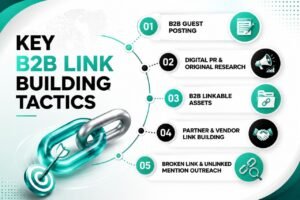
There is no secret list of tactics that nobody else knows. What makes a difference is how well teams use a few proven methods consistently, week after week. Below are the tactics that regularly earn links in b2b link building.
Guest posting is still one of the most reliable b2b link building tactics when the focus is on helping readers, not simply getting links. You suggest a topic the publication needs, write something useful, and add a link where it helps readers understand the topic. That is it.
The challenge is getting access. Editors at good industry websites receive dozens of pitches every week, so most are ignored. This is why many SaaS teams work with an outreach link building agency or blogger outreach partner that already has relationships in the industry, instead of starting with a cold list of email addresses.
One practical tip: give the publication three topic ideas instead of one. Editors like having options, and this can improve your reply rate.
Original data is one of the strongest ways to attract links in b2b link building. Other people cannot simply copy your numbers, so writers need to cite your research. Your business may already have useful data that most people do not have.
For example, a hiring platform can publish the average time-to-hire for different roles. A support tool can share first-response times by company size. Survey 300 customers, turn the findings into clear charts, and pitch them to trade journalists. One strong study can continue earning links for two or three years without constant outreach.
In b2b link building, a linkable asset is a page created to be referenced by others rather than directly convert visitors. Examples include free calculators, benchmark reports, templates, comparison matrices, and glossaries.
This is one of the cheapest forms of b2b link building, yet many teams overlook it. You already work with integration partners, resellers, agencies, customers, and vendors. Many of these businesses have partner pages, case study sections, or blogs.
Make a list of every logo shown on your website and every website where your brand appears. Then reach out and ask for a link. A simple message can work: we featured you on our integrations page, would you add us to your partner directory? Response rates are often much higher than cold outreach because you already have a relationship.
In b2b link building, broken link outreach means finding dead links on industry pages and suggesting your page as a replacement. It works best when the broken resource was a report or guide that your content can genuinely replace.
Unlinked mentions are usually easier and faster. Set up an alert for your brand name. When a website mentions your brand without adding a link, send a short and polite message asking them to add one. You are not asking for a big favour; you are simply asking them to complete something they have already started.
Not every directory belongs in b2b link building, but not every directory is low quality either. Category directories, software review platforms, industry association member lists, and university resource pages can still provide value and bring visitors who are actively comparing tools.
The rule is simple. If a directory reviews submissions, has a real audience, and has a category that matches your business, the listing can be worthwhile. If anyone can pay ten dollars and get listed in five minutes, skip it.
|
B2B blogs receive an average of 1,145 backlinks from 120 referring domains, according to Backlinko’s analysis of B2B websites.
|
Tactics without a clear plan can turn into random outreach. A b2b link building strategy helps you decide which pages need links, how many links they need, and when you need them. Below are the key steps for turning scattered efforts into a clear system.
Every b2b link building strategy should begin with the pages that directly support your business: your main service pages, top comparison pages, and the two or three blog posts that already bring signups. Find the top three competitors ranking for each target keyword and check how many referring domains their pages have.
The difference between their numbers and yours becomes your goal. If your competitors have 40 referring domains and your page has only 6, you can clearly see how much work is needed. General goals such as “more authority” usually lead to unclear results.
The competitor gap is one of the fastest ways to find prospects in b2b linkbuilding, and it can save you weeks of guesswork. Export the backlinks of three or four competitors, remove websites you already have links from, and you will have a list of publishers that have already linked to businesses similar to yours.
Sales pages rarely earn many links on their own, which is a common problem in b2b link building campaigns. People are more likely to link to content that helps them do their work. So, create a small group of useful, reference-worthy pages, earn links to those pages, and then pass that value to your commercial pages through internal links.
For example, a project management SaaS can earn 30 links to a free capacity planning template and then internally link that template to its pricing and feature pages. The template attracts the links, while the money pages benefit from the authority.
Not every link opportunity deserves the same amount of effort. A single link from a website your buyers regularly read can improve a keyword more than fifteen low-value placements.
| Priority | Type of site | Effort needed | Typical impact |
| High | Niche industry publication with real traffic | High | Ranking lift plus qualified visits |
| High | Original data pickup by trade media | High | Long-term compounding links |
| Medium | Relevant SaaS blog guest post | Medium | Steady authority growth |
| Medium | Partner and integration pages | Low | Easy trust and relevance |
| Low | General business blogs with thin traffic | Low | Minimal, sometimes zero |
In b2b linkbuilding, consistency beats intensity. A workflow that produces eight quality links every month will outperform a burst of forty links followed by six quiet months.
Keep it simple: build the prospect list on Monday, verify contacts and send pitches midweek, follow up twice at four-day gaps, and log every reply in one sheet. Most teams stop after one email, which is exactly where half the wins are lost.
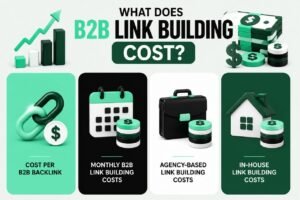
B2b link building pricing can be confusing for many founders because quotes can vary a lot. The cost depends on what you are actually paying for: just a link, or a link that also includes research, writing, and relationship management. Below are the main factors that explain where the money goes.
Most quality placements in b2b link building cost between $150 and $600 per link. Highly technical industries such as cybersecurity, fintech, and enterprise IT are usually at the higher end because there are fewer relevant publishers and editors have stricter standards.
If you see a link advertised for $20, it is usually from a network website with little or no real audience. It might look good in a report but may do very little for your rankings.
Most SaaS companies spend between $2,000 and $10,000 per month on b2b link building. Early-stage teams often start closer to the lower end, earning four to six links each month, and then increase their budget once they begin seeing keyword movement.
| Budget level | Monthly spend | Links per month | Best suited for | Realistic outcome |
| Starter | $1,500 – $3,000 | 3 – 6 | Early-stage SaaS | Slow but steady gains |
| Growth | $3,000 – $6,000 | 6 – 12 | Growth-stage SaaS | Visible ranking lifts by month 4 |
| Scale | $6,000 – $10,000 | 12 – 20 | Established SaaS | Multiple pages moving at once |
| Enterprise | $10,000+ | 20+ | Enterprise brands | Category-level visibility |
| White-label | Varies by volume | Agency dependent | SEO agencies | Delivery without hiring |
Handing b2b link building to an agency usually costs more per link than doing it yourself because you are paying for prospecting, writing, negotiation, and quality control. Pricing models can vary widely between providers, and comparing a few link building services in the USA side by side is a quick way to understand what is reasonable and what may be overpriced.
When you review a link building agency, ask three direct questions: Can I see live examples from my industry? Do you provide traffic data for placement sites? And do I get to approve every site before it goes live? These questions can also help when comparing backlink companies in usa.
Running b2b link building in-house may look cheaper until you calculate the full cost. One outreach specialist can cost $50,000 to $80,000 a year in the US. You also need tools such as Ahrefs or Semrush, writing costs, and the three to six months it can take to build relationships from scratch.
For most small teams, the biggest cost is time. Founders can end up doing outreach at 11pm, which is why many choose to work with a link building company and keep their attention on product and sales.
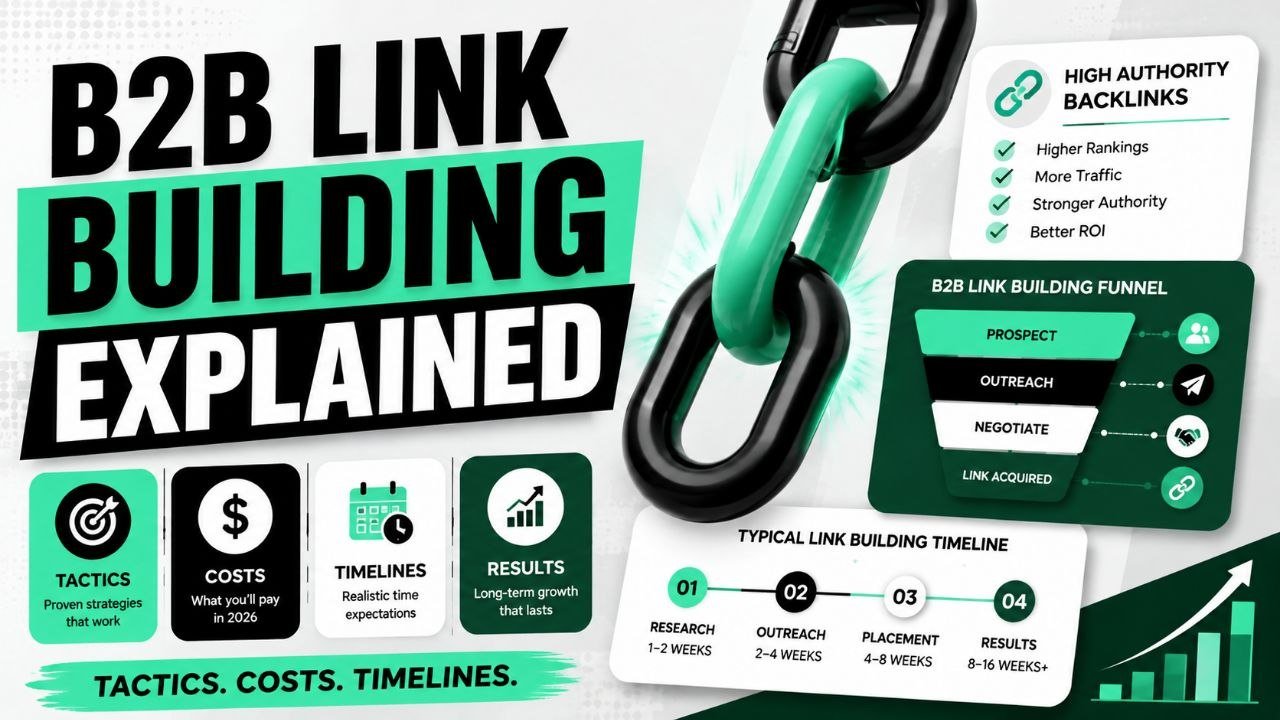
B2b link building does not work like an on-and-off switch. It works more like compound interest. Understanding the real timeline helps teams avoid giving up in the second month, just before results usually begin to show. Below is what typically happens month by month.
The first month may not feel exciting, but it is important. You review existing backlinks, choose target pages, map keywords, study competitor gaps, and create your prospect list. A few early links may go live, but the main goal at this stage is to set the right direction.
At this stage, placements begin going live. Expect a steady flow instead of a sudden spike. You will also learn which pitch angles receive the most replies, allowing you to improve the campaign. Rankings usually start moving a few positions for longer, lower-competition keywords.
This is when most teams begin to notice the impact. Pages that were stuck on page two may start reaching the bottom of page one. Organic traffic to the linked pages can increase, and branded searches may also start to grow.
By month six, the earlier links have had time to settle and build value. New pages can start ranking faster because the overall domain is stronger. Many companies find that posts published around month eight can rank in weeks instead of months because the SEO foundation is already in place.
| Period | Main activity | What you should see |
| Weeks 1-4 | Audit, mapping, prospecting | Strategy set, first links secured |
| Months 2-3 | Outreach and placements | Steady links, small rank movement |
| Months 3-6 | Volume plus content support | Page one entries, traffic growth |
| Months 6-12 | Compounding authority | Faster indexing, more leads |
| Month 12+ | Maintenance and defence | Stable rankings, lower cost per win |
If you learn one skill from this guide, make it this one because it can decide whether your b2b link building budget works. Knowing how to check link quality can protect your budget better than any tool subscription. Here are the points that separate a useful link from an expensive decoration.
Authority scores are a starting point, not the final answer. They are third-party estimates and can sometimes be inflated. Use them to shortlist websites, then check the actual page: Does it rank for keywords? Does it receive traffic? Does the site look active and maintained?
Ask one simple question: Would your ideal buyer realistically read this site? If the answer is no, the link is mostly decoration. A DR 40 site read by 3,000 DevOps engineers can be more valuable than a DR 70 general blog that nobody in your market visits.
Check where your link appears. A link inside useful body content is a good sign. A footer link, an author bio packed with brand names, or a page marked as sponsored content usually carries much less value.
Check the traffic of every potential site. Watch for two red flags: a site with high authority but almost no organic traffic, and a site whose traffic has dropped sharply in recent months. Both can signal potential problems.
The sentence around your link matters, and so does the page it leads to. Sending every link to your homepage can waste the opportunity. Point links to pages you want to rank, then use internal links to pass value to other important pages.
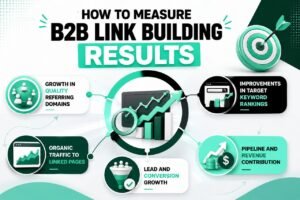
Raw link counts do not make useful b2b link building reports. Executives want to know how the business has changed. Below are the key metrics to track and the order to follow.
Count unique domains instead of total links. Fifty links from one website still represent one relationship. Track how many new, relevant domains you gain each month, and make sure the average quality stays strong instead of gradually declining.
Track keywords connected to your target pages rather than a large list of vanity keywords. Moving from position 34 to 14 may seem small, but it is often one of the strongest early signs that the campaign is working.
Check the pages that received links and compare their traffic before and after using a 90-day period. If a page gains five good links but traffic does not increase, either the links are not strong enough or the content needs improvement.
Connect organic sessions with demo requests, trials, and signups. Many B2B teams find that organic leads convert at a higher rate than paid leads because the buyer arrives while actively researching instead of being interrupted by an ad.
This is the metric that helps justify the budget. Track organic-sourced deals in your CRM and report pipeline value instead of link volume. If a campaign costs $4,000 per month and brings in one $60,000 contract, the campaign is clearly generating business value.
Most failed b2b link building campaigns fail because of the same few mistakes. Below are the common problems that can cost companies the most money, time, and effort.
Focusing only on link numbers pushes teams toward the easiest websites, which are often the weakest. Ten relevant links can be more valuable than a hundred random links, while also keeping your domain safer.
A pet care blog linking to your API monitoring tool looks strange to search engines and is not useful to readers. Relevance is essential in B2B because your buyer pool is too small to waste placements on the wrong audience.
If forty percent of your anchor text uses the same commercial phrase, the link profile can look unnatural. Keep it varied with brand names, partial matches, URLs, and simple phrases such as “this guide” or “their research.”
A link placed in a paragraph that has nothing to do with your product adds little value. Readers are unlikely to click it, and search engines may discount it. The surrounding sentence should give readers a genuine reason to click before the link can provide value.
Link networks, PBNs, and mass link swaps are still widely offered. They may create a short-term improvement but can lead to a longer decline. If a provider refuses to show or name the websites before placement, it is better to walk away.
Outsourcing b2b link building is not a sign of weakness. It is usually a practical decision: what does your team have to give up by handling everything in-house? Below are the signs that it may be time to get outside help.
If one marketer handles content, email, social media, product marketing, and SEO, outreach will often be the task that gets pushed aside. Small teams can benefit from outsourcing execution while keeping the overall strategy in-house.
Good outreach takes skill. It requires strong pitch writing, understanding editors, consistent follow-ups, and knowing which websites are actually worth pursuing. Teams without this experience can often get faster results by working with a b2b link building agency built for SaaS brands, rather than spending a year learning everything from scratch.
Building relationships with publishers can take months, and this is often the biggest challenge in b2b link building. An established link building agency for saas may already have contacts at the industry publications you want to reach, helping reduce the time needed to secure placements.
Scaling a b2b link building strategy from five links a month to twenty requires more prospecting, writing, and follow-ups. Most in-house teams cannot increase their workload that quickly, which is why growth-stage companies often turn to seo link building services when they reach a limit.
B2b link building is not complicated, but it does require consistent effort. You need a clear list of target pages, a steady supply of publishers your buyers actually read, content that people want to link to, and the patience to let six to twelve months of work build over time. Teams that treat b2b link building as a regular monthly activity tend to see better results. Teams that treat it as a one-time project usually do not.
If your internal team is already stretched thin, getting outside support can make sense. VH Info is a SaaS-focused link-building agency that works with SaaS, B2B software, AI, cybersecurity, and other technology companies. It uses white-hat outreach and a competitor-gap approach to earn relevant backlinks.
The team focuses on links that can improve search rankings, domain authority, and organic traffic, with transparent pricing and a dedicated project manager. This allows busy founders and marketing teams to stay focused on product and revenue. If this sounds more suitable than hiring another in-house team member, it may be worth discussing before your next quarter begins.
The most effective b2b link building strategies include guest posting on industry publications, publishing original research that journalists can cite, creating free tools and templates, reclaiming unlinked brand mentions, and asking partners for links. In b2b link building, relevance and consistency matter much more than volume or clever tricks.
The main types of b2b link building include editorial links earned through useful content, outreach links from guest posts and digital PR, relationship links from partners and customers, directory and resource listings, and reclaimed links from broken pages or unlinked mentions. Each type works for different goals and budgets.
Link building means getting other websites to link to your website, while b2b link building focuses on business-related publishers. Each link works like a recommendation that tells search engines your content can be trusted. Strong b2b backlinks can improve rankings, bring referral visitors, and help AI search tools cite your brand when people search for your category.
Most quality b2b link building placements cost between $150 and $600 each, while monthly budgets usually range from $2,000 to $10,000. Pricing depends on website quality, niche difficulty, and whether writing is included. Cheap links from low-traffic websites rarely provide meaningful ranking improvements.
Yes. Links remain an important ranking signal, and AI search tools also rely on sources that are widely cited and trusted. A strong b2b link building strategy can support both traditional search rankings and visibility in AI-generated answers, making quality backlinks more valuable, not less.
A b2b link building specialist researches relevant websites, finds contact information, pitches ideas to editors, negotiates placements, and handles follow-ups. They also check website quality and traffic before outreach. In b2b linkbuilding, they focus on publishers your buyers actually read instead of simply chasing high link volume.
Adding one link to an existing article, often called a link insertion, usually costs $100 to $400 depending on the website. Guest posts generally cost more because they also include writing. Always check that the website has genuine organic traffic before paying for a placement.
Every article dives deep into what works, why it works, and how to use it.
Do you remember HARO? For years, Help a Reporter Out was the easiest way to win links from journalists. Then…
 Vishal ambani
October 16, 2026
Vishal ambani
October 16, 2026
Back in January 2014, Google’s Matt Cutts posted something that made a lot of SEO people nervous. “So stick a…
Vishal ambani
October 15, 2026
Back in early 2011, J.C. Penney ranked No. 1 on Google for searches like “living room furniture.” Then The New…
Vishal ambani
October 14, 2026

 Share
Share