
The best FatJoe alternative for a SaaS brand isn’t always the cheapest one. It’s the one that puts your links on sites your buyers actually read. That sounds simple, but many SaaS teams only learn it after their first big link order.
Picture ten new guest posts going live in two weeks. The price felt fair and ordering was easy. Then you look at the sites and find home décor blogs and travel guides. Worse, Google’s spam policies on links say paid links that pass ranking value can hurt you, so cheap shortcuts carry real risk.
FatJoe is a popular, affordable choice, but it isn’t always the right fit for SaaS. In this guide, we compare the top FatJoe alternative options, from custom outreach agencies to simple per-link services. You’ll also learn what makes a quality link and how to choose the right provider for your growth stage.
TL;DR
FatJoe is quick and affordable, but SaaS teams often need more relevant sites and more say in where links go.
The best FatJoe alternative for you depends on your budget, your growth stage, and how much planning you need.
VH Info is a good fit for SaaS brands that want hand-built outreach, site approval, and relevant placements.
uSERP and Siege Media work well for bigger SaaS brands with larger budgets and long-term goals.
Editorial.Link, Rhino Rank, and The HOTH suit teams that just want simple pricing per link.
Before you pick any provider, check that its sites are relevant, get real traffic, and come with clear reports.
FatJoe is an SEO outsourcing company that started in 2012. Instead of running custom campaigns like a traditional agency, it works more like a self-serve platform. You place orders, track progress, and get reports through one online dashboard.
FatJoe is best known for blogger outreach, where you choose guest posts based on a site’s Domain Rating. It also offers niche edits, digital PR, and white-label services that agencies can resell under their own brand.
Third-party reviews put FatJoe’s blogger outreach at about $60 to $72 per link for DR 10+ sites. Links on stronger sites, like DR 60+, can cost a few hundred dollars each. Most orders are finished in around two weeks, so it’s a quick option for many teams.
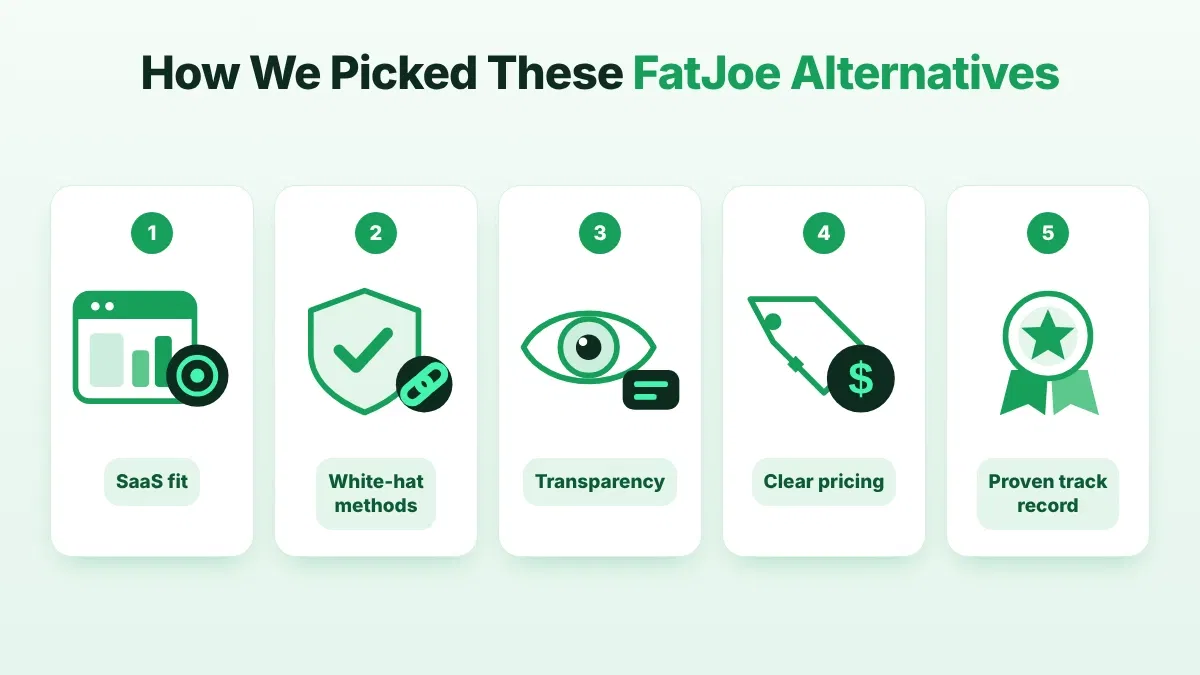
We didn’t just list popular link building names. Each FatJoe alternative in this guide was chosen because it meets the needs of SaaS brands in a clear way. Below are the criteria we used to decide which providers made the list.
We looked for providers that can place links on sites SaaS buyers actually read, like software, marketing, and tech blogs. Topic fit mattered more to us than Domain Rating alone, because relevant links reach the right audience and carry more weight.
Every provider on the list uses outreach, content, or editorial placements to earn links. We left out services that rely on link farms, private blog networks, or other risky tactics. SaaS brands can’t afford penalties that wipe out months of growth.
We gave extra weight to providers that share sample sites, offer site approval, or clearly report every live link. When you know exactly where your brand appears, it’s much easier to protect your reputation and prove results.
We included options for different stages, from per-link services for early-stage startups to retainers for larger SaaS brands. Each provider either publishes its prices or has pricing that’s widely reported, so you can compare costs more easily.
We checked how long each provider has been operating and how clients rate them on review sites. Only providers with a steady track record made the cut. That way, every FatJoe alternative here is a dependable option, not a short-term gamble.
Before diving into each provider, here’s a quick side-by-side view. It shows who each FatJoe alternative suits best and how it prices its work. Below is the comparison table, followed by a closer look at each option.
| Provider | Best For | Pricing Model | Starting Price |
|---|---|---|---|
| VH Info ↗ | SaaS brands that want hand-built outreach on real SaaS sites | Per link, based on DR | $100 (DR 45–59) to $300 (DR 80+) per link |
| uSERP | Well-funded SaaS brands at the enterprise stage | Monthly retainer | Projects start at $10,000+ (Clutch) |
| Siege Media | Established brands that want to earn links through content | Content retainer | Around $5,000 to $10,000+ a month |
| Page One Power | Custom link building focused on relevance | Custom retainer | Custom quote |
| Editorial.Link | Teams that want editorial links whenever they need them | Per link or package | $300 to $375 per link |
| Rhino Rank | Teams on a budget that want guest posts and curated links | Per link | Starts at $60 per link |
Every FatJoe alternative below has its own strengths, from custom SaaS outreach to quick per-link ordering. For each one, we explain what it does, how much it costs, and who it’s best for. Below are the seven options worth a look in 2026.
Over the past five years, the team at VH Info has built more than 20,000 links for over 50 clients, mostly across the USA and Europe. It’s a link building agency that focuses only on SaaS, so every campaign is shaped around how software companies grow. It also works with six SEO agencies on white-label projects. Most clients see their rankings move within five to six months.
VH Info works with both B2B and B2C SaaS brands. Its experience covers AI tools, cybersecurity, VPN and antivirus software, CRM platforms, hosting and infrastructure, website builders, and sales and email marketing software. That range helps the team find sites your buyers already read.
There are two ways to work with the team. In the done-for-you model, you share target pages and anchor texts, and VH Info handles outreach and placement after your approval. In the client-led model, you get a curated list of sites with guidelines, and your team places the links.
Many clients come to VH Info because they’re short on time or have a small team. Pricing is clear, with no hidden costs, and the team works monthly toward agreed targets. It also keeps a backup plan to stay on track, which is why many new clients arrive through referrals.
SaaS startups, growing SaaS brands, and enterprise teams that want relevant, approved links without managing outreach themselves. It’s also a strong fit for SEO agencies that need a reliable white-label partner.
Looking beyond FatJoe for SaaS links?
Book a quick call. Get SaaS-focused links, clear pricing, and your approval on every site.
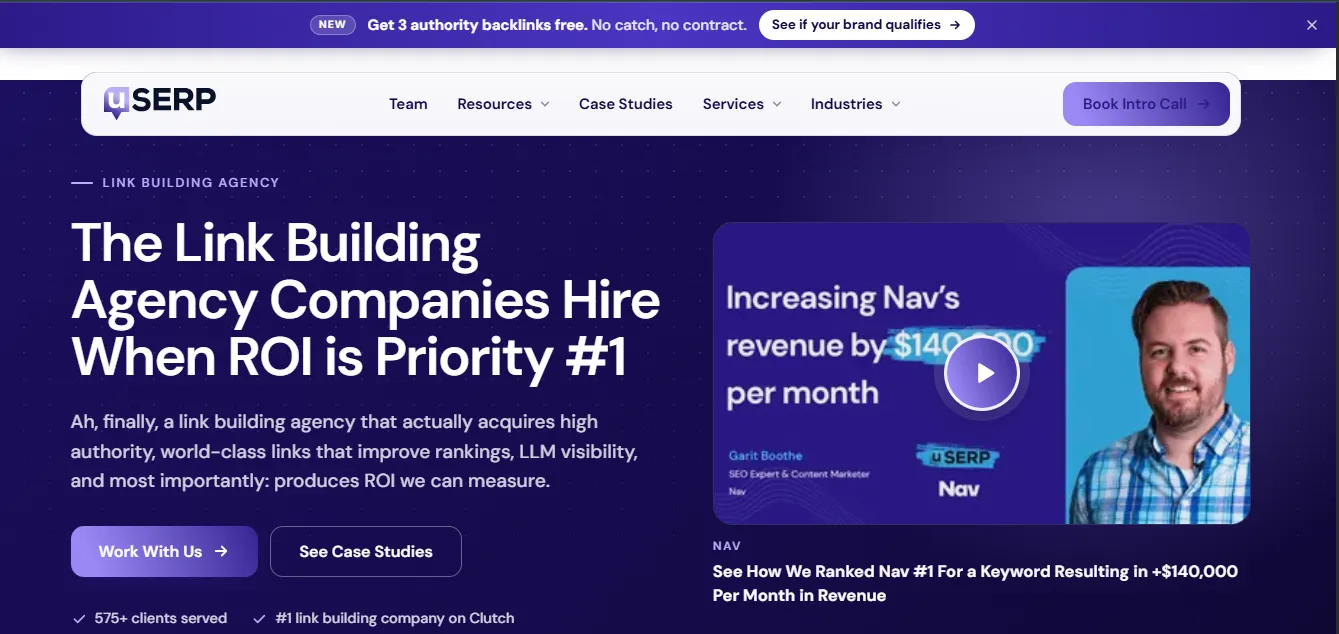
uSERP is an SEO and AI search agency that’s best known for link building. It goes after high-authority placements and brand mentions in well-known publications. On Clutch, it holds a 4.9 rating, and its minimum project size is listed at $10,000+.
The $10,000+ minimum project size puts uSERP out of reach for many early-stage SaaS companies. It’s built more for brands that already have a sizable marketing budget.
Custom retainers, with a minimum project size of $10,000+ according to Clutch.
Well-funded SaaS companies that want links and mentions from major publications.
Siege Media is a content marketing agency that earns links through useful, high-quality content. It creates things like data studies, infographics, and interactive tools that other sites want to cite. Instead of placing links directly, it builds content that attracts links over time.
Because links come from content, results usually take longer to show. It’s not the right pick if you need a set number of links each month.
Content retainers, often listed at about $5,000 to $10,000+ a month in industry roundups.
Established SaaS brands that want long-term content assets that keep earning links.
Page One Power is a link building agency that focuses on relevance and manual outreach. It builds a custom campaign around each client’s goals and target pages, instead of selling fixed packages.
Pricing isn’t published, so you’ll need a consultation before you know your costs. That can make it harder to compare quickly with per-link options.
Custom retainers, quoted based on scope and goals.
SaaS brands that want a fully custom campaign focused on relevant links.
Editorial.Link offers editorial links through hand-built outreach. You can order a single link or a larger package, and the price per link drops as you order more. Agencies get special pricing and white-label reports.
At $300 to $375 per link, it costs more per link than budget services. It suits teams that care more about link quality than volume.
$375 for a single link, $1,750 for 5 links, and $6,000 for 20 links.
In-house SaaS teams that want editorial links on demand, without a long contract.
Rhino Rank is a link building service known for curated links and guest posts. Curated links go into articles that are already live, while guest posts are new articles of 750+ words. It calls itself the original white-label link building agency.
Low starting prices don’t always mean SaaS-relevant sites. Check each site’s topic and traffic before you order.
Curated links start at $60, and guest posts start at $75.
Early-stage SaaS brands and agencies that want affordable links at scale.
The HOTH sells ready-made SEO products, from link outreach to fully managed SEO. Its link prices go up with site authority, and many agencies resell its services under their own brand.
It’s built for productized ordering rather than SaaS-specific strategy. You may need to guide site selection yourself to keep links relevant.
Link outreach costs $175 for DR 20+ sites, up to $405 for DR 50+ sites.
Agencies and SaaS teams that want simple, ready-made link packages.
The right FatJoe alternative depends on your goals, your budget, and how much say you want in where your links go. A cheap link that never reaches your audience can cost more in the long run. Below are the main things to check before you pick a provider.
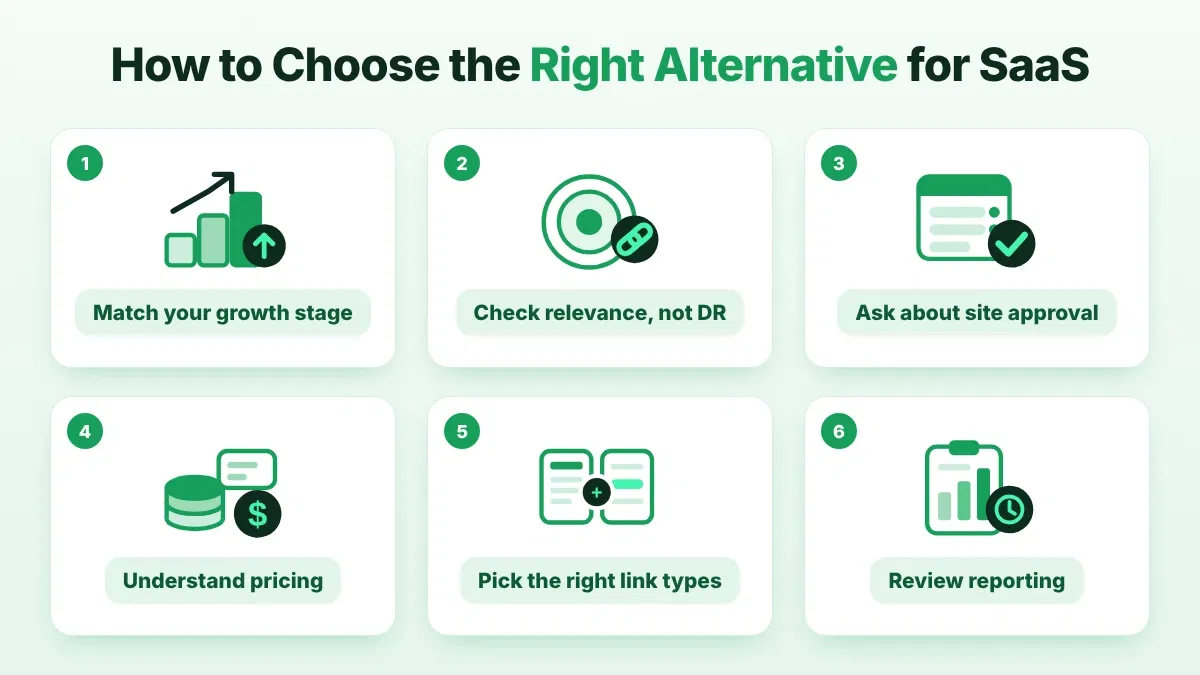
The right FatJoe alternative depends on your goals, your budget, and how much say you want in where links go. A cheap link that never reaches your audience can end up costing more over time. Below are the main things to check before you choose a provider.
Early-stage SaaS brands often do fine with affordable per-link services. Growing brands usually need an agency that plans links around specific target pages. Enterprise SaaS companies may need premium placements or digital PR to compete for the toughest keywords.
A high Domain Rating doesn’t mean a site is right for your brand. Ask for sample sites and look at their topics, traffic, and readers. It also helps to run a backlink quality analysis to make sure new links really fit your niche.
Some providers let you approve each site before they start outreach. Others place the links first and tell you about them later. If protecting your brand matters to you, pick a provider that shares sites for approval upfront.
Per-link pricing is simple and flexible, but the costs can pile up fast. Monthly retainers often include strategy, content, and reporting in one fee. Compare the total cost of each option, not just the price of a single link.
Different types of links work best for different goals. Guest posts build authority with brand-new content, while niche edits add your link to articles that already exist. Understanding link insertions vs guest posts helps you pick the right mix.
A good provider shares every live link, the page it points to, and key details about each site. Ask how often you’ll get updates and who you’ll be talking to. Clear reports make it much easier to show your team the results.
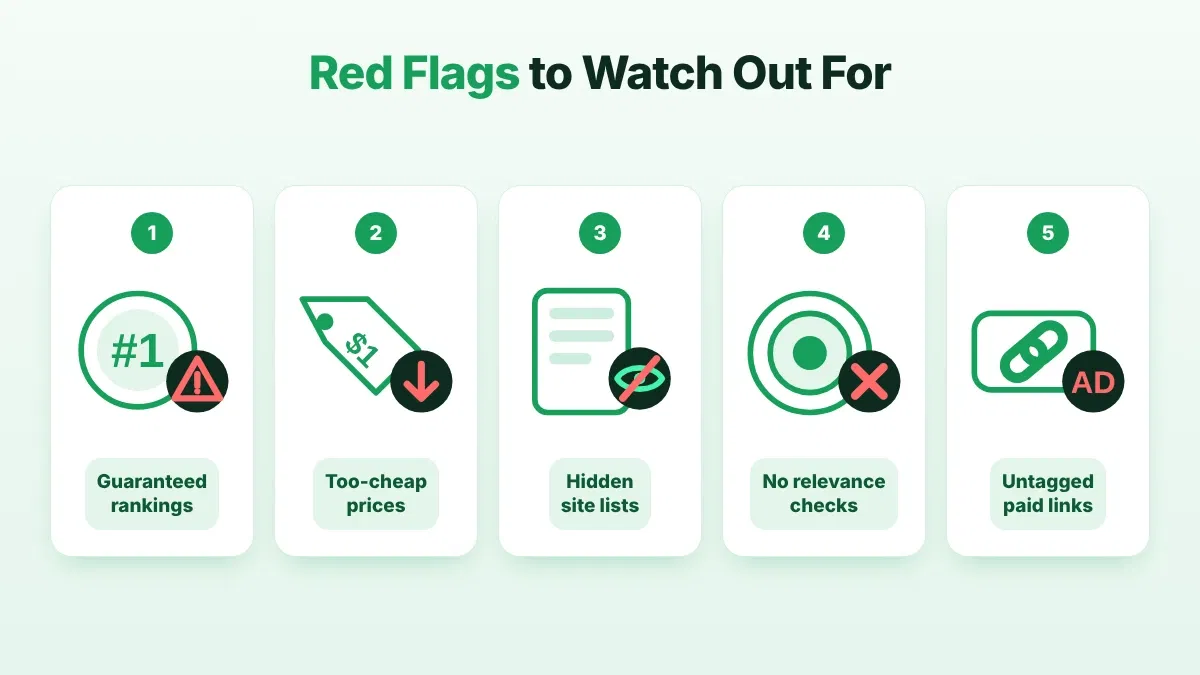
Not every link provider sticks to safe, white-hat methods. Spotting a few warning signs early can save you from wasted money or even a Google penalty. Below are the red flags to watch for when you compare options.
No honest provider can promise you a specific spot on Google. Rankings depend on your content, your competitors, and many factors outside anyone’s control. If a provider guarantees a top position, treat it as a sales trick, not a real promise.
Strong sites with real traffic take time and effort to land. If a provider sells high-DR links for a tiny price with no traffic proof, be careful. These often come from link farms and other black hat link building tactics that can hurt your site.
A good provider is open about where your links will go. If they won’t share sample sites or tell you where links will be placed, that’s a big warning sign. You should always know where your brand is showing up.
Links from sites that have nothing to do with your industry add very little value. For SaaS brands, a link on a random recipe or fashion blog won’t reach your buyers. Make sure the provider checks that every site fits your topic.
Google’s spam policies on links say paid links should be marked as sponsored or nofollow. Providers that sell paid placements as normal links can put your site at risk. Always ask how they handle this before you sign up.
Links built around your competitors’ gaps
We find sites that link to your rivals, not you, and earn those links.
FatJoe is a good option when you want links quickly and at a fair price. But as SaaS brands grow, they usually need more relevant sites, more control, and a clearer plan. The right FatJoe alternative really comes down to where your business is right now.
If you’re just starting out, a simple per-link service may be all you need. As you grow, a strategy-led agency or a content-focused partner tends to bring stronger results that last longer.
At VH Info, we work with SaaS brands that want links on sites their buyers actually read. You approve every site before we reach out, and we share every live link in our reports. That way, you always know exactly what you’re paying for.
The best FatJoe alternative for SaaS is one that places links on sites your buyers actually read. VH Info is a strong pick for this, with hand-built outreach and site approval. Larger brands may also look at uSERP or Siege Media.
SaaS brands usually switch when they need more relevant sites and more control over placements. Links from off-topic blogs rarely reach software buyers. Many teams also want a clear strategy built around their target pages, not just one-off link orders.
A good FatJoe alternative should place links on relevant sites that get real traffic. It should let you approve sites before outreach and report every live link. Safe, white-hat methods and clear pricing that fits your budget matter just as much.
No, Domain Rating shouldn’t matter more than relevance for SaaS links. A high DR shows a site’s overall strength, but relevance decides whether the link reaches your buyers. The best links come from sites that are both strong and closely related.
Yes, approving sites before outreach is a smart move for SaaS brands. It helps you avoid off-topic or low-quality sites and keeps your brand safe. At VH Info, every site is shared with you for approval before any outreach begins.
Yes, you can use more than one link building provider at the same time. Many SaaS brands mix a per-link service with a strategy-led agency. Just keep one shared list of target pages, so different providers don’t build duplicate links.
Ask where your links will be placed, whether you can approve sites, and how links are reported. Also ask about traffic requirements, replacement policies for lost links, and contract terms. Clear, honest answers usually point to a trustworthy provider.
Get a free backlink gap analysis for your SaaS site. We'll show you the placements your competitors are winning and how to close the gap.
Book My Free Strategy Call →20,000+ white-hat links built for SaaS brands
Every article dives deep into what works, why it works, and how to use it.
A SaaS founder spends forty minutes talking on a small industry podcast. She shares how she handles a problem her…
 Vishal ambani
October 24, 2026
A SaaS team publishes fifty blog posts in one year. The writing is good, the topics are useful, and the…
Vishal ambani
October 23, 2026
A small agency signs a new SaaS client for $1,500 a month in link building. It feels like a big…
Vishal ambani
October 22, 2026

Find quick answers to your questions.
Questions and answers will appear here soon.
 Share