
Getting backlinks is easy. Getting backlinks that actually improve rankings is much harder. You may see new links appearing in your dashboard every month, yet your rankings barely change. So, what is going wrong?
The problem often comes down to where those links are placed. A backlink buried on a resource page or author bio with little traffic may add very little value. A contextual link building service takes a different approach by placing links naturally inside content that people already read.
But does every contextual link building service deliver the same quality? And how can you tell which providers are actually worth your investment?
In this guide, you’ll see how five well-known contextual link building service providers compare, what separates valuable contextual backlinks from weak placements, and which factors you should check before signing a contract with any link building agency.
Contextual link building means placing a backlink naturally inside an article, guide, or blog post, surrounded by relevant text. A contextual link building service places the link within a sentence rather than in a sidebar, footer, or directory.
Unlike generic backlinks, a contextual backlink comes from content related to your industry. A relevant backlink and contextual backlink often serve the same purpose: connecting related pages and providing useful information to readers.
For example, if a SaaS marketing article links to your SaaS onboarding tools page while discussing customer acquisition, that is a contextual backlink. The link fits naturally within the content, giving both readers and search engines a clear reason for the connection.
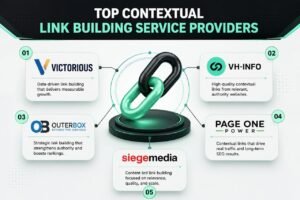
Picking the right contextual link building service depends on your budget, your industry, and how hands-on you want to be. Below is a factual look at five agencies that offer some form of service, based on their public websites, pricing pages, and third-party review platforms.
Victorious is a San Francisco based SEO agency known for combining technical SEO, content strategy, and link building into one connected system. It has been named SEO Agency of the Year multiple times and works with brands such as Salesforce, SoFi, and GE Digital.
Its link building service is one part of a broader organic search program rather than a standalone offer. The agency positions itself for established companies that want SEO, content, and authority building handled together under one roof.
| Field | Details |
| Contextual Link Building Services | 1. Editorial link building
2. Digital PR 3. Broken link outreach 4. Content-led link acquisition |
| Link Acquisition Methods | Manual outreach combined with content and digital PR campaigns |
| Link Quality Standards | Focus on relevant, authoritative sites tied to organic traffic value, not just domain metrics |
| Publisher Relevance | Industry and topic-matched publishers as part of a wider SEO strategy |
| Pricing | Retainers starting around $2,000 to $5,000 per month, with premium plans reported near $5,000 to $12,000 per month |
| Industries/SaaS Experience | IT and software, legal, ecommerce, finance, healthcare, and B2B tech clients |
| Best For | Established B2B and SaaS companies that want a contextual link building service bundled with full SEO strategy |
VH-Info is a SaaS-focused contextual link building service that helps SaaS, B2B software, AI, and cybersecurity companies grow organic visibility through white-hat backlinks. The agency works with startups, growth-stage SaaS companies, and enterprise brands, along with SEO agencies that want white-label support.
VH-Info has built more than 20,000 relevant backlinks across over 50 clients since it started, with a strong focus on the US and European SaaS market. Its link building service relies on a competitor-gap strategy to find placement opportunities that fit each client’s niche.
| Field | Details |
| Contextual Link Building Services | 1. Contextual link placements
2. Brand mention link building 3. Tool listicle link building 4. White-label link building for agencies |
| Link Acquisition Methods | Competitor-gap research paired with outreach to niche-relevant publishers |
| Link Quality Standards | White-hat placements only, with no spammy links or private blog networks |
| Publisher Relevance | Sites matched to SaaS, AI, cybersecurity, and B2B tech niches |
| Pricing |
DR 45–59: $100+ | DR 60–69: $150+ | DR 70–79: $200+ | DR 80+: $300+
|
| Industries/SaaS Experience | AI SaaS, cybersecurity, VPN, CRM, hosting, and B2B software companies |
| Best For | SaaS founders, CMOs, and agencies wanting a dedicated project manager and a B2B SaaS link building agency partner without the overhead of an internal team |
OuterBox is an Ohio-founded digital marketing agency established in 2004, with more than 250 in-house, US-based specialists. It is best known for ecommerce SEO and holds Google Premier Partner status, alongside a wide service list that includes its own link building service, paid media, and web design.
Its link acquisition work leans toward ecommerce and enterprise brands rather than SaaS specifically. OuterBox also runs a dedicated white-label link building program built for agencies and resellers that want to offer a contextual link building service under their own brand.
| Field | Details |
| Contextual Link Building Services | 1. In-content link placements
2. Content-led link earning 3. White-label link building |
| Link Acquisition Methods | Outreach paired with technical SEO review and linkable content support |
| Link Quality Standards | Publisher vetting for relevance and traffic, with anchor risk review for reseller campaigns |
| Publisher Relevance | Strongest for ecommerce, retail, and enterprise-level sites |
| Pricing | Link building packages reported from around $5,500 to $15,000 per month |
| Industries/SaaS Experience | Primarily ecommerce, retail, and enterprise brands; limited public SaaS case studies |
| Best For | Ecommerce brands and agencies that want a white-label contextual link building service bundled with broader digital marketing |
Page One Power is a Boise, Idaho based agency founded in 2012 by brothers Jon and Zach Ball. It runs an almost entirely manual, white-hat link building service, without the broader service menu that full-service SEO agencies typically carry.
The agency is frequently listed among the top link-building companies on Clutch. Its contextual link building service builds campaigns around resource link building, unlinked brand mention recovery, and broken link outreach, all done by hand rather than through automated tools.
| Field | Details |
| Contextual Link Building Services | 1. Guest post link building
2. Niche edits and link insertions 3. Resource-based link building 4. Broken link building 5. Brand mention recovery |
| Link Acquisition Methods | Fully manual prospecting, vetting, and personalized outreach to individual publishers |
| Link Quality Standards | Every placement reviewed for relevance, authority, and organic traffic before pursuit |
| Publisher Relevance | Custom-matched to each client’s vertical and target keywords |
| Pricing | Campaigns typically start around $3,700 per month, with reports of $3,500 to $12,000 depending on scope |
| Industries/SaaS Experience | Broad B2B and B2C client base; case studies span multiple industries rather than SaaS alone |
| Best For | Mid-market to enterprise brands that want a handcrafted, relationship-driven link building service |
Siege Media is a remote-first content marketing agency founded in 2012, with hubs in Austin, San Diego, New York, and Chicago. It built its reputation on high-volume content production for brands like Zendesk, Zapier, Figma, and Airbnb.
Links at Siege Media come mainly as a byproduct of content that ranks and earns citations, along with dedicated digital PR outreach, rather than being sold as a standalone contextual link building service. This content-first model suits companies already committed to a long-term content strategy.
| Field | Details |
| Contextual Link Building Services | 1. Content-led link earning
2. Digital PR 3. Data-driven outreach assets |
| Link Acquisition Methods | Content creation designed to earn organic citations, supported by digital PR pitching |
| Link Quality Standards | Editorial links tied to content performance rather than purchased placements |
| Publisher Relevance | Strong media and industry publication relationships built through digital PR |
| Pricing | Content marketing retainers reported from about $8,000 per month; digital PR retainers often $12,000 to $15,000 per month |
| Industries/SaaS Experience | Growth and enterprise SaaS, fintech, and ecommerce brands with $10M-plus ARR |
| Best For | Enterprise and growth-stage SaaS companies with budget for a long-term, content-driven link building service |
| Agency | Model | Typical Starting Price | Best Fit |
| Victorious | Full-service SEO with a link building service included | ~$2,000–$5,000/month | Established B2B and SaaS brands |
| VH-Info | SaaS-focused contextual link building service and brand mention link building | $100-$375 per placement | SaaS founders, CMOs, and agencies |
| OuterBox | Ecommerce SEO with white-label link building service | ~$5,500/month and up | Ecommerce brands and reseller agencies |
| Page One Power | Manual, relationship-driven contextual link building service | ~$3,700/month and up | Mid-market to enterprise brands |
| Siege Media | Content and digital PR-led link building service | ~$8,000/month and up | Enterprise and growth-stage SaaS |
Not every contextual backlink offers the same value. A reliable link building service checks several factors before securing a placement. Here are the key points to consider:
The linking page and your target page should cover related topics. For example, a SaaS pricing article linking to your SaaS pricing tool is relevant, while a random lifestyle blog linking to the same page is not.
The text surrounding the link should naturally explain why the link is included. If the surrounding content is unrelated to your product or service, the link can look forced.
A contextual backlink should appear naturally within the main body of an article rather than in a sidebar or footer. This is a key placement standard for any genuine link building service.
A quality contextual backlink should ideally come from a page that receives real organic traffic. A page with no visitors may offer little value, regardless of its domain authority.
The anchor text should fit naturally within the sentence and accurately describe the linked page. Overusing exact-match keywords can make the link look unnatural and signal a low-quality contextual link building service.
|
Top-ranking pages acquire followed backlinks from new referring domains at roughly 5%–14.5% per month.
|
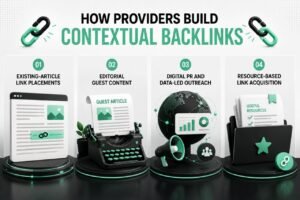
Agencies use different methods to secure contextual backlinks. Most contextual link building service providers combine several approaches based on the client’s goals and campaign needs. Below are the key methods providers use to build contextual backlinks:
This involves adding a link to an existing article that already ranks and receives traffic, often known as a niche edit. It can be a quick way for a contextual link building service to secure a contextual backlink from a page with an existing audience.
A writer creates a useful article for a publisher’s website and naturally includes a link to the client’s page. The quality depends on whether the publisher accepts genuinely helpful, non-promotional content.
This approach uses original research, data, or newsworthy ideas to earn coverage and links from journalists and industry publications. Because the links are earned through valuable content, they can become strong relevant backlinks.
A contextual link building service creates a useful resource, such as a guide or tool, and reaches out to relevant websites that may want to reference it. This works especially well when a topic has search demand but lacks strong resources.
Providers identify broken links to similar content or unlinked brand mentions and contact publishers to request a relevant replacement or link. Choosing between a specialist contextual link building service and an in-house team often depends on the time and bandwidth available, especially when comparing in-house teams vs agencies.
A few practical checks can help you choose a reliable contextual link building service, whether you are working with a link building agency or a specialist SaaS link building agency. Below are the key factors to consider when comparing providers:
Ask the contextual link building service for examples of publishers in your specific niche, rather than a general list of “high authority” websites from unrelated industries.
Check the actual organic traffic of the page where your link will be placed, not just the website’s overall traffic. Domain-wide numbers can be misleading when evaluating a contextual link building service.
Find out whether a real editor reviews and approves the content before publication. This helps you avoid automated or unmoderated placements from your contextual link building service.
A trustworthy contextual link building service should provide the live URL, anchor text, and target page for each link before or shortly after publication. Comparing a shortlist of top SaaS link building agencies can also help you identify providers that are transparent about their placements.
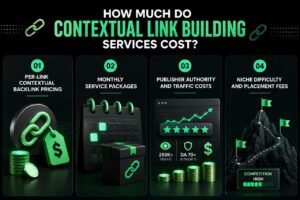
The cost of a contextual link building service depends on factors such as publisher authority, niche difficulty, and whether you choose individual links or a monthly package. Below are the key factors that influence contextual link building costs:
Individual placements from a contextual link building service can cost around $50 for a basic niche edit and $600 or more for a high-authority editorial link. Pricing depends on publisher traffic and editorial standards.
Monthly retainers for a contextual link building service generally start at around $2,000 to $5,000 for smaller campaigns. Enterprise-level campaigns can cost more than $10,000 per month.
Publishers with strong organic traffic and strict editorial standards usually charge more because they receive many pitches and accept only a limited number. Comparing local link building agency options across the US can also help you compare pricing before choosing a retainer.
Competitive industries such as finance, legal, and SaaS often have higher placement costs for a contextual link building service. This is mainly because there are fewer relevant, high-traffic publishers available for these niches.
Signing up for a contextual link building service is only the beginning. Tracking the right metrics helps you understand whether your investment is delivering results. Below are the key metrics to monitor:
Track how many new, topically relevant domains link to your website each month through your contextual link building service. Focus on the quality and relevance of these domains rather than simply counting every backlink.
Monitor the rankings of specific pages receiving links from your contextual link building service. This gives you a clearer picture than looking only at your overall domain visibility, which can change for other reasons.
Check how much direct traffic comes from the pages hosting your new links. This helps you see whether your placements from a contextual link building service are reaching pages that people actually visit.
Review whether the pages receiving links from your contextual link building service are gaining organic traffic and improving their keyword positions over time. This is one of the main goals of link building.
For SaaS companies, connect link placements from a contextual link building service to signups, demo requests, or trial starts whenever possible. Rankings matter, but the real value comes from generating business results.
Not every offer labeled as a contextual link building service delivers quality results. Some backlink companies in usa promise quick results without following proper quality checks. Below are the key risks to watch for before hiring a blogger outreach agency or any provider:
Some providers sell links on websites with inflated domain authority but little real traffic or connection to your industry. A reliable contextual link building service should focus on genuine relevance and audience value.
A link placed inside an article does not automatically make it valuable. If the surrounding content has nothing to do with your product or service, the placement may look forced, regardless of what the contextual link building service promises.
Using the same keyword-heavy anchor text repeatedly can make your backlink profile look unnatural and may attract unwanted attention from search engines. A careful contextual link building service should avoid this practice.
Networks that sell hundreds of links across the same low-quality websites rarely provide lasting value. This is not the approach you should expect from a genuine contextual link building service.
A link placed on a page with little or no search traffic offers limited value, even if the website has strong overall authority. A quality contextual link building service should prioritize pages that have real visibility and readers.
Choosing the right contextual link building service depends on your budget, industry, and how involved you want to be in the process. Some agencies include link building as part of a broader SEO program, while others focus on SaaS and B2B tech brands that need relevant, white-hat placements without managing outreach in-house.
For example, VH Info focuses its contextual link building service on SaaS, B2B software, AI, and cybersecurity companies looking to improve organic visibility through white-hat backlinks.
When comparing contextual link building services, focus on publisher relevance and real traffic rather than simply counting backlinks. These factors can help support stronger rankings over time and help you choose a provider that matches your goals.
A contextual link is a backlink placed naturally within the main body of relevant content, surrounded by text related to the topic. Unlike footer or directory links, it works like a natural citation within the content.
Yes, backlinks still play an important role in rankings, but quality matters more than quantity. Search engines and AI systems favor relevant backlinks from pages with real organic traffic and genuine editorial standards.
The three common types are natural links earned without outreach, manually built links secured through outreach or a contextual link building service, and self-created links such as directory or forum links.
SEO retainers generally range from $1,500 to $10,000 or more per month. The cost depends on the scope, industry competition, and whether the service includes content, technical SEO, and a contextual link building service.
Individual contextual backlinks typically cost between $50 and $600 or more. Pricing depends on the host page’s traffic, authority, and editorial standards. Higher-quality publishers generally charge more for placements through a contextual link building service.
Website builds generally range from $2,000 for a simple site to $30,000 or more for a custom enterprise website. Costs depend on design complexity, functionality, and ongoing development requirements.
Look for a host page with real organic traffic and strong topical relevance. The link should appear naturally within the main content, with anchor text that fits the surrounding sentence.
Most SaaS companies working with a contextual link building service may see early ranking improvements within three to six months. However, results depend on niche competition, starting authority, and how consistently relevant backlinks are added.
Every article dives deep into what works, why it works, and how to use it.
TL;DR Agencies that outsource link building for agency clients can take on more retainers without hiring, because a partner handles…
 Vishal ambani
August 29, 2026
Vishal ambani
August 29, 2026
TL;DR A digital PR company earns backlinks by pitching real stories, data, and expert quotes to journalists, instead of paying…
Vishal ambani
August 29, 2026
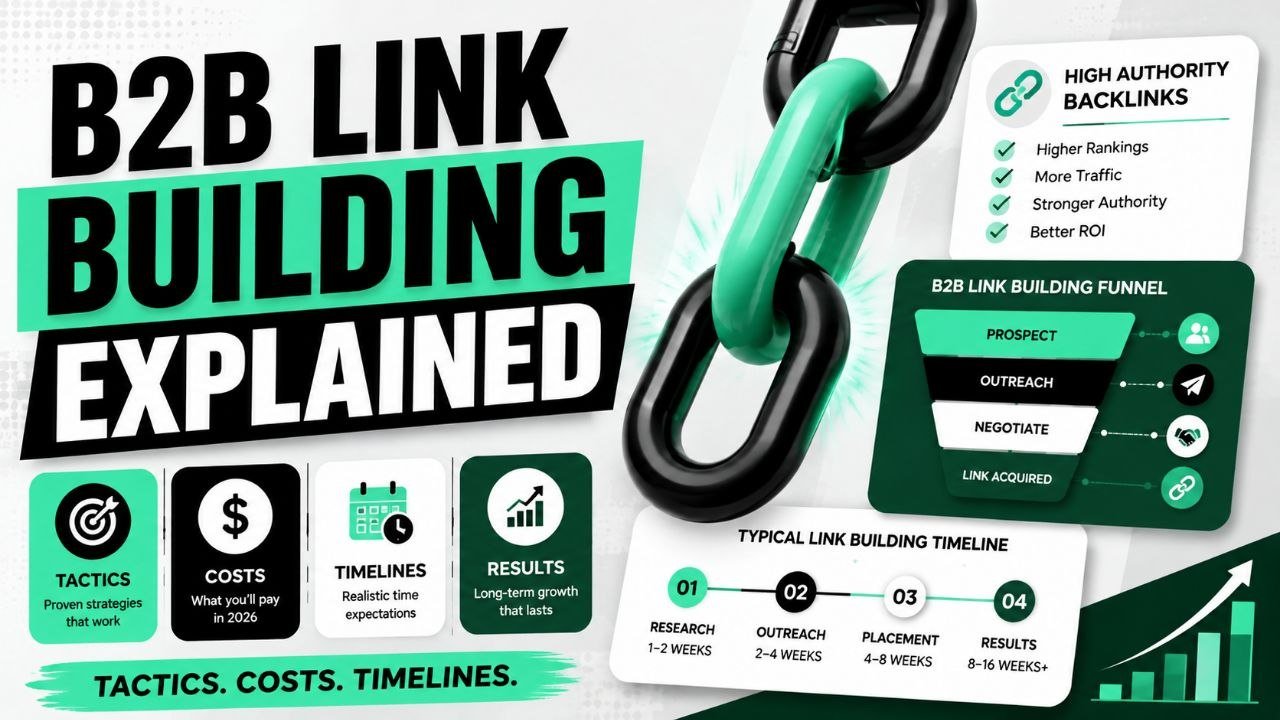
TL;DR B2B link building is the work of earning links from websites your buyers already trust. It is slower than…
Vishal ambani
August 27, 2026

 Share
Share