
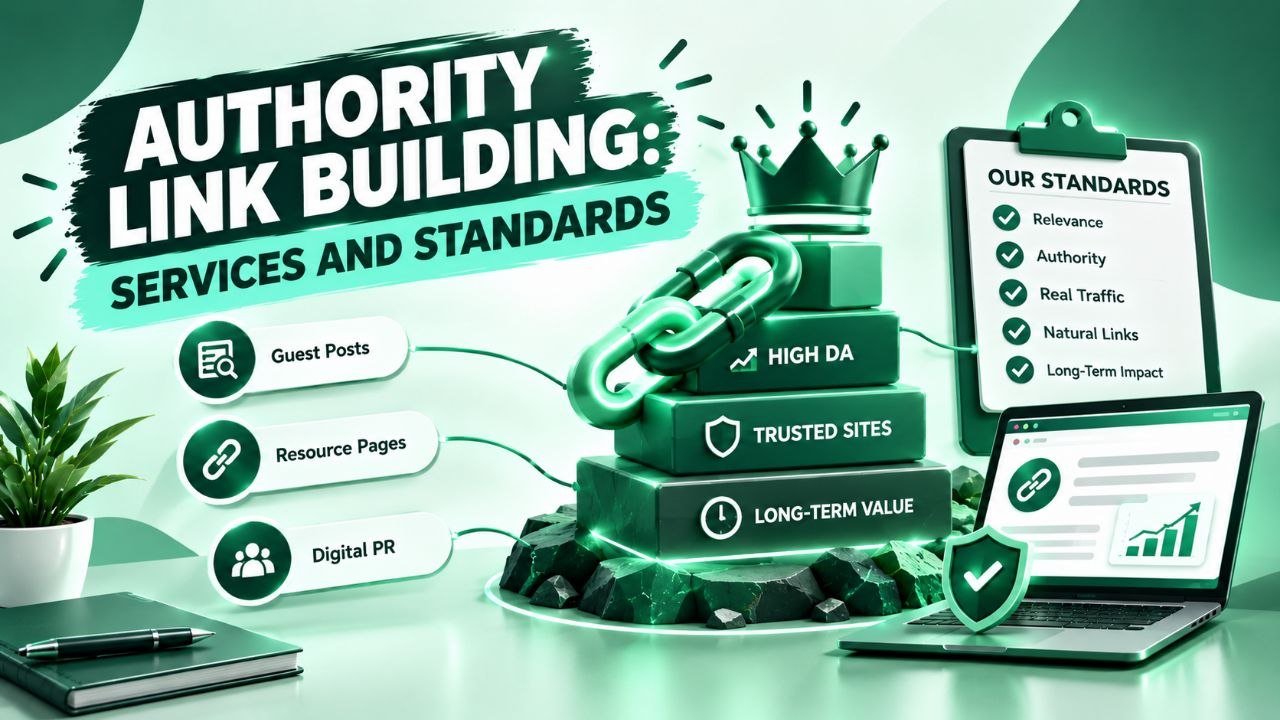
For SaaS brands competing in crowded search results, earning the right backlinks can influence how easily valuable pages gain visibility and reach relevant audiences. The challenge is finding placements that offer genuine relevance, credibility, and lasting value rather than simply adding another link.
A 2025 Ahrefs study analyzed the top 1,000,000 US keywords and found that referring domains had a 0.255 Spearman correlation with rankings, while total backlinks had a 0.248 correlation. Ahrefs also found stronger link correlations for higher-volume and informational searches.
The finding does not prove that links cause rankings. It does show why links remain relevant within a broader SEO strategy. This guide explains the services, standards, evaluation criteria, workflows, and practical safeguards behind modern authority link building.
Authority link building is a process for earning backlinks from websites that have genuine relevance, useful content, credible audiences, and editorial value. The objective is to build meaningful relationships and references rather than simply increase the number of referring domains.
The quality of a link depends on more than a domain score. The sections below explain what makes authority links different, how they compare with ordinary backlinks, and why quality should guide acquisition decisions.
An authority link comes from a credible and relevant website where the placement supports the surrounding content. Strong authority links usually have editorial context, audience relevance, useful destination pages, and a legitimate reason for the publisher to reference the source.
Authority links are assessed using relevance, editorial context, source quality, visibility, and audience fit. A standard backlink simply describes a link from another website. The difference is the quality and usefulness of the relationship surrounding that link.
Link volume alone cannot explain the strength of a backlink profile. Ten relevant editorial placements can be more strategically useful than hundreds of unrelated links. Quality evaluation helps teams spend resources on links that have genuine context and audience value.
A practical authority link building framework connects research, target-page selection, prospect qualification, outreach, and measurement. It gives a campaign a clear structure instead of treating every possible website as an equally valuable opportunity.
The framework also makes campaign decisions easier to explain. The following stages cover the main parts of an authority link building process, from finding gaps to measuring whether acquired links support meaningful growth.
Authority gaps appear when competitors have relevant referring domains that do not currently link to your website. Comparing those gaps can reveal publications, resources, associations, and communities that already show interest in your subject.
Choose target pages according to search importance, commercial value, content quality, and business priorities. A SaaS campaign might prioritize a product page, comparison guide, research report, integration page, or educational resource.
Qualification should consider topical relevance, organic visibility, content quality, audience fit, editorial standards, and outbound-link patterns. A high metric does not compensate for a website that has little relationship with the target audience.
Rank prospects according to relevance, audience quality, editorial fit, placement potential, and acquisition difficulty. This helps teams focus first on realistic opportunities that can provide useful exposure rather than spending time chasing impressive but unsuitable domains.
Track referring domains, placement quality, target-page performance, referral visits, rankings, and campaign progress. Looking at multiple indicators provides better insight than judging success through backlink counts or a single third-party authority score.
Authority link building services can use several acquisition methods because different websites respond to different forms of value. A SaaS brand may need editorial placements, expert contributions, digital PR, resource links, or brand mention reclamation.
The right service mix depends on the industry, audience, content assets, target pages, and competitive environment. The following services represent the core activities commonly used in a quality-focused campaign.
Editorial link acquisition earns references within articles, guides, reports, and other useful content. U.S. link building services can support this process when the linked resource genuinely improves the publisher’s page and gives readers a logical next step.
Digital PR uses original research, expert commentary, data, or timely stories to create media interest. Successful outreach gives journalists a clear reason to cover the subject and provides evidence they can use in their reporting.
Expert-led link building uses specialist knowledge to create publishing opportunities. Interviews, expert quotes, contributed insights, and commentary can earn relevant references when the contributor provides specific experience rather than generic promotional statements.
Resource and citation link building focuses on useful materials that publishers can reference. Research reports, technical documentation, statistics, detailed guides, and original studies can become natural destinations when they answer questions other websites need to support.
Brand mention reclamation identifies existing references to a company, product, founder, or resource that do not contain a useful backlink. When the mention is relevant, outreach can request a link that makes the reference more useful.

Building quality links requires a balanced strategy rather than one repeatable tactic. Strong campaigns consider competitor gaps, industry relevance, relationships, contextual placement, and diversity across referring domains.
These strategies help teams decide where to look and how to evaluate opportunities. The following methods focus specifically on building quality links through relevant research, outreach, and placement decisions.
Competitor link gap analysis identifies websites that already reference competing brands or resources. Those domains provide evidence of existing editorial interest, making them useful prospects when SaaS link building agencies assess relevant opportunities.
Relationship-based outreach focuses on relevant editors, publishers, writers, researchers, and industry contacts. Clear communication and useful contributions can create repeat opportunities because publishers become familiar with the expertise and resources your brand can provide.
Industry-specific prospecting narrows opportunities by subject, audience, publication type, and business context. For example, a cybersecurity SaaS company should prioritize security publications, technical resources, developer communities, and technology audiences over unrelated high-metric websites.
Contextual link acquisition places a backlink where it naturally supports the surrounding discussion. A link to a technical guide inside an article explaining that same technical problem is more useful than an unrelated link inserted only to create a backlink.
Strategic diversification means earning links from different relevant sources rather than relying on one acquisition method. Publications, resources, partnerships, expert contributions, research campaigns, and tier 2 link building can create a more varied and resilient backlink profile.
Digital PR gives brands a way to earn attention by contributing information that publishers can use. It can be especially valuable when a company owns original data, has specialist expertise, or can explain a developing industry trend.
The most useful campaigns begin with something genuinely interesting rather than a request for coverage. The following formats show how data, research, experts, and media relationships can support authority link building.
Original research can attract links because the findings are unavailable elsewhere. Surveys, benchmarks, customer studies, and proprietary datasets become stronger assets when the methodology, sample, findings, limitations, and practical implications are clearly documented.
A newsworthy data campaign connects original findings with a topic people already care about. Strong campaigns highlight a clear result, explain why it matters, and give journalists enough evidence to develop an accurate story.
Expert commentary adds interpretation to industry developments. A specialist can explain what a trend means, why a change matters, or what businesses should consider. Specific observations make commentary more useful than broad promotional opinions.
Journalist outreach works best when the pitch matches the reporter’s subject and publication. A concise message should explain the story, supporting evidence, expert availability, and relevance instead of sending the same generic pitch to every media contact.
Linkable assets give authority link building campaigns something substantial to promote. They can also continue attracting references after the initial outreach when the material solves a recurring information problem.
The most useful assets are created for a defined audience and purpose. The following formats can generate editorial interest when they contain original information, practical utility, or clear visual explanations.
Original statistics can become reference points for other publishers. An industry report becomes more useful when it explains its methodology, sample size, findings, limitations, and implications rather than presenting isolated numbers without context.
Interactive tools can attract links when they solve a practical problem. Examples include ROI calculators, pricing estimators, technical checkers, assessment tools, and planning calculators that provide useful outputs for a clearly defined audience.
Comprehensive research guides organize complex subjects into one useful resource. Their link potential increases when they include original examples, expert commentary, current data, practical explanations, and clear source information that makes the guide easy to reference.
Visual data helps publishers explain complex information quickly. Charts, diagrams, and infographics can support outreach when the underlying information is credible and the visual presentation adds clarity instead of simply repackaging common information.
Domain Authority can be useful as a screening metric, but it should not be treated as a complete definition of link quality. A website can have a strong score while offering poor relevance or little value to your audience.
A better assessment considers several signals together. The following factors help distinguish genuinely useful authority links from placements that look impressive only because of a numerical metric.
Topical relevance means the source website and destination page address connected subjects. For example, a cybersecurity publication linking to a security software guide has a clearer contextual relationship than an unrelated general website.
Organic traffic can indicate that a website attracts search visitors, while audience fit shows whether those visitors matter to your business. Both factors help estimate whether a placement can provide meaningful discovery beyond its SEO value.
Editorial context explains why a link belongs on the page. A reference within a useful explanation has a clearer purpose than a link placed in a generic author profile, directory, or page containing many unrelated commercial references.
Website trust comes from consistent publishing standards, credible information, useful content, and an identifiable audience. Reviewing the site’s recent content and editorial behavior provides more context than relying on one authority score.
Referral value considers whether readers are likely to click the link and find the destination useful. A smaller industry publication can therefore be valuable when its readers closely match the customers a SaaS brand wants to reach.
Authority link building can also include smaller industry and geographic sources. Associations, local organizations, partners, suppliers, community publications, and professional networks may offer relevant opportunities that larger publications cannot provide.
These sources become particularly useful when a campaign has a specific market or industry focus. The following areas show how local and network-based opportunities can fit into a broader acquisition strategy.
Industry publications and associations often reach highly relevant audiences. Expert contributions, member resources, event coverage, educational materials, and industry research can create legitimate opportunities for references when the relationship is genuine.
Local sources can support brands with regional customers, offices, events, or services. Relevant community publications, business organizations, chambers, and local resources can provide useful context when geographic relevance genuinely exists.
Partners and suppliers may provide legitimate link opportunities through company profiles, integration pages, partner directories, joint research, case studies, or ecosystem resources. The relationship should be genuine and publicly relevant rather than created solely for link placement.
Location-specific authority signals come from relevant organizations, publications, events, and business communities within a target market. They are useful when geography affects customer decisions and the source has a genuine connection to that location.
An authority link building provider may manage research, qualification, outreach, content development, placement verification, and reporting. The exact scope differs between providers, so buyers should understand what happens at each stage.
A good provider should make the workflow clear before a campaign begins. The following services are practical areas to examine when comparing providers or reviewing an existing campaign.
Prospect research identifies potential websites, while qualification determines whether those websites actually fit the campaign. Strong qualification reviews relevance, visibility, content quality, audience fit, editorial standards, and realistic placement potential.
Outreach connects relevant prospects with appropriate campaign opportunities. SEO outreach services can support this process through personalized communication, useful proposals, reasonable follow-ups, and accurate records of conversations with publishers or editors.
Content development supports campaigns that require expert contributions, research assets, statistics, guides, or editorial resources. Each asset should have a clear audience and purpose rather than being created solely to insert a backlink.
Placement verification confirms the live page, target URL, anchor text, source domain, and surrounding context. Monitoring helps identify broken, removed, redirected, or substantially changed placements after publication.
Performance reporting should provide enough information for clients to verify placements independently. Useful fields include source URL, target URL, anchor text, publication date, placement status, and relevant campaign performance indicators.
An authority link building service should explain how it evaluates websites before accepting them for outreach. Clients need visibility into the standards used to determine whether a prospect is genuinely relevant.
These standards also help separate careful acquisition from metric-driven link selling. The following checks provide a practical baseline when evaluating a provider or campaign proposal.
Transparent prospect qualification means the provider can explain why a website fits the campaign. The evaluation should consider relevance, visibility, content quality, editorial context, and audience fit rather than relying on one authority metric.
Relevant websites publish content for an identifiable audience and maintain a consistent editorial purpose. Review recent articles, topical coverage, organic visibility, outbound-link behavior, and page quality before approving a domain.
Manual outreach allows campaign teams to evaluate editorial fit and communicate with appropriate contacts. It also reduces dependence on generic messages sent automatically to large lists of poorly qualified websites.
Clear placement reporting should make every acquired link independently verifiable. Clients should receive the live page, destination URL, anchor text, source information, and placement status rather than a vague list of domain names.
Sustainable acquisition relies on useful content, genuine relationships, relevant outreach, and editorial acceptance. It avoids tactics based on private networks, automated placements, irrelevant domains, or unusually large volumes of repetitive backlinks.
For SaaS brands, authority link building works best when the campaign reflects the company’s niche, customers, products, and target pages. A cybersecurity SaaS brand, for example, needs a different prospect universe from a CRM or email marketing platform.
VH Info positions itself around SaaS-focused link building, including B2B and B2C SaaS, AI, cybersecurity, CRM, development, hosting, sales, and marketing technology. Its stated approach includes competitor-gap research, white-hat acquisition, transparent placements, and client approval.
Commercial pages can benefit from relevant editorial references when the destination answers a reader’s next question. A product page, comparison page, or category resource becomes easier to justify when the source article has a clear contextual reason to reference it.
SaaS campaigns can target publications, communities, resources, and expert networks within specific technology markets. For example, cybersecurity software may pursue security publications, while CRM software can target sales, revenue operations, customer experience, and business technology audiences.
Product-led SaaS companies often publish documentation, templates, research, comparisons, integrations, and educational resources. Relevant authority links can help these assets gain exposure while connecting the brand with websites already discussing the same problems.
Measure acquired links using several signals, including referring domains, target-page performance, referral traffic, rankings, assisted conversions, and brand exposure. The correct measurement depends on the purpose of each linked page and the campaign’s business objective.
Modern link evaluation requires more than checking a domain score. A useful authority link should pass several quality checks before it becomes part of a campaign.
The table below provides a practical screening framework. These are working thresholds rather than universal ranking rules, because the right standard can vary by industry, market, and campaign objective.
| Quality Standard | Minimum Threshold | Why It Matters | Warning Sign |
| Authority and Trust | Established, credible website | Supports source quality | Inflated metrics |
| Organic Visibility | Genuine search presence | Shows real discoverability | Little or no visibility |
| Topical Relevance | Closely related subject | Improves contextual fit | Unrelated niche |
| Editorial Quality | Useful, consistent content | Supports legitimate placement | Thin or copied pages |
| Link Placement | Contextual and useful | Gives readers a reason to click | Forced commercial link |
| Link Profile Health | Natural outbound patterns | Reduces placement concerns | Excessive promotional links |
Authority and trust should be evaluated through the site’s content, reputation, publishing consistency, and audience. A strong score is useful for screening, but it should never replace manual review of the actual website.
Organic visibility provides evidence that people can discover the website through search. It should be considered alongside content quality and relevance because traffic alone does not guarantee that a placement is appropriate.
Topical relevance determines whether the source and destination belong in the same conversation. A closely related publication can provide stronger contextual value than a larger website with no meaningful relationship to the subject.
Editorial quality includes useful information, clear writing, credible sources, appropriate authorship, and consistent publishing standards. A site filled with thin pages or repetitive commercial articles deserves additional scrutiny before outreach.
Link placement matters because context determines why the reference exists. A useful editorial placement should support the reader’s understanding instead of appearing as an isolated commercial link with little connection to the surrounding content.
Link profile health involves reviewing the broader pattern of links on a website. Excessive commercial anchors, unrelated outbound links, or large numbers of low-quality placements can indicate that further investigation is necessary.
A safe authority link building workflow creates quality checks before, during, and after outreach. Each stage should have a clear purpose so weak prospects can be rejected before resources are spent.
The process also makes campaign delivery easier to monitor. The five stages below cover prospect discovery, qualification, outreach, verification, and ongoing monitoring.
Start with competitor gaps, topical searches, industry publications, resource pages, existing relationships, and relevant brand mentions. Build a broad prospect list first, then remove websites that fail relevance or quality checks.
Review both the domain and proposed page. Check topical relevance, organic visibility, content quality, outbound links, page purpose, and whether the proposed placement would genuinely help the reader.
Contact relevant editors or publishers with a clear reason for the proposed reference. Explain the content, destination, context, and value before discussing placement conditions or campaign requirements.
Review every live placement before marking it complete. Confirm the source page, destination, anchor, context, and publication status. This prevents reporting errors and catches problems before they become difficult to resolve.
Links can disappear, break, redirect, or change context after publication. Regular monitoring keeps campaign records accurate and identifies placements that may need correction, replacement, or further investigation.
Authority link building becomes risky when providers focus on promises rather than transparent acquisition methods. Guaranteed metrics, unusually large volumes, unclear websites, and vague reporting should all trigger additional questions.
The following warning signs are particularly important. They can reveal campaigns that prioritize backlink quantity over genuine relevance and sustainable editorial value.
Guaranteed high-authority links deserve scrutiny because publishers control editorial decisions. A provider promising a fixed number of high-authority placements should explain exactly how those placements are sourced and what happens if publishers reject proposed content.
Third-party metrics can be useful screening tools, but they can also create a misleading picture. A domain may show a high score while having weak visibility, irrelevant content, poor editorial standards, or an unnatural outbound-link profile.
Private blog networks and link farms are designed around artificial link relationships rather than genuine publishing value. Google classifies links created primarily to manipulate rankings as link spam, making these tactics unsuitable for a sustainable strategy.
Bulk placements across unrelated websites can create impressive-looking reports without building meaningful authority. Relevance should remain central, especially for specialized SaaS companies where the audience and subject matter are clearly defined.
Clients should be able to verify where links were placed and why each source was selected. If a provider will not disclose source pages, target URLs, anchors, or placement details, campaign quality cannot be evaluated properly.
Effective authority link building depends on disciplined prospect selection, valuable destination pages, natural anchors, diversified referring domains, and consistent measurement. These principles keep campaigns focused on useful references rather than short-term backlink counts.
The following practices provide a practical quality checklist. They can be used when planning a new campaign, reviewing monthly placements, or assessing whether an existing strategy needs improvement.
Relevance explains why a link belongs in the conversation. A smaller publication with a closely matched audience can provide stronger contextual and referral value than a high-scoring website covering an unrelated subject.
Useful destinations give publishers a reason to reference your website. Research, tools, statistics, detailed guides, comparisons, and strong commercial resources are easier to justify than thin pages created mainly to receive links.
Natural anchor text describes the destination and fits the surrounding sentence. Using varied wording keeps links readable and avoids repetitive patterns that can make content appear overly optimized or unnatural.
Diversifying referring domains means building relationships across multiple relevant websites. Publications, associations, resource pages, partnerships, expert contributions, and research campaigns can create a broader acquisition mix.
Long-term authority develops through useful content, credible relationships, consistent publishing, and legitimate references. A campaign built around durable value is easier to maintain than one dependent on temporary placement volume.
Authority link building is most useful when every placement is judged on relevance, context, source quality, audience fit, and long-term value. Domain metrics can support the evaluation, but they should not replace human review or strategic judgment.
For SaaS companies, the right campaign also depends on the niche, competition, target pages, and content available for promotion. VH Info focuses on SaaS link building and states that it uses competitor-gap research, white-hat acquisition, transparent placement information, and client approval before links are created.
If you are planning an authority link building campaign and need help assessing relevant opportunities, VH Info can be considered as part of your wider link acquisition strategy.
High DA links are backlinks from websites with strong Domain Authority scores. However, DA alone does not determine quality. Relevance, organic visibility, editorial context, audience fit, and placement quality should also be reviewed before deciding whether a backlink is genuinely valuable.
You can earn high authority backlinks through original research, expert commentary, digital PR, useful resources, competitor gap analysis, relationship-based outreach, and relevant editorial contributions. The strongest opportunities usually give publishers a clear reason to reference your content instead of simply asking for a backlink.
High authority backlinks are links from credible and relevant websites with useful content and identifiable audiences. Their value comes from the overall quality and context of the placement, rather than simply the numerical authority score assigned by an SEO platform.
Link authority describes the potential value and credibility associated with a backlink based on source quality, relevance, editorial context, and surrounding content. It is broader than one third-party metric and should be evaluated as part of the website’s complete backlink profile.
Start by identifying publications that serve your specific industry and audience. Then offer something genuinely useful, such as original research, expert commentary, proprietary data, or a strong resource. Personalized outreach works better when the proposed contribution clearly matches the publication’s editorial focus.
Not always. A smaller website can provide greater strategic value when its audience closely matches your market and the placement is highly relevant. High DA links can help, but relevance, editorial quality, organic visibility, and referral potential should influence the final decision.
Blogs can build link authority when they publish original, useful, and reference-worthy content. Research, expert analysis, statistics, tools, and detailed guides can attract editorial citations. Simply publishing large quantities of blog posts, however, does not guarantee valuable backlinks or stronger authority.
Every article dives deep into what works, why it works, and how to use it.

TL;DR AI brand monitoring tracks how ChatGPT, Perplexity, Gemini, and Google AI Overviews mention your brand. For SaaS companies, it…
 Vishal ambani
October 01, 2026
Vishal ambani
October 01, 2026
TL;DR Building authority SEO is about earning trust from two audiences at once: Google and AI answer engines. Both favor…
Vishal ambani
September 30, 2026
TL;DR Blog outreach services place SaaS content on relevant third-party blogs run by real editors. This earns backlinks, referral traffic,…
Vishal ambani
September 29, 2026

 Share
Share